

An AI trading coach is an automated performance mentor that detects emotional mistakes in real time and enforces your trading rules before a bad decision becomes an executed loss. The core benefit is behavioral: it functions as a guardrail, not a signal generator. Traders who adopt one consistently report fewer revenge trades, measurable discipline scores they can track week over week, and faster habit formation because the feedback loop closes in minutes rather than days.
What to expect in practice:
- Fewer impulsive entries driven by tilt or FOMO, caught by real-time alerts
- A composite discipline score that correlates with P&L and improves with consistent process adherence
- Habit change that accelerates when the AI surfaces specific behavioral patterns, not generic advice
SafeFly integrates AI-driven coaching directly into its futures trading platform via secure OAuth broker connections, making it a credible starting point for traders managing multiple Tradovate accounts. A 3-day trial lets you connect a demo account and see your first coaching report before committing to a subscription.
Table of Contents
- What does an AI trading coach actually do?
- Where AI coaching works — and where it falls short
- How to use an AI coach effectively every day
- Integration, data quality, and what the research shows
- How to evaluate and choose an AI trading coach
- Regulatory and ethical considerations for AI trading advice
- Compatibility with different trading styles and asset classes
- Key Takeaways
- The case for a structured 30/90 day adoption plan
- SafeFly gives futures traders AI coaching with execution-grade safety
- Selected sources and further reading
What does an AI trading coach actually do?
The day-to-day functionality of an AI trading coach covers several distinct layers, and understanding each one helps traders map features to their actual needs.
Core features:
- Automated trade journaling via broker API: fills import directly, eliminating manual entry and the survivorship bias that comes with it
- Real-time tilt detection: the system monitors sizing, frequency, and timing patterns and can trigger alerts within two minutes of anomalous behavior during a session
- Sizing-drift alerts: flags when position size deviates from a trader's established baseline
- Pre-session briefings: surface best setups, danger windows, and current tilt risk based on the last 30 days of data
- Voice coaching: real-time audio check-ins and voice-to-text journaling that capture emotional context manual entry typically omits
- Periodic performance reports: weekly prose summaries identifying strongest setups, biggest leaks, and one or two concrete changes for the coming week
- Behavioral scoring: composite, weighted scores (such as the CDI model used by some platforms) that combine Confidence, Discipline, and Intuition dimensions with adaptive baselines
A one-week coaching report, for example, might note: "Your win rate on NQ long setups between 9:30 and 10:00 AM is 68%, but your average loss on those same setups taken after 11:00 AM is 2.4 times your average win. Recommendation: restrict NQ longs to the first session hour for the next five trading days." That level of specificity is what separates behavioral scoring tied to P&L from a generic trading tip.
Where AI coaching works — and where it falls short
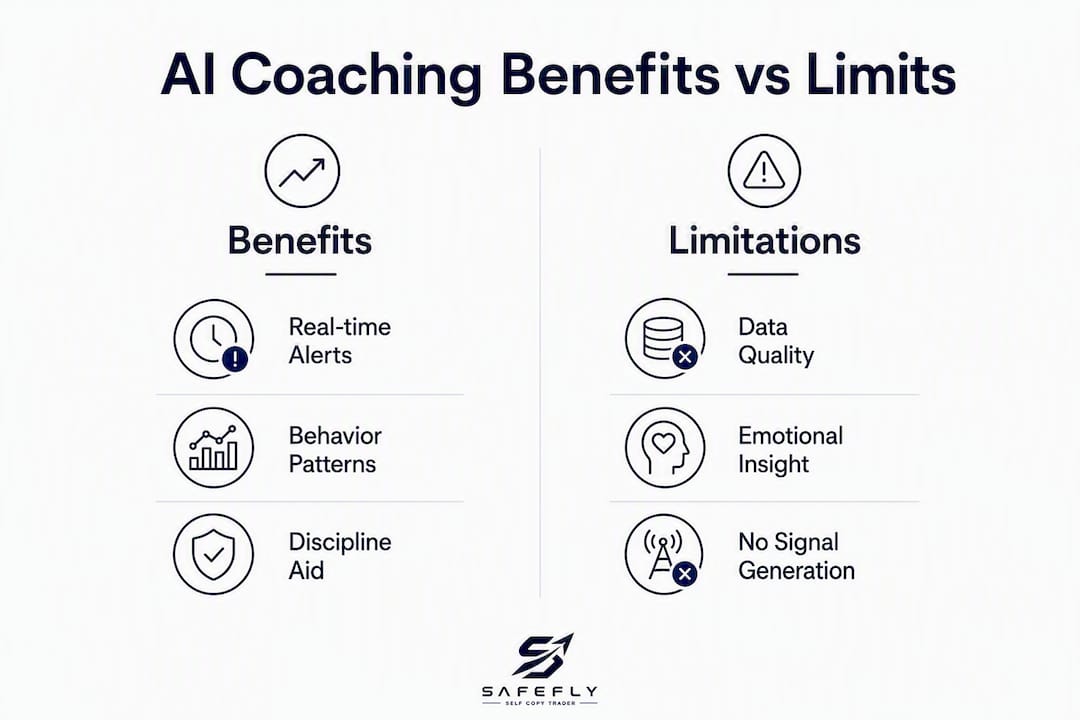
AI coaching and human mentorship serve different functions. Conflating them leads to either over-reliance on automation or underuse of a genuinely useful tool.

| Capability | AI Coach | Human Mentor |
|---|---|---|
| Real-time pattern detection | Strong: monitors every trade, every session | Limited: not present during live trading |
| Behavioral scoring and trend tracking | Automated, consistent, objective | Subjective, periodic, relationship-dependent |
| Contextual strategy design | Weak: relies on historical patterns | Strong: adapts to novel market regimes |
| Emotional accountability | Consistent: no fatigue or bias | Variable: depends on mentor availability |
| Novel regime recognition | Limited without contextual analytics | Strong: experienced mentors recognize structural shifts |
| Cost and accessibility | Low: SaaS subscription | High: hourly or retainer fees |
The limitations of AI coaching are real. The system depends entirely on data quality; native broker API integrations produce more reliable signals than manual logs, which are prone to editing and omission bias. AI coaching also lacks strategic nuance in genuinely novel market conditions. A system trained on historical volatility patterns may misread a structural regime change that an experienced human mentor would recognize immediately.
The most effective approach combines both: use AI for discipline enforcement and pattern identification during live sessions, and reserve human mentorship for higher-level strategy design and periodic review.

Pro Tip: Treat the AI as a mirror, not a guru. Its job is to show you what you are already doing, not to tell you what the market will do next. Traders who use it for accountability and pattern identification rather than signal discovery report the most durable gains in discipline.
How to use an AI coach effectively every day
A structured routine determines whether AI coaching produces measurable improvement or becomes background noise.
The first 30 days: connect, baseline, and test one rule
- Connect your broker via OAuth authentication and import your last 30–90 days of trade history.
- Let the system establish a behavioral baseline across your first 10–30 trades under live monitoring.
- Identify one specific behavioral rule to test (for example: no trades after two consecutive losses in a session).
- Run that single rule for 20 trading days and let the AI measure the before/after impact on your discipline score and P&L.
- Review your first weekly coaching report and act on exactly one recommendation, not all of them.
Daily workflow
- Pre-session: Read or listen to your AI briefing. Note your tilt risk rating and any flagged danger windows before the market opens.
- During the session: Allow real-time alerts to surface. Do not disable them when they feel inconvenient; that friction is the point.
- Post-session: Complete a voice journal entry or review the AI-written summary. Flag any trades where you overrode an alert.
Weekly and monthly review
- Review the weekly prose coaching report and extract one behavioral change to implement.
- Track your discipline score trend over four weeks, not individual session scores.
- At 90 days, compare your composite score trajectory against P&L to assess correlation.
Pro Tip: Run one rule-based experiment at a time. Changing multiple behaviors simultaneously makes it impossible for the AI to isolate which change produced the improvement. Single-variable testing is how you get clean data from your own trading.
Integration, data quality, and what the research shows
Integration steps
Connecting an AI coach to your broker follows a consistent sequence across most platforms:
- Authenticate via OAuth (no password sharing; the broker issues a scoped token)
- Enable continuous trade ingestion so fills flow in automatically
- Map your instrument tags and session labels so the AI can segment performance correctly
- Optionally connect wearables or biometric devices where the platform supports them for emotional state correlation
Timeline to useful feedback
The first coaching report typically generates after 10 trades. Real-time alerts activate immediately once the connection is live and can flag anomalous behavior within two minutes of a sizing or frequency deviation. Reliable trend-level coaching, where the system has enough data to identify durable patterns rather than noise, generally requires 30 or more trades across varied sessions.
Security checklist
| Security feature | What to verify |
|---|---|
| OAuth broker authentication | Confirm the platform uses token-based auth, not stored credentials |
| Broker-side stops | Verify stops are placed at the broker level, not just in the platform UI |
| Data encryption | Confirm trade data is encrypted in transit and at rest |
| Trade data privacy | Review the vendor's data retention and sharing policy |
Direct broker integrations remove manual-entry bias and produce more accurate coaching signals. Platforms that ingest fills directly from brokers provide more reliable behavior detection and sizing metrics than those relying on manual logs.
How to evaluate and choose an AI trading coach
Evaluation checklist
- Native broker API or OAuth integration: manual-only entry is a disqualifying limitation for serious traders
- Transparent behavioral-scoring methodology: the scoring model should be documented, not a black box
- Real-time coaching or alerts: a system that only reviews trades after the session ends misses the highest-value intervention window
- Trial or demo availability: any credible vendor offers a trial period before requiring payment
- Broker-side stops: critical for futures traders managing multiple accounts or prop firm rules
- Prop firm mode: checks drawdown and daily limits before execution, not after
Red flags
- Vendors that accept only manual journal entry
- No OAuth or API integration with major brokers
- No trial period or demo account option
- Opaque or undocumented scoring algorithms
- Any language that implies the AI generates trade signals or guarantees returns
Pricing and ROI
Most AI coaching platforms use tiered SaaS pricing with monthly and annual options. The relevant value metric is not the monthly fee in isolation; it is the improvement in CDI score relative to that cost over a 30–90 day test period. A trader who eliminates two revenge trades per week at an average loss of $300 each recovers a typical monthly subscription cost within the first week of improvement.
Traders who use AI coaching for accountability and pattern identification, rather than signal discovery, report the most durable gains in discipline. That distinction shapes how to evaluate any vendor's claims.
Regulatory and ethical considerations for AI trading advice
AI trading coaches operate in a distinct regulatory category from investment advisors. In the United States, a platform that provides personalized investment recommendations for compensation is subject to registration requirements under the Investment Advisers Act of 1940, administered by the SEC. AI coaching tools that focus on behavioral analysis, process adherence, and performance pattern detection, without recommending specific securities or generating trade signals, generally fall outside that definition. However, the line is not always clear, and vendors who market their tools with language implying return generation or signal provision warrant scrutiny.
Ethically, traders should be aware that AI coaching systems learn from historical data. Advice derived from past behavioral patterns may not account for structural market changes. Transparency in how a platform's scoring model works, what data it retains, and how it uses trader data commercially are legitimate due-diligence questions before subscribing.
This article provides general information about AI coaching tools and is not investment, legal, or financial advice. Confirm current regulatory requirements with a qualified professional or the SEC directly.
Compatibility with different trading styles and asset classes
AI coaching tools vary in how well they adapt to different trading approaches. The core behavioral monitoring functions, tilt detection, sizing alerts, and discipline scoring, apply across styles. The depth of insight, however, depends on data volume and session structure.
Day traders and scalpers generate high trade frequency, which accelerates the baseline period and produces richer behavioral data faster. Real-time alerts are most valuable here, where decisions happen in seconds.
Swing traders operate on longer timeframes with fewer trades per week. The baseline period extends accordingly, and weekly coaching reports carry more weight than intraday alerts. Behavioral scoring for swing traders tends to focus on entry discipline and position sizing relative to conviction level rather than tilt frequency.
Futures traders benefit from platforms that integrate directly with futures brokers and support prop firm rule enforcement. Broker-side stops and daily P&L lockouts are particularly relevant for this group, where account protection rules are strict and the cost of a single rule violation can be significant.
Asset class compatibility follows broker integration coverage. Platforms connected to Tradovate cover futures natively. Others support equities, options, and crypto through integrations with brokers such as Interactive Brokers or Schwab. Traders operating across multiple asset classes should confirm that the coaching engine segments performance by instrument type, not just by session, to avoid mixing signals across structurally different markets.
Key Takeaways
An AI trading coach delivers its greatest value as a behavioral guardrail, not a signal service, and measurable improvement requires broker API integration, a structured routine, and at least 30 trades of baseline data.
| Point | Details |
|---|---|
| AI as behavioral guardrail | Use AI coaching to enforce process adherence and detect patterns, not to generate trade signals. |
| OAuth integration is non-negotiable | Native broker API connections produce accurate coaching signals; manual entry introduces bias that undermines the feedback. |
| Timeline to measurable change | Expect the first coaching report after 10 trades; reliable trend-level insights require 30 or more trades across varied sessions. |
| Human mentorship still matters | Reserve human coaches for strategy design and novel regime analysis; AI handles real-time discipline enforcement. |
| SafeFly for futures traders | SafeFly combines AI coaching, broker-side stops, and OAuth-secured trade replication across Tradovate accounts in one platform. |
The case for a structured 30/90 day adoption plan
The most common failure mode when adopting an AI trading coach is treating it as a passive analytics tool rather than an active accountability system. The difference shows up in how a trader structures the first 90 days.
A disciplined 30-day objective is narrow: connect the broker, establish a behavioral baseline, and test exactly one rule. The goal is not to fix everything at once. It is to generate clean data on a single behavioral variable so the AI can measure the change. Traders who attempt to modify three or four habits simultaneously produce noisy data and cannot attribute improvement to any specific change.
At 90 days, the objective shifts to trend analysis. By that point, a trader with consistent session volume should have enough data to see whether the CDI score trajectory correlates with P&L improvement. If it does, the process is working. If the CDI score improves but P&L does not, the next question is whether the strategy itself needs review, which is where a human mentor earns their place.
Realistic habit goals matter more than ambitious ones. A trader who commits to reviewing the pre-session briefing every day for 30 days builds a more durable foundation than one who engages intensively for a week and then stops. AI alerts should inform decisions, not override them; preserving independence in strategy design is what keeps the trader developing rather than becoming dependent on the system.
SafeFly gives futures traders AI coaching with execution-grade safety
Futures traders managing multiple Tradovate accounts face a problem that AI coaching alone does not solve: execution risk across accounts. SafeFly addresses both the behavioral and the mechanical sides of that problem in a single platform.
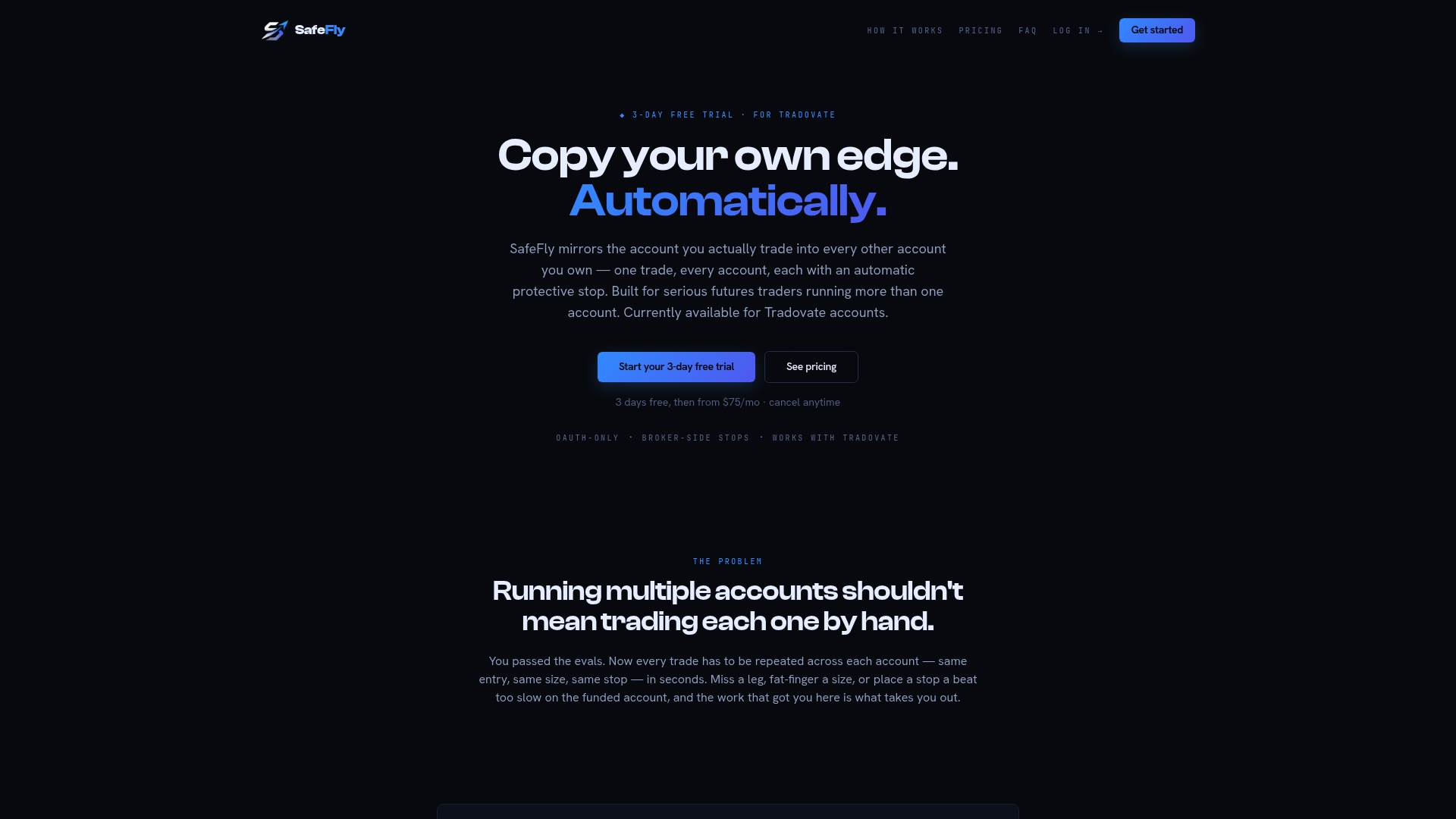
SafeFly replicates trades automatically from a lead account to connected accounts, places broker-side protective stops on every position, and enforces daily P&L lockouts that prevent a single bad session from compounding into account-level damage. All connections use OAuth authentication, so no stored credentials are required. The AI coaching and analytics layer sits on top of that infrastructure, giving traders behavioral feedback grounded in accurate, automatically ingested trade data rather than manual logs.
For serious futures traders, the combination of execution safety and behavioral coaching in one platform removes the need to stitch together separate tools. A 3-day trial is available at SafeFly. Connect a demo Tradovate account, run a session, and review your first coaching report before making a subscription decision.
Selected sources and further reading
- SafeFly — primary product reference for AI coaching, OAuth integration, broker-side stops, and multi-account trade replication for Tradovate futures traders
- AI Trading Coach App — documents prop firm mode, drawdown rule enforcement, and real-time voice coaching features