

A fat-finger trading error occurs when a trader manually enters the wrong price, quantity, or instrument into an order ticket, sending an unintended trade to the market. Quick detection and automated hard limits stop these errors before they cause outsized losses or market disruption. Exchanges, regulators, and firms including UBS, Mizuho, and Citigroup have all faced fat-finger incidents severe enough to require formal cancellation or regulatory review.
Key Takeaways
Fat-finger errors happen when manual order entry meets insufficient system-side controls, and firm-level automation closes that gap more reliably than trader discipline alone.
| Point | Details |
|---|---|
| Definition matters | A fat-finger error is an unintended order entry mistake in size, price, or instrument selection. |
| Incidents scale widely | UBS, Mizuho, Deutsche Bank, and Citigroup have all faced losses or fines from single mistyped orders. |
| Reporting windows are short | Many U.S. exchanges expect erroneous trades reported within about 30 minutes of detection. |
| Hard blocks beat discipline | Firm-side dollar and volume limits catch errors that manual review consistently misses. |
| Automation closes the gap | SafeFly mirrors trades across accounts with broker-side stops and daily lockouts to remove repetitive manual entry. |
Table of Contents
- What Is Fat-Finger Trading and Why It Matters Today
- What Causes Fat-Finger Errors in Order Entry
- Notable Fat-Finger Trading Incidents in Market History
- How Do Exchanges and Regulators Handle Erroneous Trades?
- What Prevention Controls Actually Reduce Fat-Finger Risk?
- What Should a Trading Desk Do Right Now?
- Can Automation Actually Stop Fat-Finger Errors Before They Happen?
- Why Automation Doesn't Replace Judgment on the Desk
- How SafeFly Reduces Manual Entry Risk for Futures Traders
- Sources
What Is Fat-Finger Trading and Why It Matters Today
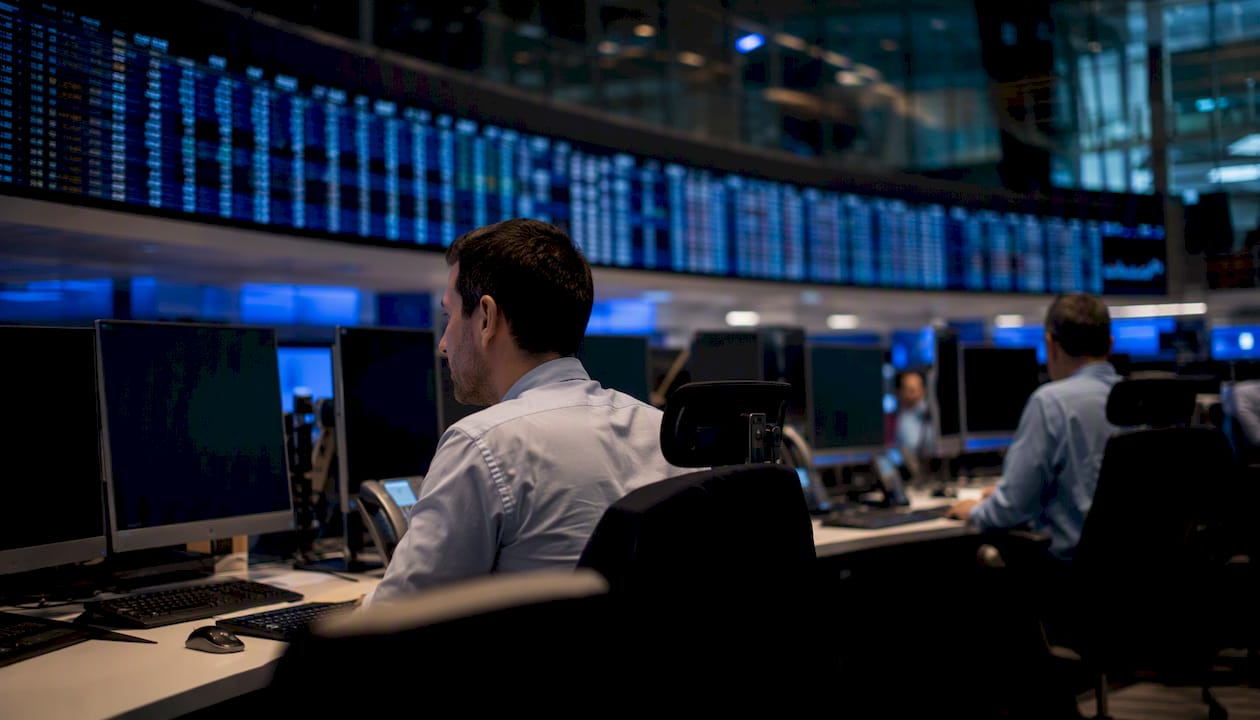
The phrase describes exactly what it sounds like: a slip of the finger on a keyboard or touchscreen that turns a routine order into a market event. Before electronic trading, floor errors were called "out-trades" and were often caught and corrected between counterparties before settlement. Computerized order entry removed that human buffer. A trader typing "1,000,000" instead of "10,000" in a quantity field, or fumbling a decimal point in a price field, can now route an erroneous order to the market in milliseconds, executed before anyone notices.
Speed is the multiplier. Automated matching engines fill orders faster than a human can react, and by the time an error registers, thousands of shares or contracts may already have changed hands. Exchanges anticipated this problem and built cancellation and reporting frameworks, but those rules vary by venue and rarely offer full protection after the fact.
What Causes Fat-Finger Errors in Order Entry
Most fat-finger errors trace back to one of two failure categories: the person at the keyboard, or the system that let the mistake through.
Human causes include:
- Mistyping order size or misplacing a decimal point in the price field
- Selecting the wrong contract, ticker, or expiration from a similar-looking list
- Copying and pasting stale values from a previous order ticket
- Mis-tapping on a mobile or touchscreen trading interface during fast markets
System and organizational causes include:
- Poor order-entry UI design that places quantity and price fields too close together
- Missing or weak pre-trade validation on unusually large or off-market orders
- No hard-coded volume or dollar limits at the firm or broker level
- Absence of a mandatory second confirmation step for atypical trades
Pro Tip: Trader discipline fails under stress, fatigue, or time pressure, which is exactly when fat-finger errors happen. System-side friction, like a hard block that rejects any order exceeding a preset dollar threshold, catches the error regardless of how rushed or confident the trader feels.
Notable Fat-Finger Trading Incidents in Market History
The scale of these incidents ranges from embarrassing to systemically disruptive, and the pattern repeats across decades and asset classes.
- UBS, 2001: A trader in Japan attempted to sell one share at 610,000 yen but instead sold 610,000 shares at one yen, a reversal of size and price that cost the bank tens of millions of dollars.
- Mizuho Securities, 2006: A trader meant to sell one share of a recruiting firm for 610,000 yen but entered an order to sell 610,000 shares at one yen each, triggering extremely large losses and causing significant disruption to the Tokyo Stock Exchange.
- Japanese broker, 2014: A single trader placed erroneous orders across major stocks totaling roughly US$600 billion, though most orders were canceled before execution, limiting real-world damage.
- Deutsche Bank, 2015: An erroneous back-office transfer sent a multi-billion dollar amount to a hedge fund client, an error caught and reversed the next day but revealing gaps in transfer verification.
- Citigroup, May 2022: A trader entered values into the wrong field, triggering roughly $1.4 billion in erroneous sales across European stocks and briefly triggering a Nordic market selloff.
BNP Paribas has also appeared in historical incident summaries tied to manual entry mismatches between trading desks and venue rule sets, underscoring how widespread this exposure is across major institutions, not isolated to one firm or market.
How Do Exchanges and Regulators Handle Erroneous Trades?
A single mistyped order rarely stays contained. Market impact typically follows one of several patterns:
- Price dislocation: A large erroneous sell or buy order moves the quoted price sharply away from fair value in seconds.
- Liquidity strain: Market makers widen spreads or step back entirely once they detect abnormal order flow.
- Cross-market contagion: Because many instruments are linked through arbitrage and hedging, an error in one contract can spill into related futures, options, or currency pairs.
- Flash-crash conditions: In extreme cases, algorithmic systems react to the erroneous print itself, compounding the initial move.
Exchanges generally reserve the right to cancel or adjust trades deemed "clearly erroneous," but the process is neither automatic nor guaranteed. Investopedia notes that U.S. exchanges commonly require erroneous trades to be reported within a short window, often around 30 minutes, though outcomes vary by venue and instrument. Rules published by individual exchanges, such as archived London Stock Exchange trading rules, spell out venue-specific cancellation conditions that desks must know in advance. Because court interpretations and exchange policies differ by jurisdiction, firms need a fast internal escalation path and immediate compliance notification the moment an error is suspected, rather than waiting to see if the market corrects itself.
What Prevention Controls Actually Reduce Fat-Finger Risk?
Reducing fat-finger risk is not about telling traders to be more careful. It's about designing systems where a moment of carelessness cannot reach the market. Prioritize controls in this order:
- Firm-side hard limits. Set absolute dollar or contract-volume caps that reject any order exceeding the threshold, no override without a second authorization.
- Order validation rules. Build in automatic checks that flag orders deviating significantly from recent average size or from the prevailing market price.
- Mandatory two-step confirmation. Require an explicit second click or verbal confirmation for any order above a defined size or outside normal trading hours.
- Authorization workflows for outsized fills. Route unusually large orders through a manager or risk officer before they route to market.
- Operational hygiene. Separate user roles by permission level, enforce session timeouts, mask default quantity fields so they never pre-populate with a prior value, and keep a full audit trail for post-trade review.
- Technology-layer defenses. Use straight-through processing for repeat orders, deploy kill-switches that halt all outbound orders instantly, and set circuit breakers that pause trading after abnormal price moves.
Pro Tip: A workable baseline for most medium-sized desks combines hard-block limits at the broker level, mandatory manager release for any order above a set notional threshold, and automatic daily profit-and-loss lockouts that stop trading once a loss limit is hit. That combination catches both the fat-finger error and the emotional overtrading that often follows one.
What Should a Trading Desk Do Right Now?
If an erroneous order has already reached the market, speed matters more than perfection. Work through this sequence:
- Stop all new manual order entry on the affected account or desk immediately.
- Notify desk risk and compliance so escalation starts before the position grows.
- Assess reversal options, including whether the venue's erroneous-trade policy applies.
- Log the incident with timestamps, order details, and the operator involved.
- Report to the exchange or venue within its required window.
- Review and tighten controls, updating hard limits or validation rules based on the root cause.
Keep a broker contact and an internal kill-switch procedure documented and accessible, not buried in a policy manual nobody opens during a crisis.
Can Automation Actually Stop Fat-Finger Errors Before They Happen?
Automation does not eliminate every risk in trading, but it removes the specific failure mode that causes most fat-finger incidents: a human retyping the same order across multiple screens or accounts under time pressure.
- Removing repetitive manual entry across accounts reduces the number of chances for a mistyped field.
- Broker-side protective stops attach automatically to every trade, including during a connectivity loss when a trader cannot intervene manually.
- Replicated execution across linked accounts keeps position sizing consistent instead of relying on a trader to re-enter the same trade five or six times.
- Centralized limits and daily lockouts enforce a firm-wide risk policy without depending on any single person remembering to apply it.
Well-designed firm-side hard blocks and automated validations prevent most large misentries; relying solely on trader discipline is repeatedly shown to be insufficient.
This is the layer where a platform like SafeFly's trade mirroring system fits: automating the repetitive part of multi-account execution so the fat-finger opportunity never opens in the first place.
Why Automation Doesn't Replace Judgment on the Desk
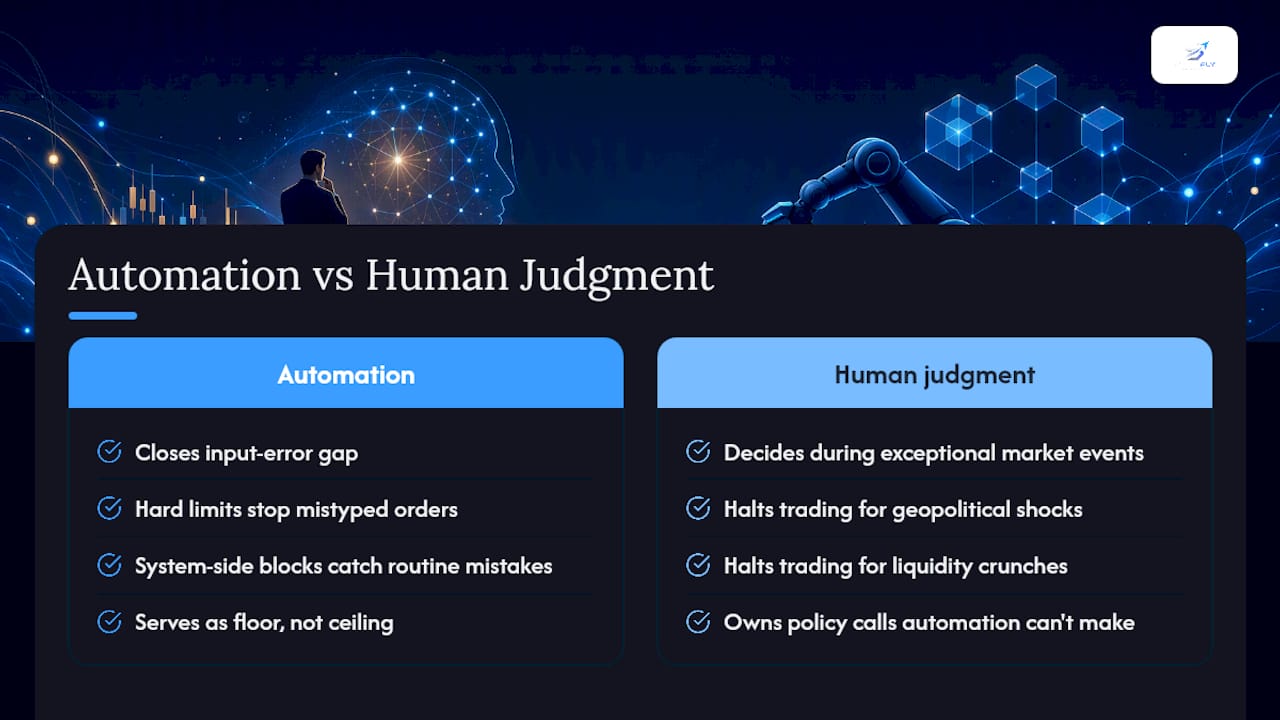
Automation closes the input-error gap, but it doesn't replace judgment during genuinely exceptional market events. A hard limit stops a mistyped order; it doesn't decide whether to halt trading during a geopolitical shock or a liquidity crunch nobody modeled. The strongest desks treat automation as the floor, not the ceiling: system-side blocks catch routine mistakes, and trained humans still own the policy calls that automation was never built to make.
How SafeFly Reduces Manual Entry Risk for Futures Traders
Every control described above points to the same conclusion: the fewer times a human retypes an order, the fewer chances a fat-finger error has to happen. That's the specific problem SafeFly is built to remove for futures traders running multiple Tradovate accounts.
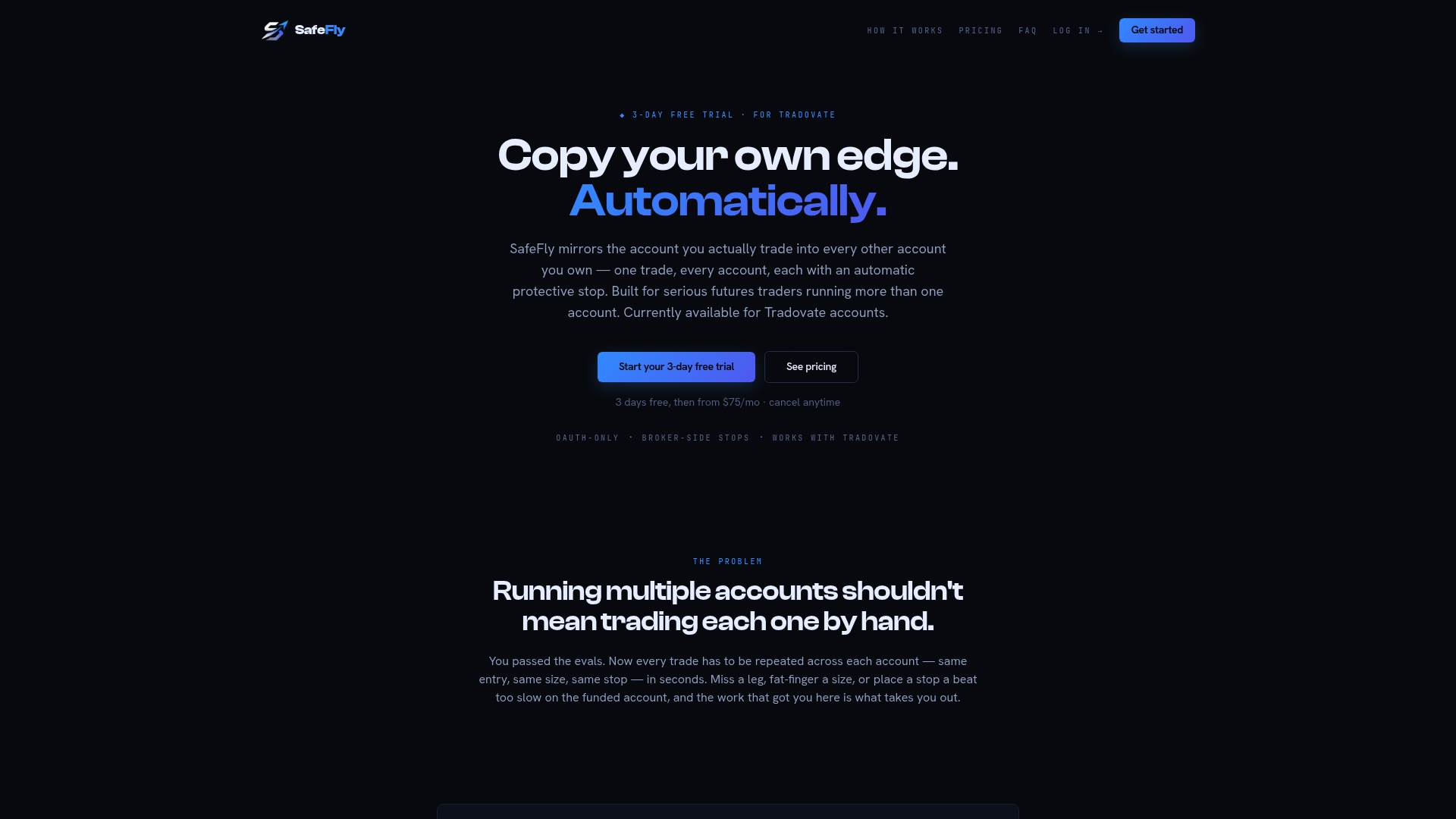
Instead of manually replicating a trade across five or ten accounts, one at a time, under time pressure, SafeFly mirrors trades from a single lead account automatically. Every mirrored trade carries a broker-side protective stop, so positions stay protected even during a disconnection, the exact moment manual traders are most exposed. Daily profit and loss lockouts enforce a firm-level risk policy without depending on anyone remembering to apply it, and secure OAuth connections keep account access controlled without sharing credentials across platforms. Detailed trade analytics and AI coaching round out the picture, giving traders visibility into execution quality over time. See exactly how the automation and protective stops work on the SafeFly how it works page and start a trial to see it running on your own accounts.
Sources
- What is a Fat-Finger Error? Definition and Real-World Examples
- Fat Finger Errors: What Are They and Why These Trades Disrupt Markets - Bloomberg
- Fat-finger error