

An OAuth scope is a permission string that limits exactly what an access token can do, nothing more. The token embodies whatever scopes the authorization server actually grants, and that grant becomes the enforceable boundary for every API call made with it. The one action that matters immediately: request the minimum set of scopes your application needs, and write your code to handle a reduced grant gracefully rather than assuming you got everything you asked for.
TL;DR:
- OAuth scopes are defined solely by the authorization server, which can grant fewer scopes than requested or send a default if omitted by the client.
- Clients should always parse and trust the actual granted scope returned in the token response, not the one requested, to avoid silent permission mismatches.
- Scopes indicate allowed actions, while claims provide specific user information, and confusing the two can lead to authorization errors.
- Proper scope design emphasizes simple, human-readable names that match the intended function and avoid over-granular permissions that may trigger users to grant excessive access.
- In financial applications, scope minimization is critical because over-permissioning can result in real monetary risk if a token is leaked or misused.
Table of Contents
- What Are OAuth Scopes? RFC Grounding and Server Responsibilities
- Scopes vs Claims: How They Relate and When to Rely on Each
- How Scopes Work in the OAuth Flow
- Designing Scopes: Practical Best Practices
- Common Scope Patterns and Concrete Examples
- Security Implications and Token Handling: Practitioner Guidance
- Why SafeFly Treats Scope Design as a Security Decision, Not a Checkbox
- Why Most Scope Failures Are Design Failures, Not Spec Failures
- Sources
What Are OAuth Scopes? RFC Grounding and Server Responsibilities
Understanding OAuth scopes starts with the specification itself. RFC 6749 defines scope as an optional parameter in the authorization request, formatted as a list of space-delimited, case-sensitive strings. There's no universal catalog of scope names in the spec. The authorization server, not the OAuth standard, decides what scope values exist and what each one unlocks, a point Oauth reinforces in its own overview of the mechanism.
Two server responsibilities matter for anyone building against this:
- If a client omits the scope parameter, the server must have documented default behavior, whether that means issuing a baseline scope or rejecting the request outright.
- If the server grants fewer scopes than the client requested, the token response must include the actual granted scope so the client isn't operating on a false assumption.
That second rule trips up a surprising number of implementations. Developers assume the requested scope and the granted scope are always identical, then build client logic that never checks the response. When a user declines part of a consent screen or an admin policy trims a request, that assumption breaks silently.
Scopes vs Claims: How They Relate and When to Rely on Each
Scopes and claims solve different problems, though they're routinely confused. A scope is a requested bundle of permissions. A claim is a specific assertion embedded inside a token, things like a user's email address, role, or subscription tier.
The relationship works like this in practice:
- Requesting a scope often triggers the server to include a related set of claims in the resulting token.
- Your resource server should still verify permissions at the API level rather than trusting that a scope alone proves what claims exist.
- In OpenID Connect, requesting the
openidscope is what triggers issuance of an ID token, and that token's claims (name, email, subject identifier) are separate from whatever access-control decisions your API makes based on scope. Microsoft's identity platform documentation lays out this distinction clearly for its own scope catalog.
Treat scope as "what you're allowed to ask for" and claims as "what you're told about the user." Conflating the two leads to authorization bugs that are hard to trace.
How Scopes Work in the OAuth Flow
Tracing a scope from request to enforcement means following it through four distinct checkpoints, and knowing where to look when something breaks saves hours of debugging.
- Authorization request. The client sends
scope=read trade offline_access(or similar), space-delimited, as part of the redirect to the authorization endpoint. - Consent screen. The authorization server translates each scope into a human-readable permission line for the user. A well-designed server groups related scopes so the screen doesn't read like a legal disclaimer.
- Grant decision. The user approves all, approves part, or the server's policy engine reduces the grant automatically. Per RFC 6749, this is where a mismatch between requested and granted scope originates.
- Token response. The server returns an access token along with the actual
scopevalue granted. Client code should parse and store this value, not the one it originally sent.
A pattern worth watching for: roughly 44% of API-related integration bugs reported by developers trace back to a mismatch between what a client assumed it received and what a token actually contained, according to patterns documented in the Oauth. Resource servers commonly enforce this through token introspection, checking the scope claim against the endpoint being called, and returning a 403 with an insufficient_scope error when the token doesn't cover the requested action.
Designing Scopes: Practical Best Practices
Good scope design is a UX problem and a security problem at the same time, and the two goals pull in the same direction more often than developers expect.
Start with the principle of least privilege: a scope should map to one real function, not a department or a feature area. A reports:read scope beats a generic analytics scope that quietly also grants export and delete rights. From there:
- Use human-readable scope names.
write:invoicescommunicates intent;perm_4Adoes not, and users will click through a confusing consent screen without reading it. - Group scopes only when splitting them would overwhelm the consent screen with near-identical permissions a typical user can't meaningfully distinguish.
- Split scopes when the risk profile differs meaningfully. Reading account data and moving money are not the same risk tier and should never share a scope string.
- Document your full scope catalog publicly, including which scopes are granted by default and which require explicit request.
- Plan a deprecation path before you ship v1. Renaming or splitting a scope later means supporting both versions during a migration window.
Pro Tip: Write your consent screen copy before you finalize your scope names. If you can't describe a scope in one plain sentence a non-technical user would understand, the scope is probably too broad or too vague.
The oauth.com best-practices guide makes a related point worth internalizing: over-granular scopes backfire. Users faced with fifteen checkboxes tend to hit "allow all" without reading any of them, which defeats the entire purpose of granular consent.
Common Scope Patterns and Concrete Examples
Real-world scope catalogs tend to follow a handful of recurring shapes once you've seen enough of them.
- Read/write splits:
contacts:readandcontacts:writeas separate, independently grantable scopes, rather than onecontactsscope that always includes both. offline_access: this scope signals that the client wants a refresh token, not just a short-lived access token, enabling the app to stay authorized without the user reauthenticating every session.- Provider-defined catalogs: GitHub uses named scopes like
repo,read:user, anduser:email, and exposes the granted scopes on an OAuth app's token via theX-OAuth-Scopesresponse header, useful for debugging exactly what a token can do. - Broker and trading patterns: platforms like Tradier document
readandtradeas distinct scopes, deliberately separate from any account funding or withdrawal permission.
The soundest rule in high-risk integrations, trading platforms especially, is to never request a scope broader than the task actually requires. If an application only needs to place and monitor trades, a withdrawal or money-movement scope has no reason to exist in that request at all.
That last pattern isn't a convention. It's a documented safeguard: guidance on broker permissions for trading bots is explicit that automated trading integrations should never request funds-transfer scopes, full stop.
Security Implications and Token Handling: Practitioner Guidance
A token carrying a scope is a credential, not a config value, and it should be handled with the same discipline as a password.
- Store tokens server-side wherever possible. Client-side storage (local storage, mobile app sandboxes without hardware-backed encryption) expands your attack surface for no functional benefit.
- Keep access token lifetimes short and lean on refresh tokens for continuity, rather than issuing long-lived access tokens out of convenience.
- Build a real revocation path. If a token is compromised or a user disconnects an integration, the ability to invalidate it immediately, not just let it expire, is a baseline requirement.
- Validate scope at the resource server on every request, either through introspection or signature verification, rather than trusting a client's claim about what it's authorized to do.
A meaningful share of OAuth-related security incidents trace back to over-scoped tokens, permissions granted broadly at setup and never revisited, sitting unused until a token leaks. That's the practical case for least privilege: a narrowly scoped token that leaks does less damage than a broadly scoped one.
For financial integrations specifically, the guidance from Tradier's authentication documentation and industry commentary on broker permission models converges on the same point: never request withdrawal scopes for an automated system, and confirm the provider offers a working revocation flow before you build your integration around it. If elevated permissions are ever required, that request should trigger human review, not silent approval.
Why SafeFly Treats Scope Design as a Security Decision, Not a Checkbox
Building trade-mirroring automation across multiple Tradovate accounts forces a hard line on scope design, because the cost of over-permissioning in a trading context is measured in dollars, not inconvenience. SafeFly's integration requests read access to monitor positions and trade access to mirror orders and place broker-side stops. It does not request, and has no functional reason to request, any scope tied to withdrawals or fund transfers.
That split reflects the least-privilege principle covered throughout this guide: narrow scopes matched to real functions, a documented catalog, and revocation readiness if a connection needs to be cut. Readers who want to see this applied in a live integration can review how SafeFly's OAuth connection works for a concrete example of the read/trade separation in practice.
Why Most Scope Failures Are Design Failures, Not Spec Failures
The OAuth 2.0 spec gives implementers almost total freedom to define scope values, and that freedom is exactly where most real-world scope problems originate. RFC 6749 tells you the syntax. It says nothing about whether admin should be one scope or twelve, and that decision is left entirely to the authorization server's designer.
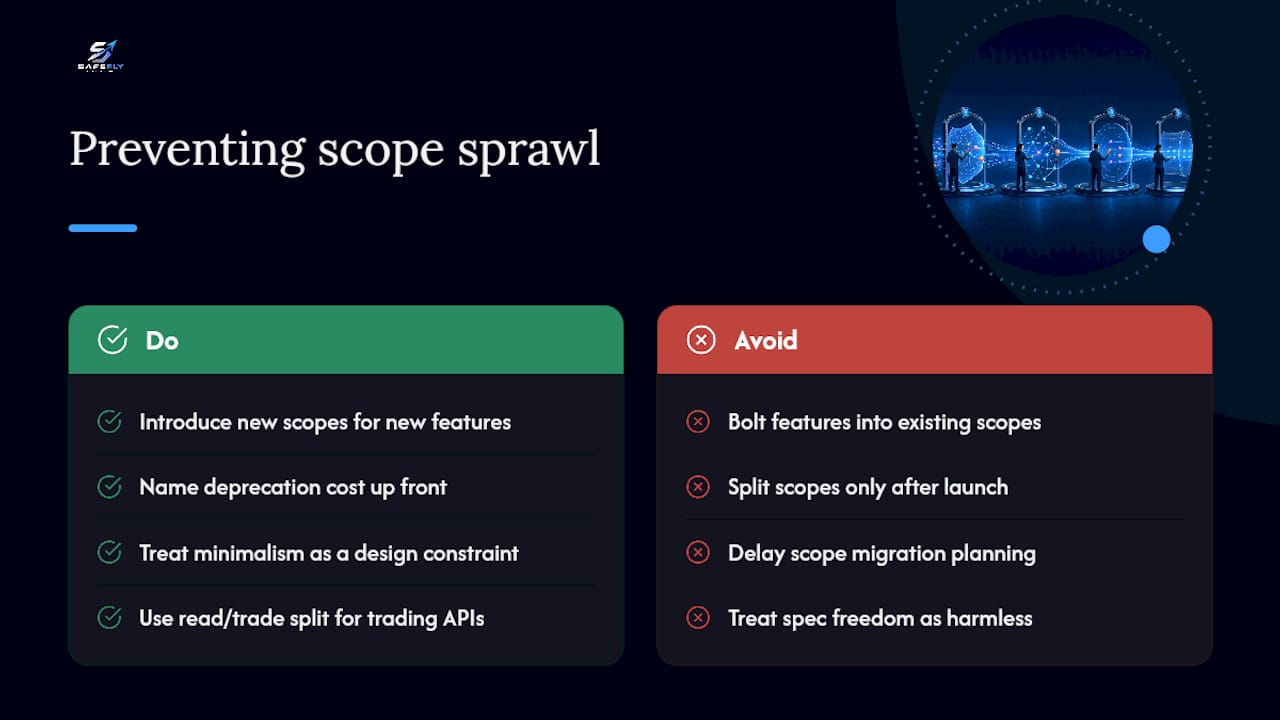
What gets underestimated is how often scope creep happens by accident rather than by design. A team ships read and write scopes for an MVP, then bolts on new features by expanding what those two scopes cover instead of introducing new ones, because splitting scopes after launch means a migration headache nobody wants to schedule. Two years later, a write scope that started out managing user profiles also controls billing settings, webhook configuration, and account deletion, and nobody planned that. The fix was never complicated. It just required naming the deprecation cost early instead of paying it later, with interest, after a security review flags the sprawl.
The trading context makes this failure mode expensive in a way that a to-do list app never will. A leaked token with an over-broad write scope on a consumer app is embarrassing. A leaked token with an over-broad scope on a brokerage connection can move real money. That asymmetry is why SafeFly's own integration philosophy treats the read/trade split as a floor, not a nice-to-have, and why any developer working in a financial API should treat scope minimalism as a design constraint from the first line of authorization code, not a cleanup task for later.
— Arturo
Sources
For implementers who want to verify these behaviors against primary sources rather than secondhand summaries, three references cover the ground this article draws from. RFC 6749 remains the authoritative definition of the scope parameter and the requirement to return granted scope in the token response. OAuth.net's scope overview offers a shorter, provider-agnostic summary of the same mechanism. For platform-specific scope catalogs, GitHub's OAuth apps documentation and Microsoft's identity platform scope guide both show how the abstract spec becomes a concrete, named permission system in production. For a broker-specific API example, Tradier's authentication docs demonstrate scope naming for financial data access. Developers evaluating least-privilege enforcement patterns more broadly may also find value in this overview of least-privilege access controls.
- RFC 6749: The OAuth 2.0 Authorization Framework
- OAuth 2.0 Scopes
- Oauth
- Scopes for OAuth apps — GitHub Docs
- Tradier authentication docs