

Size the position from that risk figure, not the other way around. Enforce a daily loss limit that shuts down trading once it's hit. Everything else in this article, the formulas, the ATR adjustments, the session controls, exists to make that one rule executable under pressure.
TL;DR:
- Set a maximum risk of 0.5% to 1% of your account equity per trade to avoid cumulative errors from high-frequency scalping.
- Use volatility-adjusted sizing with ATR to dynamically scale stops and position size during changing market conditions.
- Enforce a strict daily loss limit and automate stop loss and kill switch mechanisms to prevent single sessions from causing catastrophic losses.
- Incorporate spreads and slippage into your risk calculations, especially during news or illiquid periods, and widen stops accordingly.
- Automate position sizing and risk enforcement across multiple accounts with tools that attach broker-side stops and enforce session limits reliably during fast markets.
Table of Contents
- What Does Scalping Risk Management Actually Require?
- How Do You Calculate Position Size and Stop Placement?
- How Do Daily Loss Limits and Kill Switches Work?
- How Do Volatility, Spreads, and Slippage Change Your Risk?
- Which Order Types and Automation Tools Enforce These Rules?
- How Should You Backtest a Scalping Strategy?
- What Belongs on a Pre-Market Risk Checklist?
- Why Risk Discipline Outlasts Any Single Winning Streak
- Enforce Every Rule in This Article Without Lifting a Finger Mid-Trade
- Sources
What Does Scalping Risk Management Actually Require?
Scalping risk management is the discipline of capping loss exposure on every trade and every session before market noise, leverage, or emotion can override that cap. It differs from general day trading risk management mainly in speed: a scalper might take 20 to 100 trades a day, so a sizing error or a missed stop compounds fast. The core tactics below apply on every session, regardless of instrument.
- Fixed-fraction risk per trade. Cap risk at 0.5% to 1% of account equity per scalp. Scalpers who trade high frequency should sit at the low end of that range because a string of small errors adds up quickly across dozens of trades. Position sizing guides place the common scalper range at 0.5% to 2%, but 1% is already aggressive once you factor in slippage and multiple daily entries.
- Stop placement tied to invalidation, not comfort. A stop belongs at the price level where your trade thesis is objectively wrong, not wherever produces a round-number loss you can tolerate. Treating the stop-loss as your first line of defense means it's a structural decision, made before you calculate size, not an afterthought bolted on after you're already in the trade.
- Volatility-adjusted sizing with ATR. A fixed pip or tick stop that ignores current volatility either gets clipped by normal noise or exposes you to more risk than intended. Average True Range solves this by scaling the stop distance to what the market is actually doing right now.
- Daily loss limits and kill switches. A hard stop on daily losses, enforced automatically where possible, prevents one bad session from becoming a career-threatening one.
- Execution hygiene. Watch spread widening in real time and skip trades when spreads blow out relative to your expected profit target. A scalp that only nets 3 ticks of edge doesn't survive a 2-tick spread spike.
Professional traders reverse the instinct most beginners follow. Instead of picking a trade and then figuring out how big to make it, they define the risk first, set the invalidation level, and calculate size from there. That order matters more than any individual number in this list.
How Do You Calculate Position Size and Stop Placement?
The math behind scalping position size is straightforward once you separate it into three steps: risk dollars, per-unit risk, and the resulting size. Most beginners skip step one and jump straight to "how many contracts can I afford," which is backward and dangerous.
- Calculate your account risk in dollars. Account risk $ = account equity × risk percentage. A $25,000 account risking 1% per trade sets a maximum loss budget of $250 for that trade.
- Determine per-unit risk. Per-contract or per-lot risk = stop distance × point or pip value. If you're trading the E-mini S&P 500 (ES) and your structural stop sits 4 points away, and ES has a $50 per point value, your per-contract risk is $200.
- Divide to find position size. Contracts or lots = account risk $ ÷ per-unit risk. In the ES example: $250 ÷ $200 = 1.25, which rounds down to 1 contract. That rounding matters. Rounding up to "make the trade worth it" is how traders quietly double their intended risk.
Run the same process on a forex micro-lot. Trading EUR/USD with a 15-pip stop on a micro-lot, where each pip is worth $0.10, puts per-unit risk at $1.50. That $50 budget supports roughly 33 micro-lots, a size worth double-checking against your broker's margin requirements before you place it.
Statistic Callout: Maintenance margin on futures contracts typically runs 80% to 90% of the initial margin requirement, not a fixed buffer. Sizing a position around the maximum contracts your margin allows, rather than around your actual risk tolerance, is one of the fastest ways to blow through a daily loss limit when a trade moves against you.
ATR-based sizing versus fixed fractional
It isn't. A 4-point stop on a calm morning and a 4-point stop during a volatility spike carry very different odds of getting hit by noise alone.
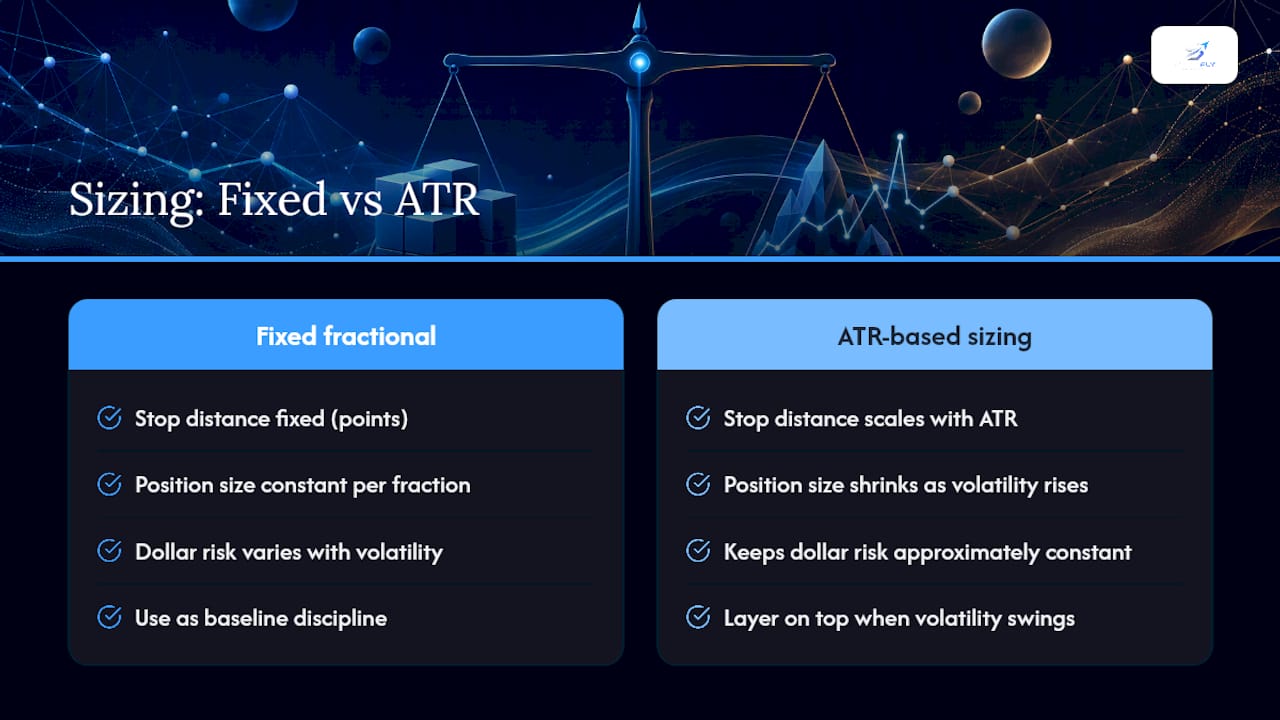
ATR-based sizing corrects for that by setting your stop distance as a multiple of the Average True Range, then working the same three-step formula from that distance. Your position size shrinks accordingly, which is the point: bigger stops in volatile conditions mean smaller size, keeping dollar risk constant even as market noise changes.
Use fixed fractional as your baseline discipline and layer ATR on top of it when volatility swings meaningfully within a session.
How Do Daily Loss Limits and Kill Switches Work?
A daily loss limit is a hard ceiling on how much your account can drop in a single session before you're done trading, no exceptions. Professional practitioners vary widely in their limits depending on account size and experience, but strict enforcement is more important than the exact number.
- Set the daily limit before the session starts, not after a losing streak has already started eroding your judgment.
- Cap your maximum trade count per session. A hard ceiling of 15 to 25 trades, depending on your strategy, prevents the slow creep into overtrading that happens when a scalper starts chasing losses with more frequent, lower-quality entries.
- Automate the kill switch where the platform allows it. A manual promise to "stop at $500 down" evaporates the moment adrenaline and frustration take over.
- Tie the daily limit to your per-trade risk math. If you're risking 1% per trade and capped at 3% daily loss, you have a built-in three-strike rule: three consecutive max losses and you're done, regardless of how convinced you are the next trade will work.
Pro Tip: *Set your daily loss limit slightly below your actual pain threshold, not at it.
The behavioral value of a daily limit isn't only the dollar figure. The enforced pause itself functions as a circuit breaker, interrupting the exact moment a trader is most likely to abandon their rules and chase a loss with an oversized revenge trade. A limit you can override by clicking "one more trade" isn't a limit. It's a suggestion.
How Do Volatility, Spreads, and Slippage Change Your Risk?
Every risk calculation above assumes clean execution at the price you expect. Scalping rarely delivers that, which is why volatility and liquidity conditions need to adjust your stops and size in real time, not just at the start of the session.
- Use ATR to set stop multiples. A workable rule of thumb is a minimum of 1x ATR for your stop distance, with many professional scalpers preferring 1.5x to 2x on short timeframes to avoid getting stopped out by ordinary price chop rather than a genuine reversal.
- Build a slippage buffer into your risk math. If your calculated stop distance is 4 ticks, assume actual fills might land 1 to 2 ticks worse during fast markets, and size down slightly to compensate.
- Widen stops and cut size during volatility spikes, rather than holding a tight stop and hoping. Professional scalpers routinely scale down position size when ATR jumps, accepting a wider stop in exchange for staying in the trade long enough for the setup to play out.
- Skip trades entirely around scheduled news or in illiquid conditions. A scalp built on a 3 tick edge has no margin for the kind of gap that a surprise data release can produce.
- Check correlation across open positions before adding a new one. Three correlated instruments each risked at 1% can silently combine into a 3% exposure on a single underlying move, particularly across related currency pairs or index futures.
Statistic Callout: Professional scalpers treat combined correlated exposure as a single risk figure, because three "independent" 1% positions on correlated instruments can behave like one 3% bet the moment the underlying driver moves. Checking correlation before stacking trades is as important as checking any individual stop.
Spread widening deserves the same discipline as a volatility spike. When the bid ask spread on your instrument doubles heading into a data release or during thin overnight liquidity, your effective cost per trade rises even though your stop distance hasn't changed. Standing aside is often the correct trade in that moment.

Which Order Types and Automation Tools Enforce These Rules?
Risk rules only matter if they execute reliably under pressure, which is where order type selection and automation come in. A stop market order guarantees execution once triggered but not the price, which can matter during fast moves. A stop limit order guarantees price but not execution, meaning it can fail to fill entirely during a sharp gap. Guaranteed stops, offered by some brokers for a fee, remove that execution risk but add cost to every trade.
- Attach your stop at entry, every time, with no exceptions for "quick" trades. A stop set manually after entry is a stop that sometimes doesn't get set at all, particularly during the exact volatile moments when you need it most.
- Use automated position-sizing calculators rather than mental math during live trading, where stress and speed both increase the odds of an arithmetic error.
- Understand that maintenance margin can shift. Margins typically run 80% to 90% of initial margin, and sizing decisions should account for that flexibility rather than assuming a static number.
- Consider automation when disconnect risk or multi-account complexity is in play. A dropped connection during an open scalp with no attached stop is one of the more common ways a single trade destroys a week of gains.
This is where a tool like SafeFly fits into the picture for traders running multiple Tradovate accounts. Broker-side protective stops attach automatically to every mirrored trade, meaning a lost connection doesn't leave a position naked. Daily profit and loss lockouts enforce the session-level kill switch discussed above without requiring the trader to manually track it mid-session, and the platform's secure OAuth integration handles the multi-account replication that would otherwise require manually re-entering the same trade across several accounts under time pressure, itself a source of costly execution errors.
How Should You Backtest a Scalping Strategy?
A scalping edge that looks strong on daily-close data and evaporates on tick data isn't an edge, it's an illusion built on unrealistic assumptions. Backtesting a scalping strategy requires more granular data and more honest cost modeling than swing or position trading does.
- Use tick or sub-minute data, never daily bars. A strategy holding trades for two to five minutes needs price action at that same resolution to produce a trustworthy backtest.
- Model realistic spreads and slippage into every simulated trade, not just the average spread but the widened spread that shows up during news or thin liquidity. Effective backtesting depends on this cost modeling; skip it and your backtest edge quietly disappears the moment you go live.
- Track expectancy alongside win rate. A 40% win rate with an average win twice the size of an average loss beats a 65% win rate where losses run larger than wins. Expectancy, not win rate alone, tells you whether the system is worth trading.
- Record max drawdown and trade frequency together. A strategy that produces 50 trades a day with a 15% max drawdown carries very different psychological demands than one producing five trades a week at the same drawdown.
- Run walk-forward testing before committing real capital. Split your data into in-sample and out-of-sample periods, and confirm the edge holds on data the strategy wasn't tuned against.
- Validate with small real-money size and strict risk caps before scaling up. A backtest, however careful, still can't fully replicate the psychological pressure of a live scalp.
If your live results diverge sharply from backtested expectancy after 100 trades, the issue is usually slippage assumptions or spread modeling that didn't match reality, not bad luck.
What Belongs on a Pre-Market Risk Checklist?
A short checklist run before every session catches the mistakes that happen when a trader skips setup steps under the pressure of an opening bell. Run through this before the first trade of the day:
- Confirm current account equity and re-enter your risk percentage into your position-size calculator. Equity changes daily; a stale number from last week produces a wrong position size today.
- Check today's ATR baseline against recent averages to spot unusually calm or unusually volatile conditions before you're already in a trade.
- Review the economic calendar for scheduled news that could spike spreads or trigger illiquid conditions during your planned trading window.
- Confirm instrument liquidity matches your intended size, particularly on futures contracts or forex pairs outside the most heavily traded sessions.
- Attach stops on entry as a rule, not an option, before placing the first trade.
- Enable your kill switch or session stop mechanism, whether that's an automated tool or a written commitment you'll actually honor.
- Pin your maximum trade counter where you'll see it throughout the session, so overtrading shows up as a number, not a vague feeling.
Five minutes spent on this checklist before the open is cheaper than one oversized loss caused by a stale risk input or a missed news release.
Why Risk Discipline Outlasts Any Single Winning Streak
Scalpers who last years in this business rarely talk about their best trade. They talk about the losing streaks they survived without blowing up an account, and that survival almost always traces back to rules that were mechanical rather than aspirational. The moment conviction starts overriding the math, position sizing becomes guesswork wearing a spreadsheet's clothing.
Journaling every trade, including the ones you skipped because a setup didn't meet your criteria, builds the pattern recognition that separates a scalper who's actually improving from one who's just accumulating screen time. Small, deliberate scaling of size, only after a strategy has proven itself across a meaningful sample of trades, protects capital during the exact period when a trader is most likely to overestimate a fresh edge.
Layering ATR-based sizing, daily loss limits, and automated enforcement isn't redundant. Each layer catches a different failure mode: ATR catches volatility blindness, the daily limit catches emotional overrides, and automation catches the moments a trader simply can't act fast enough. Treating any one of them as sufficient on its own is how good traders still find ways to lose more than they planned.
— Arturo
Enforce Every Rule in This Article Without Lifting a Finger Mid-Trade
Every rule covered here, the risk-first sizing, the attached stops, the daily kill switch, only works if it survives contact with a live, fast-moving session, and that's exactly where manual discipline tends to break down across multiple Tradovate accounts. SafeFly mirrors trades from a lead account to every connected account automatically, attaching a broker-side protective stop to each one so a dropped connection never leaves a position unguarded.
Daily profit and loss lockouts enforce the session-level kill switch discussed above without requiring you to watch a running total between trades, and the secure Tradovate OAuth connection means your accounts stay linked without sharing credentials outside the platform. Built-in analytics and coaching tools give you the same expectancy and drawdown data this article recommends tracking, without a separate spreadsheet. Futures trading carries real risk regardless of the tools involved, and SafeFly's risk disclosure lays out those risks plainly before you start. If you manage more than one Tradovate account and want your stop and lockout rules enforced the same way on every one of them, start a trial and see how the mirroring and broker-side stops hold up during your next live session.
This article is general information, not a substitute for advice from a qualified financial advisor. Consult a qualified financial professional about your own circumstances before acting on anything here.
Sources
- Understanding margin changes | CME Group
- Risk management for futures trading | Investopedia
- Position Sizing for Scalping: A Practical How-To Guide - TradingIM
- Risk Management for Futures Trading - NexusFi Academy
- How Professional Scalpers Manage Risk During High Volatility – ForexScalperZone