
When a trade copier errors, check these four items immediately: process connectivity, auto-trading permissions, a quick restart, and your logs. Most trade-copier incidents trace back to a short list of root causes, and this triage sequence surfaces them in under a minute. Running through it before you touch configuration files or contact support saves time and often resolves the problem outright.
Confirm the copier process and broker connection are actually running. A copier that has silently disconnected from its broker session, or a platform that lost its data feed overnight, will show no errors at all. It will simply stop copying.
Verify auto-trading (or Algo Trading) is enabled on every account in the chain. MT4 and MT5 both require this toggle active on the chart itself, not just in platform settings, and a mismatched Master/Slave build version will quietly break execution even when the toggle looks correct.
Restart the platform or copier and retest with a single small trade. This clears a surprising share of NinjaTrader 8 and MetaTrader issues tied to stale sessions or memory leaks, according to CrossTrade's troubleshooting documentation, which identifies long platform uptime as one of the handful of recurring root causes behind copier failures.
Open your logs before you do anything else destructive. Capture the exact error string, the timestamp, and any ticket numbers tied to the failed trade. If you restart the platform before recording this, you may erase the evidence you need to diagnose the problem or hand it to support.
Key Takeaways
Most trade copier errors trace back to a short list of causes: broken connections, disabled auto-trading, duplicate data-feed authorizations, or bracket orders fired out of sequence.
| Point | Details |
|---|---|
| Run the four-item triage first | Check connectivity, auto-trading status, restart, and logs before changing any configuration. |
| Reproduce with a tiny trade | Use the smallest lot size on a single symbol to isolate the failure without added risk. |
| One data feed per account | Multiple feed authorizations on a single account is a leading cause of doubled or tripled fills. |
| Sequence bracket orders correctly | Wait for the market order's execution event before submitting stop and take-profit legs. |
| Build a complete support payload | Include the exact error string, timestamp, ticket numbers, and account history before contacting support. |
| Consider SafeFly for structural protection | Broker-side stops and OAuth-based session handling address disconnection and partial-close errors at the architecture level. |
Table of Contents
- How to Diagnose Trade Copier Errors in the Right Order
- Symptom-by-Symptom Fixes for Common Trade Copier Issues
- What to Capture From Logs Before Contacting Support
- Platform-Specific Gotchas That Cause Copying Errors
- Preventive Steps That Cut Future Copying Errors
- How SafeFly's Design Addresses These Root Causes
- What Support Cases Actually Reveal About Copier Failures
- Try SafeFly Before Your Next Copier Failure Costs You a Funded Account
- Where to Look for Platform-Specific Troubleshooting Help
- Frequently Asked Questions
- Sources
How to Diagnose Trade Copier Errors in the Right Order
Guessing at fixes wastes time and can mask the real problem. A fixed diagnostic order gets you to root cause faster and gives you a reproducible workflow you can repeat every time something breaks.
- Reproduce the error with a tiny trade. Use the smallest tradable lot size on a single symbol so you are not risking capital while you isolate the bug.
- Check receipt at every stage of the chain. Confirm the signal left the source (webhook or master terminal), arrived at the copier add-on, reached the platform, and was accepted by the broker. A signal that dies at any one of these stages tells you exactly where to focus.
- Inspect the logs immediately after reproduction. Match the error string against known patterns rather than guessing at causes.
- Isolate variables one at a time. Test with a single follower account, a single symbol, and a minimal lot size. If the error disappears, reintroduce variables one by one until it returns.
- Restart components in sequence, not all at once. Restart the copier first, then the platform, then the machine, only if earlier steps do not resolve it. Restarting everything simultaneously destroys the evidence trail you need if the problem recurs.
A decision-tree approach, similar to the flow outlined in DaneTrades' support documentation, moves through connection status, account linkage, log review, symbol mapping, and sizing checks in that order. It works because each stage rules out an entire category of failure before you move to the next.
Pro Tip: Build a controlled test script that trades a single symbol, a fixed lot size, and a distinct magic number you don't use elsewhere. Running this same script every time you suspect a timing or sequencing bug gives you a consistent baseline, so you can tell whether a new error is actually new or just the old one resurfacing.
Symptom-by-Symptom Fixes for Common Trade Copier Issues
Different symptoms point to different root causes, and matching the symptom to the fix quickly is the fastest path out of a stalled trading session. Here is how the most frequent trade copier issues break down.
| Symptom | Usual Causes | Immediate Fix |
|---|---|---|
| Trades not copying at all | Auto-trading disabled, connection dropped, missing webhook delivery | Enable Algo Trading on every chart; confirm webhook delivery status |
| Symbol not found / wrong symbol | Broker uses different symbol naming than source (e.g., TradingView vs. broker ticker) | Update the symbol mapping file to match broker-specific naming |
| Wrong lot size or invalid volume | Sizing rule mismatch, netting vs. hedging account conflict | Recheck lot multiplier settings and confirm account mode matches expectations |
| Stops or take-profits missing | Sync gap between master and slave order legs | Verify stop/TP sync settings and resend the order manually to test |
| Positions not closing or partial closes | Close-matching failure, ticket mismatch between accounts | Cross-reference ticket numbers in logs; manually close and resync |
| Duplicate trades (2x or 3x fills) | Multiple copier instances running, or one account authorized to multiple data feeds | Keep exactly one data feed authorized per account while trading |
| Copy delays, timeouts, or requotes | Cloud server latency, API rate limits, high-volatility queuing | Consider a copier with fewer server hops, or reduce follower account count during high volatility |
| Broker rejections | Margin insufficiency, permission flags, or exceeding max position limits | Check margin and sequencing; confirm broker permissions allow third-party automation |
A 2026 analysis of copier failures lists missing webhook delivery, symbol mismatch, disabled AutoTrading, cloud latency, stop/TP sync gaps, EA crashes, API rate limits, and close-matching failures as the nine most common causes, and recommends local execution or robust position-tracking to eliminate several of them at once.
Duplicate trades deserve special attention because the cause often sits outside the copier entirely. If a single account is authorized to more than one data feed, each feed submits its own independent order. The copier never sees a duplication bug because the duplication already happened at the platform level, according to FlowBots' support documentation on the issue.
Sequencing errors follow a similar pattern. Submitting a market order and its bracket orders (stop loss and take profit) too quickly, before the market order has actually filled, can trigger an "Exceed account's maximum position" rejection. The platform still counts the pending bracket as an open position risk. Waiting for the execution event before placing the bracket order resolves this reliably, according to reports on the NinjaTrader support forum.
What to Capture From Logs Before Contacting Support
Support teams can only move as fast as the evidence you hand them. A vague description like "it stopped copying" forces a back-and-forth that eats hours. A precise payload gets a real answer on the first reply.
Start by locating the right logs for your platform. MetaTrader stores relevant activity in the Experts, Journal, and Trade tabs, each capturing a different layer of the failure. Copier add-ons typically maintain their own dashboard or log file separate from the platform's native logs, and you need both when an error spans the connection between the two.
- Check the Experts tab for EA-level errors, including crashes or rejected function calls.
- Check the Journal tab for connection-level events, including disconnects and re-authentications.
- Check the Trade tab for order-level history, including exact fill prices and rejection reasons.
- Check your copier's own dashboard or log export for signal receipt timestamps at each hop in the chain.
Vendor support pages, such as ApexTraderFunding's error message guide, catalog exact error strings and their meanings, which is useful for confirming whether your error matches a known, documented issue before you escalate.
Here is what a complete support payload should include:
| Payload Item | Why It Matters |
|---|---|
| Exact error string | Lets support match against known failure patterns instantly |
| Timestamp with timezone | Correlates your report against server-side logs on the broker or copier's end |
| Ticket numbers (master and slave) | Allows support to trace the exact order across every account in the chain |
| Account history report | Shows the sequence of events leading up to and following the error |
| Platform uptime at time of error | Flags whether long-running sessions contributed to the failure |
| Minimal reproduction steps | Tells support exactly how to trigger the same error on their end |
Pull these together before you open a ticket, and most support teams can give you a real answer within one exchange instead of five.
Platform-Specific Gotchas That Cause Copying Errors
Every platform has its own quirks, and knowing where to look before you file a ticket saves real time. Here is what to check on the platforms most multi-account traders actually use.
On MT4 and MT5, confirm AutoTrading (sometimes labeled Allow Algo Trading) is toggled on both in the platform's toolbar and within the EA's own properties window. Check whether you are using an investor password instead of a trader password. An investor password allows read-only access and will silently block execution. Also confirm symbol suffixes match. A broker that appends ".raw" or ".pro" to symbol names will cause a "symbol not found" error even when the base ticker is correct.
On NinjaTrader, avoid authorizing a single account to more than one data feed at the same time. This alone is one of the most common causes of doubled or tripled fills. Vendor guidance generally recommends a restart cadence around every 48 hours to prevent long-uptime instability, and you should always sequence bracket orders to fire only after the market order's execution event, not simultaneously with it, per the NinjaTrader forum discussion on maximum position errors.
On TWS and MultiCharts, wrong-account routing is a known issue when auto-trading defaults to the wrong account rather than the one you intend. Community reports on the MultiCharts forum describe orders landing in the wrong account specifically when auto-trading is active, which mapping the preferred account explicitly in strategy or broker settings resolves.
On Tradovate and Rithmic, watch for OAuth or session expiry, which silently breaks the connection between your copier and the broker without an obvious error message. Rate limits on the broker's API can also throttle order submission during high-volume periods, and broker-side permission flags sometimes block third-party automation outright until explicitly enabled.
Pro Tip: Keep a written record of your Master and Slave build versions side by side. A version mismatch between them is one of the most overlooked causes of copier failure, and it never shows up as an obvious error, it just quietly stops copying.
Preventive Steps That Cut Future Copying Errors
Fixing today's error matters, but preventing tomorrow's error matters more if you are running several funded or prop accounts at once. A handful of operational habits eliminate most recurring problems before they start.
- Keep Master and Slave platform builds synchronized, and check for version drift after every platform update.
- Set a fixed restart schedule for your platform and copier rather than waiting for a failure to force one.
- Test every configuration change with a single small trade before applying it across all follower accounts.
- Authorize exactly one data feed per account at all times, never more, even temporarily.
- Assign a unique magic number or instance identifier to every copier instance so you can trace trades back to their source.
- Maintain a consistent symbol mapping file across all accounts and update it immediately when a broker changes ticker naming.
- Export logs weekly and back up your configuration files, so a rollback after a bad change takes minutes instead of hours.
- Roll out configuration changes to a small subset of follower accounts first, then expand once you confirm stability.
How SafeFly's Design Addresses These Root Causes
Most of the errors covered above trace back to a handful of structural weaknesses: fragile session connections, unclear order tracking, and no reliable audit trail when something goes wrong. SafeFly's architecture was built specifically around Tradovate multi-account replication, and several of its design choices map directly to the error classes above.
| Error Class | Root Cause | SafeFly's Approach |
|---|---|---|
| Session expiry / disconnects | Fragile or manually managed broker sessions | Secure OAuth connections maintain a stable, authenticated link between SafeFly and Tradovate |
| Partial closes / stop mismatches | No protective stop tied to each position at the broker level | Broker-side protective stops attach to every mirrored trade, so positions stay protected even during a disconnection |
| Untraceable duplicate or lost trades | No reliable per-trade identifier across accounts | Trade mirroring is tracked at the account level, giving each replicated trade a clear audit trail from lead account to follower |
| Slow or unclear support cycles | No centralized record of what happened when | Detailed trade analytics and logging give traders and support a single source of truth when reproducing an incident |
The broker-side stop feature deserves particular attention because it addresses a failure mode this article covered earlier: positions left unprotected when a connection drops mid-trade. Rather than relying on the platform to hold a stop order client-side, where a disconnection can leave a position exposed, SafeFly places the protective stop directly with the broker. The stop survives even if SafeFly's connection to your terminal goes down.

Daily profit and loss lockouts add a second layer of protection that goes beyond pure error-fixing. Even a perfectly functioning copier can compound a bad trading day across every mirrored account. A lockout caps that risk automatically. You can read more about how the full architecture works, including how OAuth integration and audit logging fit together for Tradovate copy trading specifically.
What Support Cases Actually Reveal About Copier Failures
The patterns behind most copier support tickets are more repetitive than traders expect. The same handful of root causes surface again and again: a platform left running for days without a restart, two copier instances accidentally left active on the same account, a symbol mapping file that never got updated after a broker changed its ticker format, or bracket orders fired before the parent order confirmed its fill.
That last one is worth a closer look because it looks like a copier bug when it is actually a sequencing problem. A trader running five follower accounts submits a market order and its bracket orders almost simultaneously across all five. On four accounts, execution is fast enough that the sequence works. On the fifth, a half-second delay means the bracket order arrives before the market order's fill confirmation registers, and the platform rejects it with a maximum position error. The fix was not a settings change or a support ticket. It was reordering the script logic to wait for the execution event before firing the bracket. Once that single change went in, the error never recurred, on that account or any other.
The lesson generalizes well beyond that one case. Most "random" copier errors are not random. They are timing problems, authorization overlaps, or version drift that only look mysterious because nobody wrote down what changed right before the failure started.
Try SafeFly Before Your Next Copier Failure Costs You a Funded Account
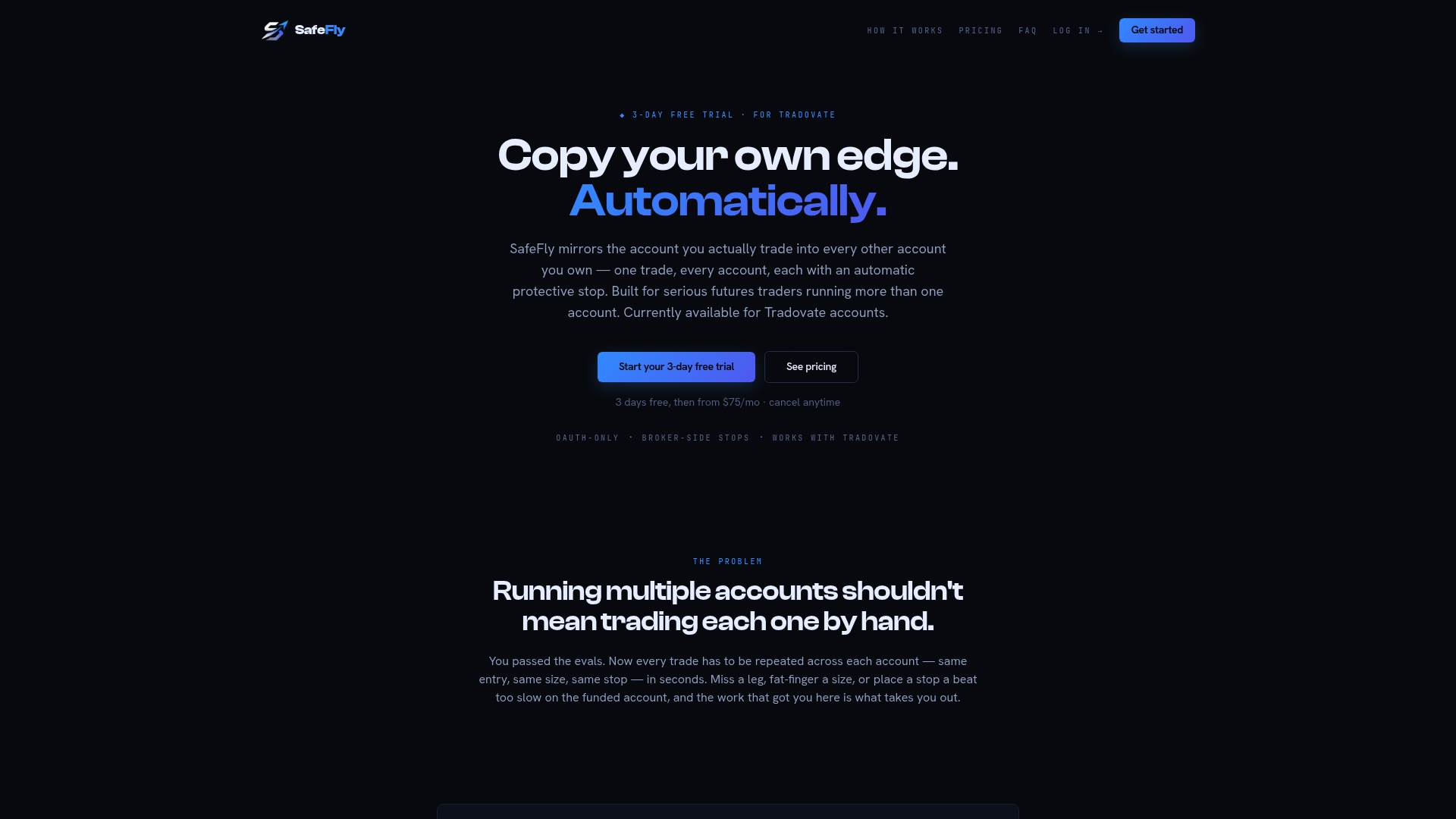
SafeFly is the alternative to piecing together a copier setup from separate tools and manual checklists. It replaces the disconnected stack of platform toggles, data-feed authorizations, and manual stop placement covered throughout this article with a single system built specifically for Tradovate multi-account traders, backed by broker-side stops that hold even if your connection drops.
Before you commit to any copier solution, including SafeFly, ask three questions during your trial: Does it log exact ticket numbers and timestamps for every mirrored trade? Does it require only one data-feed authorization per account? And how does it handle bracket-order sequencing across multiple follower accounts? These are the exact failure points this article walked through, and how a product answers them tells you whether it was built for serious multi-account trading or adapted from something else.
See the full breakdown on the how it works page, review the subscription tiers and trial details, and start the trial to see how your own account setup performs against these error classes.
Where to Look for Platform-Specific Troubleshooting Help
When you need exact UI steps or a second opinion from other traders who hit the same wall, a few sources consistently deliver.
For general copier failure patterns and restart guidance, CrossTrade's troubleshooting docs cover the most common root causes in plain language. For a broader breakdown of the nine most frequent copier failure types, including webhook and API rate-limit issues, the Why Trade Copiers Fail analysis is worth bookmarking. For sequencing and maximum-position errors specific to NinjaTrader, the NinjaTrader support forum thread documents the exact fix traders have used. For MetaTrader-specific alerts around Magic Number conflicts and netting account limits, the MQL5 blog post on copier troubleshooting walks through platform-level configuration fixes. For a decision-tree style walkthrough when trades simply stop copying, DaneTrades' support article is a solid starting point. For duplicate fills tied to feed authorization, the FlowBots support article explains the exact mechanism.
Frequently Asked Questions
Why is my trade copier failing even though the connection looks fine? A visible connection does not guarantee auto-trading is enabled on every chart, and it does not confirm your Master and Slave builds match. Check both before assuming the connection itself is the problem.
How do I fix a trade copier that copies trades with the wrong lot size? Recheck your sizing multiplier settings and confirm whether the account is set to netting or hedging mode, since a mismatch between the two commonly produces invalid volume errors.
What causes duplicate trades in a trade copier setup? The most common cause is a single account authorized to more than one data feed at the same time, which submits independent orders before the copier is even involved. Running two copier instances on the same account produces the same effect.
How long should I let a copier platform run before restarting it? There is no universal number, but long, uninterrupted uptime is a known contributor to instability on platforms like NinjaTrader. A routine restart every couple of days reduces the odds of this becoming a factor.
What should I include when contacting a trade copier's support team? Send the exact error string, the timestamp with timezone, master and slave ticket numbers, an account history report, and the minimal steps needed to reproduce the issue. This turns a multi-day back-and-forth into a same-day fix in most cases.
This article is general information, not a substitute for advice from a qualified financial advisor. Consult a qualified financial professional about your own circumstances before acting on anything here.
Sources
- CrossTrade — Trade copier troubleshooting
- Why Trade Copiers Fail: 9 Causes & Fixes (2026)
- Troubleshooting: Trades not copying — DaneTrades support
- Why is my trade being doubled/tripled in the follower — FlowBots support