

SafeFly is the recommended futures trade copier for experienced traders and prop firm participants needing multi-account mirroring, broker-side risk enforcement, and low-latency execution without managing a VPS. For this audience, the evaluation comes down to three factors: how the copier connects to your broker, where risk controls are enforced, and whether the architecture holds up under prop firm rules.
- Multi-account scaling: SafeFly mirrors trades from a single leader account to multiple Tradovate follower accounts simultaneously, with per-account contract multipliers and automatic ES→MES conversions.
- Broker-side protective stops: Every mirrored trade carries a broker-side protective stop, so positions remain protected even if the client connection drops.
- Daily P&L lockouts: Automated daily profit and loss lockouts prevent accounts from breaching funded-account drawdown limits without manual intervention.
SafeFly offers a trial period, with the full feature set available immediately.
Table of Contents
- What does SafeFly do, and how does it compare to generic copiers?
- How does the leader-to-follower copying process actually work?
- What latency should you realistically expect from a cloud copier?
- What risk controls does a prop firm copier actually need?
- Which brokers and prop firms are compatible with SafeFly?
- How is SafeFly priced, and what does the trial include?
- How do you evaluate any futures trade copier before committing?
- Why broker-side enforcement and broker-mix support define the category
- Key Takeaways
- What actually matters when scaling a multi-account futures strategy
- Start your SafeFly trial and connect your Tradovate accounts
What does SafeFly do, and how does it compare to generic copiers?
SafeFly is a subscription SaaS platform built specifically for futures traders managing multiple Tradovate accounts. It automates trade mirroring from a designated leader account to any number of follower accounts, and it does so through a secure OAuth connection rather than stored credentials.
| Capability | SafeFly implementation |
|---|---|
| Trade copying | Leader-to-follower mirroring across multiple Tradovate accounts |
| Risk controls | Broker-side protective stops, daily P&L lockouts, per-account multipliers |
| Deployment | Cloud-based, no VPS required |
| Integrations | Tradovate OAuth, TradingView trigger compatibility |
| Analytics | Detailed trade logs, P&L tracking across accounts |
| Coaching | AI-driven performance coaching |
| Trial | 3-day trial, full feature access |
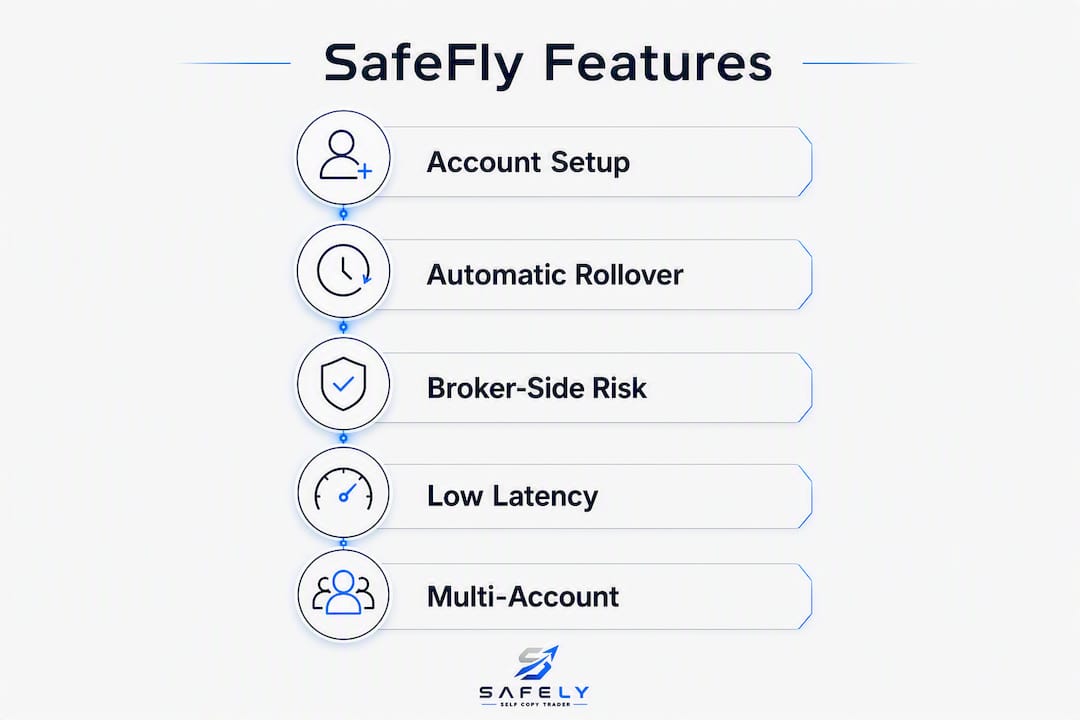
The distinction between a generic multi-asset copier and a futures-specific platform matters here. Generic tools often lack automatic contract rollover handling and mini/micro conversion logic, both of which are operationally necessary when managing multiple prop firm accounts across different contract sizes.
How does the leader-to-follower copying process actually work?
The copying sequence in SafeFly follows a defined flow from account authorization through live order mirroring. Understanding each stage helps traders assess integration risk before committing to a live setup.
- Link accounts via OAuth. Connect each Tradovate account to SafeFly using OAuth authorization. No passwords are stored; the connection uses token-based authentication.
- Designate the leader account. Select one account as the signal source. All trades placed in this account will be replicated to followers.
- Configure follower sizing. Set per-account multipliers to scale contract quantities up or down. A leader trading 2 ES contracts can mirror to a follower trading 4 MES contracts using automatic conversion.
- Enable broker-side stops. Activate protective stops so each mirrored order carries a stop at the broker level, independent of client connectivity.
- Set daily P&L lockouts. Define the maximum daily loss threshold per account. SafeFly enforces the lockout automatically when the threshold is reached.
- Activate and monitor. Once live, SafeFly mirrors orders in real time and logs all activity for review in the analytics dashboard.
Automatic contract rollovers handle expiring front-month symbols, keeping leader and follower accounts synchronized through quarterly rolls without manual symbol updates. This matters most during high-volatility periods when manual rollover errors are most costly.
Pro Tip: Before scaling to full position size, run a 1-contract test on each follower account during a low-volatility session. Confirm fill prices, stop placement, and P&L attribution are all correct before increasing size.

What latency should you realistically expect from a cloud copier?
SafeFly operates as a cloud-based platform, which means traders do not need to provision or maintain a VPS. The trade-off is straightforward: cloud architecture delivers reliable 24/7 availability and eliminates single-point-of-failure risk from a user-managed server, but it does not compete with colocated infrastructure on raw exchange proximity.

Cloud copiers typically report sub-200ms internal processing time for order replication. End-to-end fill time, however, depends on the broker's own execution infrastructure, network routing between the cloud server and the broker's API, and market conditions at the time of execution. For most futures strategies, including swing, intraday, and systematic approaches that do not require sub-10ms fills, cloud processing at this level is operationally sufficient.
Colocation matters primarily for high-frequency strategies that require single-digit millisecond latency to CME Globex. If a strategy's edge depends on fill priority measured in microseconds, a cloud copier is the wrong tool regardless of vendor. For prop firm traders copying a discretionary or systematic intraday strategy across multiple funded accounts, the relevant question is consistency and reliability, not raw microsecond speed.
To validate end-to-end fill quality during your trial:
- Place a 1-contract market order on the leader account at a known time.
- Record the fill timestamp on the leader and each follower account.
- Compare fills across accounts and note any slippage relative to the leader fill price.
- Repeat at market open, mid-session, and near the close to capture different liquidity conditions.
What risk controls does a prop firm copier actually need?
Prop firm accounts operate under strict drawdown rules, and a copier that enforces risk only at the client level creates a gap: if the connection drops, the enforcement disappears. Broker-side enforcement closes that gap.
SafeFly's risk control architecture addresses the core requirements for funded account management:
- Broker-side protective stops: Stops are placed at the broker, not just tracked in the application layer. A disconnection does not leave positions unprotected.
- Per-account size multipliers: Each follower account can be configured independently, so a trader managing accounts of different sizes does not need to run separate leader accounts.
- Daily P&L lockouts: When a follower account reaches its configured daily loss limit, SafeFly halts further copying to that account for the remainder of the session.
- Automatic contract conversion: ES-to-MES and equivalent conversions prevent oversizing errors when followers trade smaller contracts than the leader.
- Disconnection quarantine: Positions on disconnected follower accounts remain protected by broker-side stops rather than being left open without oversight.
Red flags to watch for in any vendor evaluation:
- Risk controls enforced only at the application layer, with no broker-side stop placement.
- No per-account multiplier configuration, forcing all followers to mirror the leader's exact size.
- Manual-only override for daily loss limits, which requires human intervention to prevent a breach.
- No documented behavior for disconnected accounts.
Any vendor that cannot clearly answer how risk is enforced when the client application is offline should not be used for prop firm accounts.
Which brokers and prop firms are compatible with SafeFly?
SafeFly's primary integration is with Tradovate, using OAuth for account authorization. This covers the majority of prop firm accounts that run on Tradovate infrastructure, including many funded programs that use Tradovate as their clearing and execution layer.
For traders who need detailed setup guidance, SafeFly's Tradovate copy trading documentation covers multi-account configuration, symbol mapping, and compatibility notes specific to the Tradovate API. TradingView trigger compatibility extends the platform's utility for traders who use TradingView alerts as their signal source.
Before signing up, verify the following with SafeFly and your prop firm:
- Account type confirmation: Confirm that your specific funded account type is supported under the Tradovate OAuth integration.
- Instrument list: Verify that the futures instruments you trade (ES, NQ, CL, GC, etc.) are supported and that symbol mapping is current.
- Rollover handling: Confirm how SafeFly handles contract rollovers for each instrument you trade, and whether the rollover is automatic or requires manual configuration.
- Prop firm policy: Some funded programs restrict third-party automation tools. Confirm with your funding provider that using a trade copier is permitted under your account agreement before connecting.
Cross-broker copying, where the leader and followers use different broker infrastructure, is a capability that varies by platform. Traders managing accounts across multiple broker rails should verify this directly with SafeFly's support team.
How is SafeFly priced, and what does the trial include?
SafeFly uses a tiered subscription model with both monthly and annual billing options. The 3-day trial provides full access to the platform's features, allowing traders to complete a meaningful evaluation including live copying tests, risk control configuration, and analytics review.
| Billing detail | SafeFly |
|---|---|
| Billing cadence | Monthly or annual subscription |
| Trial length | 3 days, full feature access |
| Pricing structure | Tiered plans based on account scale |
| Per-trade fees | Not applicable (subscription model) |
| Trial requirement | Account registration required |
The subscription model is preferable to per-trade or per-account fee structures for traders managing multiple funded accounts, because costs remain predictable regardless of trading frequency or account count. Per-trade pricing can create meaningful cost drag for active strategies, and per-account fees scale poorly as a prop firm portfolio grows.
During the trial, prioritize testing broker-side stop placement, daily P&L lockout behavior, and contract conversion accuracy. These are the features that differentiate a futures-specific copier from a general-purpose tool, and they are the ones most likely to surface configuration issues before real capital is at risk. Full pricing details are available on the SafeFly pricing page.
How do you evaluate any futures trade copier before committing?
The evaluation framework below applies to any futures copy trading software, not just SafeFly. Use it to structure vendor conversations and identify disqualifying gaps before onboarding.
- Confirm broker rail compatibility. Verify that the copier supports your specific broker and account type via a documented API or OAuth integration, not a workaround.
- Test latency end-to-end. Measure fill time from leader order placement to follower fill confirmation. Do not accept vendor-stated processing time as a substitute for measured end-to-end performance.
- Verify broker-side risk enforcement. Ask explicitly: "If my client application disconnects, what happens to open positions on follower accounts?" Acceptable answers involve broker-side stops. Unacceptable answers involve manual intervention or application-layer-only controls.
- Test per-account multipliers. Configure followers at different sizes and confirm that contract conversions and sizing are accurate before scaling.
- Review rollover handling. Place a test trade in a contract approaching expiration and confirm the platform handles the rollover without manual symbol updates.
- Request documentation and audit logs. A platform without clear documentation of its order routing, security model, and fail-safe behavior is not suitable for funded account management.
- Confirm security model. OAuth or API key authentication with no stored passwords is the minimum acceptable standard.
Vendor questions that should stop the evaluation if answered poorly:
- "How are broker-side stops placed, and what triggers them?" A vague answer indicates application-layer-only enforcement.
- "What is your documented rollover process for ES, NQ, and CL?" No documented process means manual risk.
- "Can I set different position sizes per follower account?" A no here means the platform cannot serve a mixed-size prop firm portfolio.
- "Do you have audit logs for all copied orders?" No audit logs make compliance and dispute resolution impossible.
Why broker-side enforcement and broker-mix support define the category
The futures trade copier category has a clear dividing line: platforms that enforce risk at the broker level and platforms that enforce it only in the application layer. For prop firm traders, this distinction has direct financial consequences.
When a funded account's protective stop exists only in the copier's application layer, a network interruption, server restart, or API timeout can leave an open position without protection. Broker-side stops persist independently of the copier's connectivity state, which means the risk control survives the failure mode it was designed to address. SafeFly places protective stops at the Tradovate broker level through its OAuth integration, so follower account positions remain protected regardless of client-side connectivity.
Cross-broker support addresses a separate but equally practical problem. Prop firm traders frequently hold accounts across multiple funded programs, and those programs often use different broker infrastructure. A copier that requires all accounts to share the same broker forces traders to consolidate onto a single provider, which limits diversification and creates concentration risk at the infrastructure level. SafeFly's Tradovate-focused architecture, combined with TradingView trigger compatibility, covers the most common prop firm account configurations in the U.S. market.
AI coaching and detailed trade analytics extend the platform's value beyond order replication. Reviewing P&L attribution across multiple accounts, identifying which follower accounts consistently underperform the leader fill, and using AI-driven coaching to refine execution are capabilities that a pure order-mirroring tool does not provide.
Key Takeaways
SafeFly is the most defensible choice for prop firm futures traders who require broker-side risk enforcement, multi-account Tradovate integration, and automatic contract conversion in a single subscription platform.
| Point | Details |
|---|---|
| Broker-side stops are non-negotiable | Application-layer-only risk controls fail during disconnections; broker-side stops persist independently. |
| Contract conversion and rollover | Automatic ES→MES conversion and rollover handling prevent sizing errors across mixed-contract follower accounts. |
| Cloud deployment trade-off | Sub-200ms cloud processing suits most intraday and systematic strategies; colocation is only necessary for sub-10ms HFT requirements. |
| Evaluation checklist | Test latency end-to-end, verify broker-side stop behavior, and confirm rollover handling before scaling. |
| SafeFly trial | Start a 3-day full-access trial, run 1-contract tests on each follower, and validate risk controls before live scaling. |
What actually matters when scaling a multi-account futures strategy
The conventional wisdom in futures copy trading focuses on latency as the primary differentiator. That framing is incomplete. For prop firm traders, the failure mode that costs real money is not a 50ms delay on a fill. It is an unprotected position on a follower account after a connectivity event, or a sizing error during a contract rollover, or a daily drawdown breach that a manual process failed to catch.
The evaluation criteria that matter most are broker-side enforcement, automatic rollover handling, and a security model that does not require storing account credentials. Latency matters, but it matters within a range, and for the strategies most prop firm traders run, cloud-based processing at sub-200ms is operationally sufficient.
SafeFly's architecture addresses the failure modes that actually occur in multi-account prop firm operations: disconnected accounts, rollover errors, and drawdown breaches. That is the right set of problems to solve.
Start your SafeFly trial and connect your Tradovate accounts
Traders who manage multiple Tradovate accounts and need broker-side risk enforcement without a VPS have a direct path to validation: SafeFly's 3-day trial provides full platform access from day one.
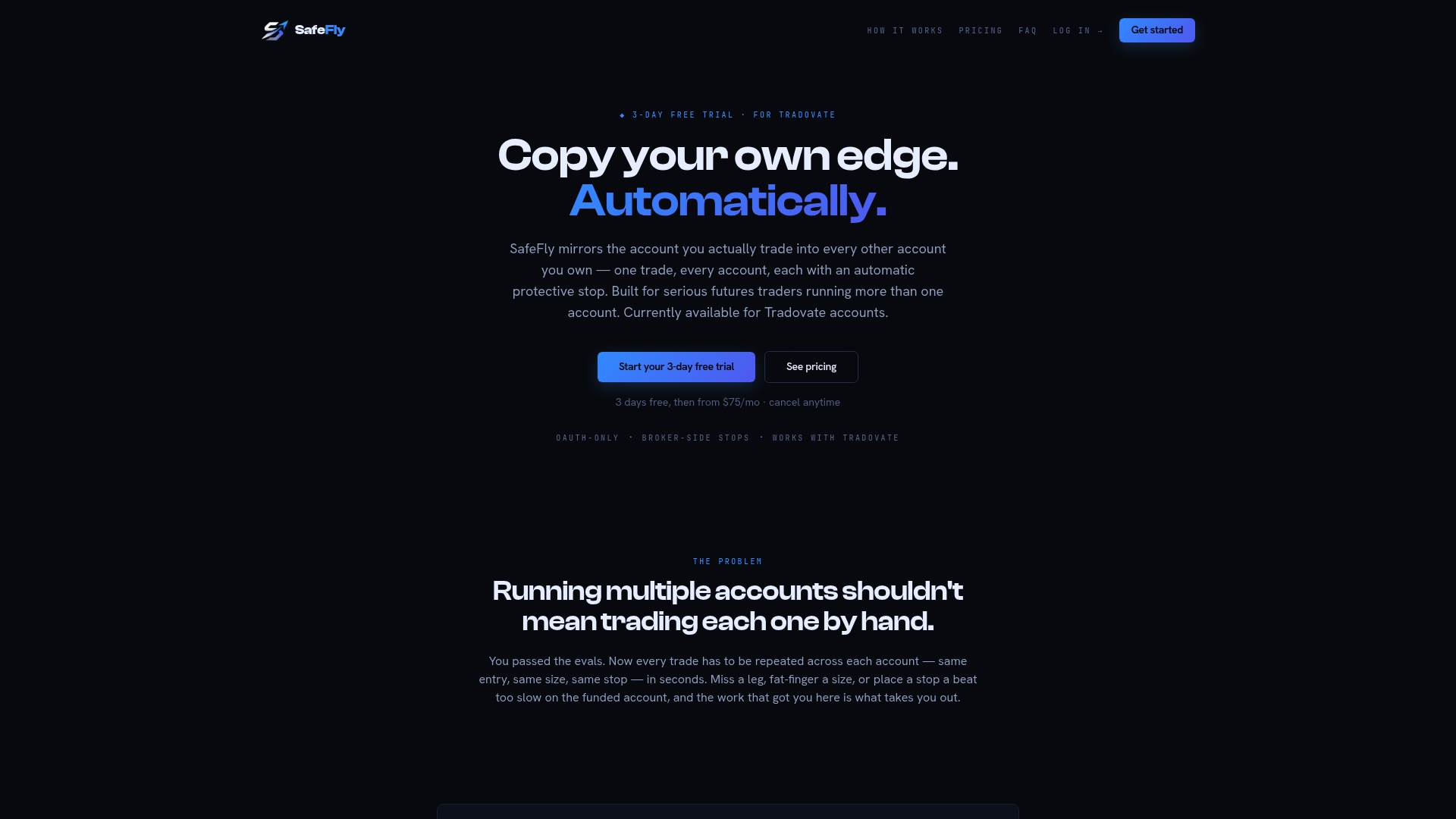
Onboarding takes four steps. Create a SafeFly account, authorize each Tradovate account via OAuth, designate your leader account and configure per-follower multipliers, then run a 1-contract test trade to confirm fill accuracy and stop placement. During the trial window, test daily P&L lockout behavior by simulating a threshold breach on a paper or sandbox account before applying the configuration to live funded accounts.
The trial is the right time to verify prop firm compatibility with your specific funding provider and to confirm that contract rollovers for your instruments are handled automatically. Review the platform documentation for setup details, and check the pricing page for current plan options and billing terms.