

No federal rule caps how many trades an account can place in a single day, but the practical ceiling is shaped by two separate forces: account-level regulations tied to margin and equity, and exchange-level price limits that halt trading regardless of your account type. Pattern Day Trader rules and intraday margin standards govern margin accounts, while circuit breakers and daily price bands govern the market itself, no matter who holds the account.
For a starting point, beginners generally do best capping themselves at a few trades per day, active retail traders often operate with moderate trade counts, and experienced traders running tested systems may reasonably scale to higher trade counts. These ranges depend heavily on capital, strategy, and account type, so treat them as a starting frame, not a rule carved in stone.
Before your next session, do three things:
- Confirm whether your account is cash or margin, since that determines which rules apply to you.
- Read your broker's specific day-trading and margin policies, since implementation details vary by platform.
- Set a hard daily profit-and-loss stop before you place a single trade.
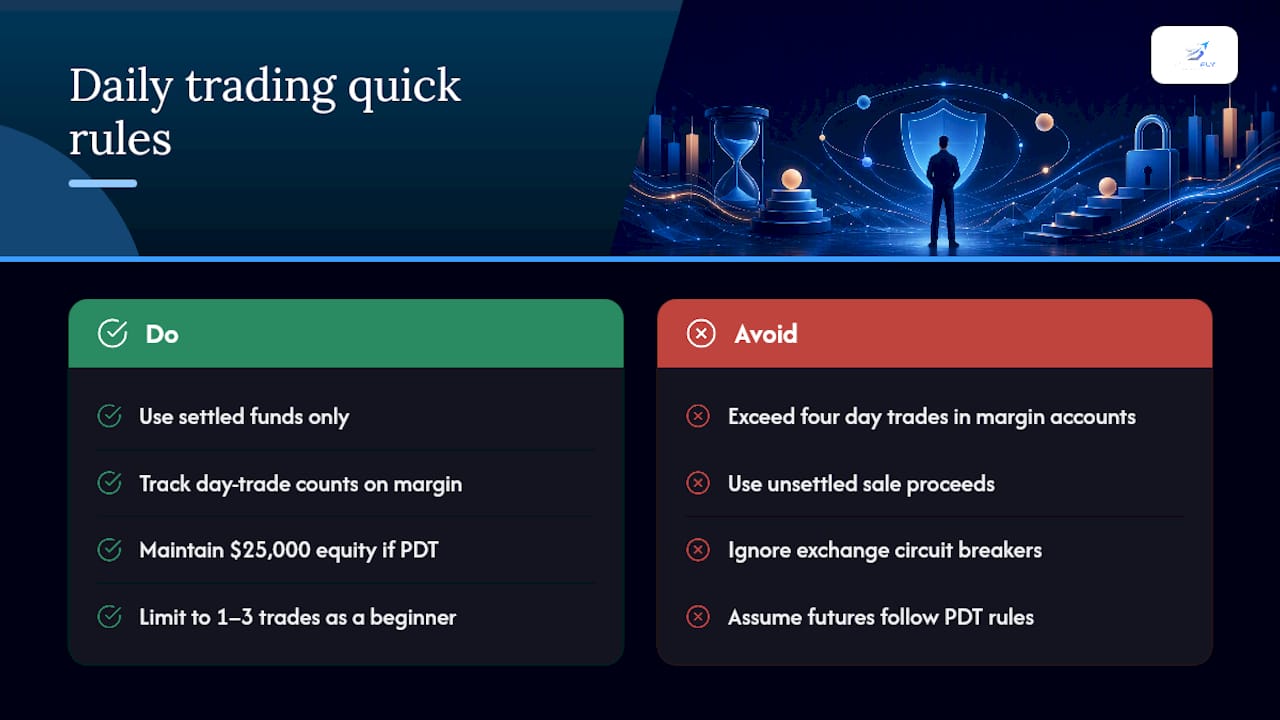
Quick fact: the SEC defines pattern day trading as four or more day trades within five business days in a margin account, a threshold that triggers the $25,000 minimum equity requirement.
Key Takeaways
A disciplined daily trade limit combines regulatory awareness, personal risk math, and mechanical enforcement, since willpower alone consistently fails during losing streaks.
| Point | Details |
|---|---|
| Know your account type | Cash accounts allow unlimited trades with settled funds; margin accounts trigger PDT rules at four day trades in five days. |
| Equity minimum matters | Margin accounts flagged as Pattern Day Traders must maintain $25,000 in equity or face trading restrictions. |
| Exchange limits are separate | Circuit breakers and price bands halt the whole market regardless of your account type or trade count. |
| Use risk math for your cap | Divide your daily loss budget by per-trade risk to calculate a mechanical trade-count ceiling. |
| Enforce, don't just plan | Automated tools like broker-side stops and P&L lockouts hold your limit when discipline alone would not. |
Table of Contents
- What Are the Pattern Day Trader and Margin Rules?
- Do Exchange Price Limits Cap How Many Trades You Can Make?
- How Do Cash Accounts and Settlement Change Your Trade Limit?
- How Many Trades Per Day Should You Actually Make?
- How Do You Set and Enforce Your Own Daily Trading Cap?
- Can Automation Help You Enforce a Daily Trade Limit?
- Are High-Frequency Trading Algorithms Changing Daily Trade Limits?
- Do Brokers Set Their Own Trade Limits Beyond Regulatory Minimums?
- Are There Exceptions to Standard Day-Trading Rules?
- Why Does Trading Frequency Affect Your Psychology?
- How Does Frequent Trading Affect Your Taxes?
- What Actually Matters When Setting Your Trading Cap
- Frequently Asked Questions
- Sources
What Are the Pattern Day Trader and Margin Rules?
The Pattern Day Trader (PDT) designation applies to margin accounts that execute four or more day trades within five business days, provided those trades represent more than 6% of total trading activity in that window. Once an account crosses that threshold, the SEC's day trading bulletin requires it to maintain a minimum equity of $25,000. Fall below that number and your broker will typically restrict further day trading until equity is restored.
Intraday margin adds another layer traders often overlook. Your buying power fluctuates throughout the session as positions open and close, and brokers monitor that in real time. FINRA Notice 26-10 warns that active day trading demands careful planning around intraday margin management, because equity maintenance calls can arrive mid-session if losses erode your buffer too quickly.
The consequences for ignoring these calls are not gentle:
- A margin call that goes unmet can force your broker to liquidate positions without further notice.
- Repeated violations can trigger a 90-day restriction limiting your account to cash-only, fully settled trading.
- Some brokers apply stricter internal thresholds than the regulatory minimum, so your actual limit may be tighter than $25,000 implies.
Worth noting: some platforms have begun shifting away from a strict trade-count PDT test toward an intraday margin standard instead, meaning the rules that applied last year may not match what your broker enforces today. Regulatory frameworks and broker implementations both evolve, so check your platform's current disclosures rather than relying on older guidance you read elsewhere.
Do Exchange Price Limits Cap How Many Trades You Can Make?
Exchange-level price limits work nothing like PDT rules. They don't count your trades. They restrict the market itself when volatility crosses a threshold, which means every participant, regardless of account type, faces the same halt.
Circuit breakers and daily trading limits pause or restrict trading when a security's price moves beyond a defined band relative to its prior close. The mechanism exists to prevent panic-driven cascades, not to police individual trading behavior, and these limits can lock a market entirely on extreme sessions, leaving you unable to exit at any price until the halt lifts.
Japan Exchange Group publishes one of the clearest public examples of how these bands work in practice. Its daily price limit tables set an absolute yen-denominated range based on the previous closing price tier:
The practical effects show up fast once a security nears its band: spreads widen, liquidity thins, and orders sitting near the limit price may not fill at all. A trader who planned five exits in a session can find the market simply unavailable for the last two, which is a completely different problem than a broker-enforced trade cap.
How Do Cash Accounts and Settlement Change Your Trade Limit?
Cash accounts allow unlimited day trades, but only when you're trading with settled funds. That caveat matters more than most beginners realize.
Most U.S. equities settle on a T+1 basis, meaning proceeds from a sale become available one business day after the trade. If you sell a position and immediately use those unsettled proceeds to open a new trade, you risk a Good Faith Violation. Rack up three of these within a rolling 12-month period and your broker will typically restrict the account to settled-cash-only trading for 90 days, which functions as its own version of a forced trading cap.
Margin accounts sidestep the settlement problem but trade it for a different constraint: intraday equity monitoring. Your broker calculates buying power continuously, and if losses push your equity below required maintenance levels, you can be locked out of new positions mid-session even without hitting the PDT trade count.
Futures accounts occupy a distinct category. They generally avoid PDT-style trade-count rules entirely, but they still carry exchange-set margin requirements and their own price-limit regimes, so "unlimited" trading in futures still runs into structural constraints elsewhere.
Pro Tip: Track your settled cash balance separately from your total account value. A quick mental note before each trade, "is this money settled?", prevents most Good Faith Violations before they happen.
How Many Trades Per Day Should You Actually Make?
The honest answer depends on your account size, strategy, and experience, but the reasoning behind sensible ranges is consistent across skill levels.
- Beginners (1 to 3 trades per day). New traders are still calibrating their read on setups, so fewer trades means fewer chances to compound an unrefined process into a losing streak.
- Active retail traders (3 to 5 trades per day). This range balances enough opportunity to build a track record against the fatigue and rushed decisions that creep in past the fifth trade of a session.
- Experienced traders with tested systems (5 to 15 or more). Higher counts only make sense once a strategy has a verified edge and the trader has the screen time to execute it without emotional drift.
The math behind a personal cap is simpler than it sounds. If you risk 0.5% of a $50,000 account per trade, that's $250 at risk each time. Set a daily loss budget of $1,000, and you've mechanically capped yourself at four trades before hitting your stop, assuming each one loses. That formula, daily risk budget divided by per-trade risk, gives you a real ceiling instead of a guess.
Trade quality matters more than trade count. Risk-management practices commonly used across trading desks favor mechanical daily limits specifically because they prevent revenge trading and other behavioral errors that creep in once a trader starts chasing losses. Five high-probability setups executed with discipline will outperform fifteen impulsive entries almost every time.
How Do You Set and Enforce Your Own Daily Trading Cap?
Building a personal maximum takes four steps, and skipping any one of them tends to be why traders blow past their own limits within a week.
- Define your strategy and per-trade risk first. Decide your setup criteria and the percentage of capital you'll risk per trade before the market opens, not while you're staring at a chart.
- Set both a daily P&L stop and a trade-count cap. The P&L stop protects your capital; the trade-count cap protects your decision-making quality, and you need both because either one alone leaves a gap.
- Choose time cutoffs and execution rules. Many traders find the last hour of a session breeds impulsive entries, so a hard stop time removes that temptation entirely.
- Enforce the rule and journal every session. A cap you don't track is a suggestion, not a rule.
Enforcement is where good intentions usually fail. Some traders rely on pre-session order blocking, others set a phone timer that forces a stop at a specific time, and some simply close the platform once they hit their count. Manual discipline works until a losing streak tempts you to "make it back," which is exactly when a mechanical or automated enforcement layer earns its keep.
Watch for warning signs that your current cap is too loose: slippage creeping into your fills, a string of small losses that feel like they should have been one stop, or catching yourself sizing up "just this once." Any of those mean it's time to tighten the number, not loosen it.
Pro Tip: Write your daily trade cap on a sticky note on your monitor. It sounds almost too simple, but a visible number is harder to rationalize past than a rule you only remember exists.
Can Automation Help You Enforce a Daily Trade Limit?
Self-discipline breaks down exactly when you need it most, usually mid-drawdown, which is why operational enforcement tends to outperform willpower alone. SafeFly was built for futures traders managing multiple Tradovate accounts who need their risk rules to hold even when they're distracted, disconnected, or tempted to override themselves.
The gap between a rule you intend to follow and a rule your platform enforces is where most overtrading actually happens. Automated stops and lockouts close that gap by executing the decision before emotion gets a vote.
Several SafeFly features map directly onto the trade-cap discipline covered throughout this guide:
- Automated trade replication mirrors your lead account's trades across every connected account, removing the manual copy-paste errors that multiply risk.
- Broker-side protective stops stay attached to every position, even if your connection drops mid-session.
- Daily profit-and-loss lockouts enforce your P&L stop automatically, so hitting your number ends the session whether you're ready to stop or not.
- Secure OAuth integration connects your accounts without exposing credentials.
- Trade analytics and AI coaching show you where your actual trade count and risk patterns diverge from your stated plan.
Confirm your broker's specific day-trading and margin rules before layering on any automation. Review SafeFly's how-it-works page for the full mechanics of stop placement and account mirroring.
Are High-Frequency Trading Algorithms Changing Daily Trade Limits?
High-frequency trading (HFT) firms execute thousands of orders per second using co-located servers and algorithmic logic that no retail platform can match. Their volume doesn't raise your personal trade limit. It changes the conditions you're trading in.
HFT activity thickens liquidity in normal conditions, which can tighten spreads and make retail fills cleaner. But during volatile stretches, some HFT strategies pull back or shift to one-sided quoting, and that withdrawal can widen spreads exactly when you're trying to exit a position. The exchange price limits and circuit breakers covered earlier exist partly because algorithmic feedback loops can accelerate a price move faster than human traders can react.
For a retail trader setting a personal daily cap, the practical takeaway isn't to compete with HFT speed. It's to recognize that algorithmic activity can make the first and last thirty minutes of a session more volatile and less predictable, which is one more reason many experienced traders build time cutoffs into their daily rules rather than trading through the entire session. A five-trade cap means less if all five get filled during a chaotic open where algorithmic order flow is dominating price action.
Do Brokers Set Their Own Trade Limits Beyond Regulatory Minimums?
Regulatory rules like the PDT threshold set a floor, not a ceiling, and individual brokers routinely apply stricter internal policies on top of them. Some platforms flag pattern day trading behavior earlier than the regulatory four-trade, five-day window as an internal risk-management practice. Others set higher equity minimums than the $25,000 regulatory standard for certain account types or trading products.
Futures brokers and platforms that route through Tradovate typically apply their own margin requirements per contract, and those can shift with volatility, sometimes with same-day notice. A broker might also cap the number of open positions across linked accounts, restrict order size during specific market conditions, or apply different day-trading buying-power multipliers depending on your account tier.
The practical lesson: never assume the regulatory minimum is what your broker actually enforces. Read your platform's day-trading and margin disclosures directly, and check for update notices, since some brokers have shifted their day-trading rule structure in ways that change effective trade limits without changing the underlying regulation. If you manage multiple accounts across a single broker, confirm whether trade activity is aggregated for PDT purposes or evaluated per account, because that answer changes your real-world ceiling significantly.
Are There Exceptions to Standard Day-Trading Rules?
Futures accounts represent the clearest exception to equity PDT rules. Because futures trading falls under a different regulatory structure than stock margin accounts, traders working through CFTC-regulated futures exchanges generally don't face the four-trades-in-five-days PDT test at all. That doesn't mean unlimited freedom. Futures exchanges impose their own margin requirements and daily price limits, so the constraint simply shifts location rather than disappearing.
Cash accounts offer a different kind of exception. There's no PDT trade-count limit, since PDT rules apply specifically to margin accounts. The tradeoff is the settlement constraint covered earlier: trade only with fully settled funds, or risk a Good Faith Violation and the account restriction that follows repeated violations.
Some brokers also carve out exceptions for specific account types, retirement accounts often can't use margin at all, which sidesteps PDT entirely but eliminates leverage as a factor too. There's no universal exemption process for exceeding four day trades on an under-funded margin account. The $25,000 threshold is a firm line for standard margin accounts, and the practical fix is either maintaining that equity, switching to a cash account and respecting settlement timing, or trading in a product category like futures that operates under different rules from the start.
Why Does Trading Frequency Affect Your Psychology?
Every trade you place carries a small emotional cost, win or lose, and that cost compounds across a session in ways most traders underestimate. A losing trade early in the day often triggers what's commonly called revenge trading, an urge to immediately re-enter the market to "win back" the loss, usually with looser criteria and larger size than the original plan called for.

Decision fatigue is real and measurable in how trading quality degrades late in a session. The tenth decision of the day rarely gets the same careful analysis as the first, even when the trader believes otherwise. This is part of why professional risk-management practices favor mechanical daily trade-count limits: they remove the decision of "should I take one more?" from a mind that's already depleted.
Overtrading often masquerades as diligence. A trader convinced they're "staying opportunistic" by taking a twelfth setup of the day is frequently just bored, anxious about an earlier loss, or unwilling to accept that the best opportunities already passed hours ago. The fix isn't more willpower. It's a pre-committed number that doesn't require willpower to enforce, because the decision was already made before the emotional state showed up.
How Does Frequent Trading Affect Your Taxes?
Trading frequency changes how your gains get taxed, and the difference can be substantial depending on your jurisdiction and holding periods. In the United States, positions held one year or less are typically taxed as short-term capital gains at ordinary income rates, while positions held longer qualify for lower long-term capital gains rates. Frequent day trading, by definition, generates almost exclusively short-term gains.
Traders who meet specific activity thresholds may qualify for trader tax status, a designation that can allow certain trading-related expenses to be deducted and, in some cases, allows electing mark-to-market accounting. That election changes how gains and losses are recognized and can affect wash-sale rule exposure, but qualifying requires substantial, regular, and continuous trading activity, not just a handful of trades per week.
Wash-sale rules deserve specific attention for anyone trading the same security repeatedly within a short window. Selling a position at a loss and repurchasing a substantially identical security within 30 days can disallow that loss for current tax purposes, deferring it instead. High trade counts in a narrow set of instruments make this far more likely to trigger than occasional trading across varied positions.
Tax treatment varies significantly by country and account structure, so consult a tax professional familiar with active trading before assuming any specific treatment applies to your situation.
What Actually Matters When Setting Your Trading Cap
The regulatory framework around day trading gets treated like a single monolithic rule, when it's really three separate systems, account equity requirements, exchange price mechanics, and settlement timing, that happen to overlap in ways that confuse most retail traders. Understanding which system is actually constraining you at any given moment matters more than memorizing a single number.
Conventional advice tends to stop at "pick a trade limit and stick to it," which is true but incomplete. The traders who actually stick to their limits are the ones who built enforcement into their process instead of relying on discipline they haven't tested under pressure. A number written in a trading journal means far less than a number your platform enforces automatically when you're emotionally compromised.
If there's one priority worth acting on immediately, it's this: calculate your mechanical trade-count ceiling using your real risk budget today, then build in an enforcement layer, whether that's a timer, a broker feature, or dedicated software, before your next losing streak tests whether your rule actually holds.
Frequently Asked Questions
Is there a legal limit on how many trades I can make per day? No federal law caps trade count directly. Pattern Day Trader rules apply only to margin accounts crossing four day trades in five business days, and separate exchange-level circuit breakers can halt trading regardless of account type.
What happens if I exceed four day trades in a margin account? Your account gets flagged as a Pattern Day Trader and must maintain at least $25,000 in equity going forward, or your broker will restrict further day trading until that balance is met.
Can I day trade unlimited times in a cash account? Yes, as long as you use fully settled funds. Using unsettled proceeds from a recent sale risks a Good Faith Violation, and three within 12 months typically triggers a 90-day restriction.
How many trades per day is reasonable for a beginner? Most beginners do best with 1 to 3 trades per day, prioritizing setup quality and process discipline over volume while they're still calibrating their edge.
Do futures traders face the same daily trade limits as stock traders? Generally no. Futures accounts typically avoid PDT-style rules, but they carry their own exchange margin requirements and daily price limits that create different constraints.
Can software help enforce my daily trade limit? Yes. Tools like SafeFly apply broker-side stops and daily profit-and-loss lockouts automatically, enforcing your limit even if you're disconnected or tempted to override it manually.
This article is general information, not a substitute for advice from a qualified financial advisor. Consult a qualified financial professional about your own circumstances before acting on anything here.
Sources
- FINRA Notice 26-10
- Investor Bulletin: Day Trading — U.S. Securities and Exchange Commission
- Trading curb — Wikipedia
- Daily Price Limits | JPX