

A trailing max drawdown (TMD) is a dynamic account-level loss limit anchored to the account's highest recorded equity peak. The floor only moves upward, never down, and any touch triggers an immediate hard breach — typically resulting in account closure with no appeal.
Three things to confirm before trading any account with this rule:
- Equity-based or balance-based calculation? Equity-based enforcement counts open unrealized P&L against the floor; balance-based enforcement uses only closed trades.
- Intraday or end-of-day (EOD) update? Intraday models advance the high-water mark (HWM) on every tick of unrealized equity; EOD models update only at session close.
- Does the trail lock at the starting balance? Many prop firms stop the floor from advancing once it reaches the initial account balance, giving traders a fixed cushion from that point forward.
Key Takeaways
A trailing max drawdown floor advances permanently with every new equity peak, making continuous monitoring and pre-positioned broker-side stops the two most critical operational controls for any trader subject to this rule.
| Point | Details |
|---|---|
| Verify the account rule set | Confirm EOD vs intraday update, equity vs balance basis, and buffer-lock behavior before funding. |
| Size from the buffer backward | Divide the total buffer by the maximum concurrent losing positions to set the per-trade risk ceiling. |
| Use broker-side stops | Platform-side risk rules can fail during disconnections; broker-side stops execute independently. |
| Backtest with intraday equity | Use tick-level or minute-level equity series that include unrealized P&L to reproduce real breach conditions. |
| SafeFly for multi-account control | SafeFly automates broker-side stop placement and daily lockouts across multiple Tradovate accounts, reducing latency-driven breach risk. |
Table of Contents
- What is trailing max drawdown and how does the floor move?
- How to calculate trailing max drawdown with worked examples
- How trailing max drawdown differs from static drawdown and trailing stops
- Concrete controls to avoid breaching the trailing floor
- How to backtest and monitor trailing drawdown rules in live trading
- How automation reduces hard-breach risk for Tradovate traders
- Why professionals treat trailing rules as a strategy filter, not just a constraint
- SafeFly automates the controls that prevent trailing breaches
- Sources
What is trailing max drawdown and how does the floor move?
The trailing max drawdown is the industry's standard term for what some platforms label "max trailing drawdown" (MTD). The mechanics are straightforward: the platform records the highest equity or balance the account has ever reached, then subtracts the permitted buffer to set the current floor. When equity rises, the floor rises by the same amount. When equity falls, the floor stays exactly where it was. Prop-firm documentation confirms that any touch of the floor, even by a single tick, constitutes a hard breach and closes the account immediately.
High-water mark mechanics
The HWM is the single most important variable in the calculation. What counts as the peak depends entirely on the platform's policy:
- Realized close (EOD model): The HWM advances only when a session ends with a higher closing equity than any prior session. Unrealized intraday gains do not move the floor.
- Intraday equity peak (real-time model): The HWM advances the moment account equity exceeds the prior peak, even if the position is still open. A trade that runs $3,000 into profit before reversing to flat will have permanently raised the floor by $3,000.
Audacity Capital's guide documents a third behavior: buffer-locking. Once the floor reaches the account's starting balance, the trail stops advancing. A $50,000 account with a $2,500 buffer stops trailing when equity first reaches $52,500; from that point the floor sits at $50,000 permanently.
EOD vs intraday: the practical consequence
EOD trailing is materially more forgiving for swing traders because intraday unrealized peaks never tighten the cushion. A position that runs $4,000 in profit overnight and closes flat the next day leaves the floor unchanged under an EOD model. Under an intraday model, the floor would have advanced $4,000, permanently reducing the available buffer.
NinjaTrader's platform documentation describes both End-of-Day and Real-Time trailing modes and flags a critical implementation caveat: setting the trailing value to $0 triggers immediate position liquidation. Confirm the exact numeric setting before enabling the feature.
Equity-based vs balance-based enforcement
Under equity-based enforcement, an open position that moves against the account can breach the floor before any trade is closed. Under balance-based enforcement, only realized P&L counts, so an underwater open position does not itself trigger a breach — though it will reduce the balance when closed. Most prop firms use equity-based enforcement because it prevents traders from holding losing positions indefinitely to avoid a realized loss.
Key rule: Hard breach behavior at most prop firms is non-negotiable. There is no grace period, no partial liquidation, and no reinstatement. The account is closed the moment equity touches the floor.
How to calculate trailing max drawdown with worked examples
The core formula is:
Floor = HWM − Buffer
where the buffer is either a fixed dollar amount or a percentage of the starting account size.
Step-by-step calculation
- Record the reference value (equity or balance) at each update interval (tick or EOD close).
- Compare the current value to the stored HWM; if higher, update the HWM.
- Compute the floor: HWM minus the fixed buffer.
- Compare current equity to the floor; if equity ≤ floor, the account is in breach.
- Log the HWM, floor, and nearest-breach distance after each update for monitoring.
Worked examples
Example A — $50,000 account, $2,000 fixed buffer, EOD model: Starting HWM = $50,000. Floor = $48,000. After three winning sessions the account closes at $53,500. New HWM = $53,500. New floor = $51,500. The trader now has only $1,500 of cushion above the original starting balance before the buffer-lock kicks in (if the firm sets the lock at $50,000).
Example B — $100,000 account, 3% buffer, intraday model: Buffer = $3,000. Starting floor = $97,000. During a session, unrealized equity peaks above the previous peak. The high-water mark advances immediately, raising the floor correspondingly. If the position then reverses and closes lower, the account remains safe but the floor stays permanently higher.
Funded Futures Family's knowledge base provides concrete account-size tables showing starting drawdown levels and the exact times at which EOD updates occur, which is useful for calibrating these calculations to specific firm rules.
Handling deposits, withdrawals, fees, and corporate actions
Platforms diverge significantly here. Common approaches:
- Fees and commissions: Most platforms deduct commissions from balance before computing the floor, so a high-frequency strategy pays a compounding cost in floor advancement.
- Deposits: Some platforms add deposits to both equity and the HWM simultaneously, preserving the buffer; others add only to equity, which temporarily widens the cushion.
- Withdrawals: Withdrawals typically reduce equity and may reduce the HWM proportionally, though policies vary. Confirm in writing before withdrawing from a funded account.
- Corporate actions (futures rolls): Roll adjustments that change the account's nominal value should be reconciled against the HWM before the next session to avoid phantom breaches.
How trailing max drawdown differs from static drawdown and trailing stops
These three controls operate at different levels and serve different purposes. Substituting one for another is a common and costly mistake.
| Control | Level | Reference point | Moves with profits? |
|---|---|---|---|
| Trailing max drawdown | Account | HWM of equity/balance | Yes, upward only |
| Static max drawdown | Account | Fixed starting value | No |
| Trailing stop order | Position | Position's price peak | Yes, upward only |
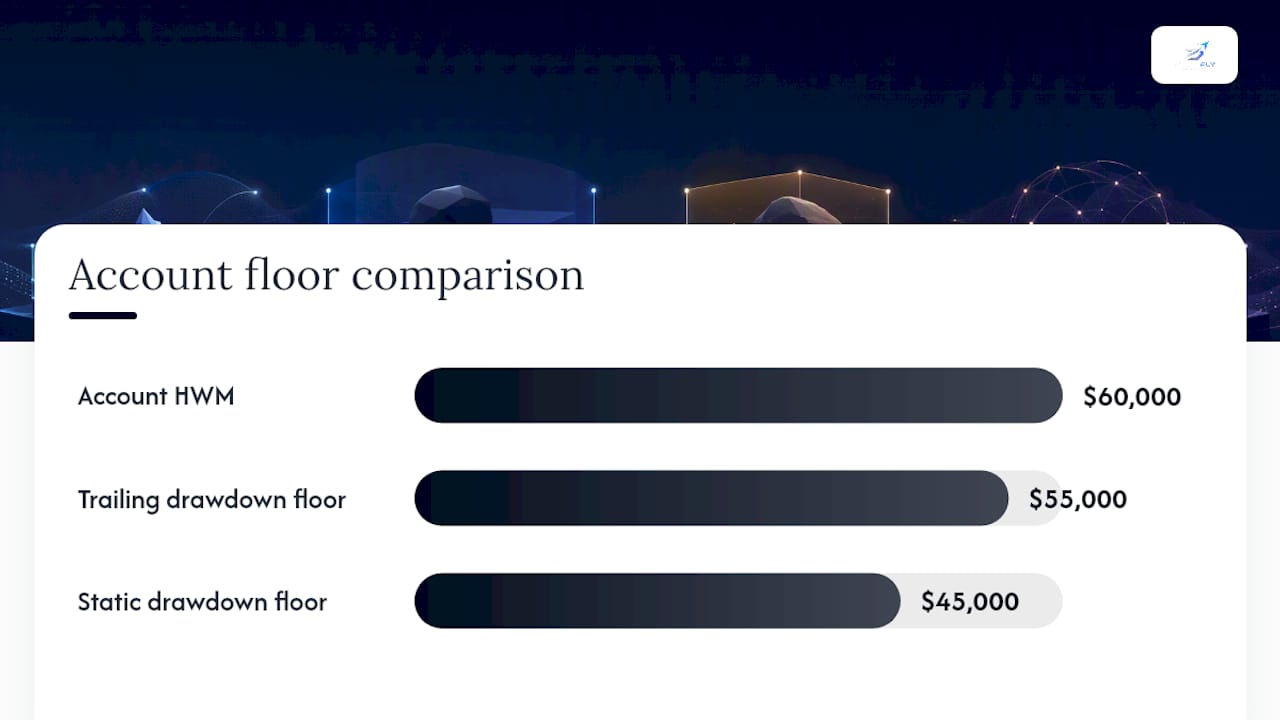
Static max drawdown sets a floor once at account inception and never moves it. A $50,000 account with a $5,000 static drawdown always has a floor of $45,000, regardless of how much profit the account accumulates. The cushion widens as profits grow.
Trailing max drawdown tightens the cushion after every new profit peak. A $50,000 account that grows to $60,000 under a $5,000 trailing rule now has a floor of $55,000, not $45,000. Every new high-water mark permanently reduces the room available for pullbacks.
Trailing stop orders are order-level execution tools. They follow a single position's price and trigger an exit when price reverses by the specified amount. They have no direct relationship to account equity or the HWM. A trailing stop on a futures contract protects that contract's unrealized gain; it does nothing to prevent the account from accumulating losses across multiple positions simultaneously.
The practical consequence: a trader running five positions with trailing stops on each can still breach an account-level trailing drawdown if all five positions lose simultaneously. Account-level and position-level controls are complementary, not interchangeable.
Pro Tip: Always layer both controls. Set position-level trailing stops to limit per-trade loss, and set account-level drawdown alerts at 50% and 75% of the buffer to trigger a manual or automated risk reduction before the floor is threatened.
Concrete controls to avoid breaching the trailing floor
1. Size positions from the buffer backward
Determine the maximum per-trade dollar risk by dividing the total buffer by the maximum number of simultaneous losing trades the strategy can produce. For a $2,000 buffer with a maximum of four concurrent positions, the per-trade risk ceiling is $500. Lot sizing follows from that figure, not from conviction or recent performance.
2. Place broker-side protective stops before entry
Platform-side risk rules can fail during disconnections or latency spikes. Broker-side stops reside at the brokerage and execute independently of the trading platform. For Tradovate users, this means placing the stop order directly through the broker's API, not relying solely on platform risk settings.
3. Implement daily P&L lockouts
Set a hard daily loss limit at roughly 40–50% of the total buffer. Once the limit is reached, all positions are closed and no new entries are permitted for the session. This prevents a single bad day from consuming the majority of the trailing cushion.
4. Monitor correlation across positions
Highly correlated positions (e.g., multiple equity index futures) can move against the account simultaneously, multiplying the effective per-session loss. Drawdown-constrained portfolio optimization research demonstrates that explicitly minimizing maximum drawdown in position construction produces materially better drawdown outcomes than variance-minimization alone.
5. Reduce size after a drawdown spike
When the account drops to within 30% of the floor, cut position size by at least half. This is not optional risk management — it is the mechanical response that keeps the account alive long enough to recover.
Pro Tip: After any session that consumes more than 20% of the remaining buffer, recalculate the per-trade risk ceiling before the next session opens. The buffer has changed; the sizing must change with it.
The following reference points are useful for calibrating monitoring thresholds:
| Buffer consumed | Recommended action |
|---|---|
| 0–30% | Normal operations |
| 30–50% | Reduce position size by 25% |
| 50–75% | Reduce position size by 50%, tighten stops |
| 75–100% | Close all positions, halt trading for session |
How to backtest and monitor trailing drawdown rules in live trading
Backtesting setup
A backtest that ignores intraday equity will understate breach risk for any strategy that holds positions through intraday volatility. The correct setup:
- Generate a tick-level or minute-level equity series that includes unrealized P&L on open positions, not just closed-trade P&L.
- Apply the firm's exact HWM update rule (EOD or intraday) to that series.
- Include commissions, slippage, and roll costs in every bar.
- Record the HWM, floor, and nearest-breach distance at each bar.
- Count the number of bars where equity came within 10% of the floor — this is the "near-miss" frequency, a more useful risk metric than the binary pass/fail.
Scenario testing
Run at least three stress scenarios before going live:
- Fast reversal: A position runs $X into unrealized profit (advancing the HWM under an intraday model), then reverses fully. Measure the floor impact.
- Gap open: An overnight gap moves against all open positions simultaneously. Measure whether the opening equity is above the floor.
- Multi-day drawdown sequence: Five consecutive losing sessions at the maximum daily loss limit. Confirm the account survives all five.
Live monitoring checklist
Stream these four metrics continuously during a session:
- Current equity (real-time)
- Current HWM
- Current floor (HWM minus buffer)
- Nearest-breach distance (current equity minus floor)
Set alerts at 50% and 25% of the remaining buffer. Automated mitigations — position reduction or full halt — should trigger at 25% without requiring manual intervention. Academic work on drawdown minimization confirms that the HWM-based framing locks in gains in a way that structurally increases breach probability after volatile profit runs, making continuous monitoring non-optional rather than precautionary.
How automation reduces hard-breach risk for Tradovate traders
The most common cause of a hard trailing breach is not a bad strategy. It is execution latency: the gap between the moment equity touches the floor and the moment the platform processes a risk-rule response. Under intraday trailing models, that gap can be measured in seconds, and a fast-moving futures contract can move several ticks further against the account in that window.
Broker-side protective stops eliminate most of that latency. Because the stop order resides at the brokerage, it executes independently of the trading platform's risk engine. A platform disconnection, a software crash, or a network interruption does not prevent the stop from firing.
For traders running multiple Tradovate accounts, the complexity compounds. Each account has its own HWM, its own floor, and its own breach threshold. Manual monitoring across accounts during active trading is operationally unreliable. SafeFly's multi-account mirroring automates trade replication from a lead account to all mirrored accounts and places broker-side protective stops on each position at entry, addressing both the latency problem and the multi-account coordination problem simultaneously.
The Karatzas et al. mathematical treatment of drawdown-constrained portfolio optimization establishes that optimal allocation under a drawdown floor requires continuous rebalancing relative to the current floor distance — a computational task that is impractical to perform manually across multiple accounts in real time.
Automation does not eliminate the risk of a trailing breach. It reduces the probability that a breach occurs due to factors unrelated to strategy performance — latency, human error, and coordination failures across accounts. Those are the preventable causes, and they are the ones that automation addresses most directly.
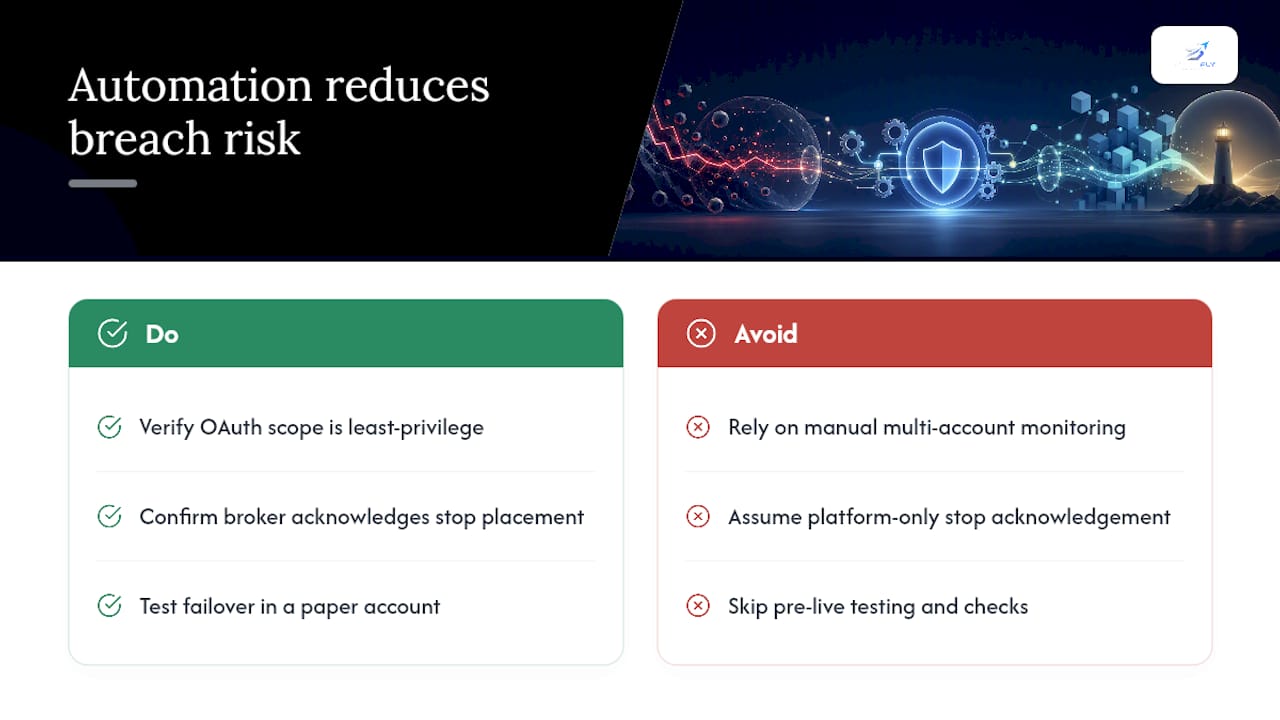
Pro Tip: Before going live with any broker-side stop automation, run a full pre-live checklist: verify OAuth credential scope is least-privilege, confirm stop placement is acknowledged by the broker (not just the platform), and test the failover behavior by simulating a disconnect during an open position in a paper account.
The SafeFly risk disclosure documents the platform's account-level controls and how broker-side stops interact with trailing drawdown enforcement, which is useful reading before configuring any automated risk system for a funded account.
Why professionals treat trailing rules as a strategy filter, not just a constraint
The conventional view frames trailing max drawdown as a risk control imposed on traders by prop firms. That framing is incomplete. For a professional, the trailing rule is a filter that determines whether a given strategy is compatible with a given account structure.
An intraday trailing model is structurally incompatible with any strategy that relies on holding positions through large unrealized drawdowns before they recover. The rule does not make the strategy worse; it makes the account unsuitable for the strategy. Accepting an intraday trailing account and then running a mean-reversion swing strategy is an operational mismatch, not a risk management failure.
EOD trailing models are more forgiving, but they introduce a different constraint: the HWM advances at session close, so a strong closing day permanently tightens the cushion even if the next session opens with a gap against the position. Swing traders on EOD accounts need to account for overnight gap risk in their sizing, not just intraday volatility.
The practical recommendation for professionals evaluating a new account: negotiate the account type before funding. Ask specifically whether the trailing model is EOD or intraday, whether the buffer locks at the starting balance, and how the firm reconciles deposits and withdrawals against the HWM. These are not administrative details — they are the parameters that determine whether the account is tradeable with a given strategy. When automation is available to place broker-side stops and enforce daily lockouts, intraday trailing accounts become more viable, because the preventable breach causes are removed from the equation.
— Arturo
SafeFly automates the controls that prevent trailing breaches
Traders managing multiple Tradovate accounts face a specific operational problem: every account has its own trailing floor, and maintaining broker-side protective stops across all of them manually during live trading is not reliable at the speed futures markets move.
SafeFly resolves this directly. The platform mirrors trades from a lead account to all connected accounts automatically, places broker-side protective stops on every position at entry, and enforces daily P&L lockouts that halt trading when the daily loss threshold is reached. Each connection uses secure OAuth integration, so credential exposure is minimized. Detailed trade analytics and AI-driven performance coaching give traders a clear view of where drawdown risk is accumulating across the account set.
For traders who want to evaluate the platform before committing, SafeFly offers a 3-day trial. Review the full feature set and subscription tiers at the pricing page, then start the trial to validate broker-side stop placement in a live Tradovate environment.
Sources
The sources below were used to build the recommendations in this article. Each covers a distinct layer of the topic: platform-level rules, practitioner guides, and formal academic treatment of drawdown-constrained optimization.
- Max Trailing Drawdown in Prop Firms: EOD, Intraday & Static Explained
- What Is Trailing Max Drawdown? Ultimate Guide | Audacity Capital
- Rules: Trailing Max Drawdowns / Risk Parameters Explained | Funded Futures Family Help Center
- Risk Settings - Trailing Max Drawdown
- Drawdown minimization / Encyclopedia of Quantitative Finance (Columbia Business School)
- The problem of portfolio optimization under the drawdown constraint / I. Karatzas et al. (Drawdown.pdf)
- Constrained Max Drawdown: a Fast and Robust Portfolio Optimization Approach
- Trailing stop definition and mechanics | Investopedia
This article is general information, not a substitute for advice from a qualified financial advisor. Consult a qualified financial professional about your own circumstances before acting on anything here.