

A daily profit target lockout is a rule, enforced by a platform or an automation tool, that halts trading once a session reaches a preset profit level. Its main benefit is straightforward: it protects gains by removing the decision to keep trading after a goal is met. Enforcement can come from native platform settings or from third-party automation layered on top.
TL;DR:
- A profit lockout can stop new trades immediately or send alerts, with session resets aligning to trading hours or fixed midnight times.
- Traders should set lockout targets based on account size or performance metrics and test them thoroughly in simulation before live use.
- Lockouts are most effective when integrated into a disciplined routine with pre-planned targets and consistent journaling of triggered sessions.
- Broker-side lockouts enforce rules regardless of terminal used and are easier to manage across multiple accounts with automation tools like SafeFly.
- Lockouts alone do not address poor strategy, sizing issues, or weak edges, so ongoing review and adjustment are essential for risk management.
Table of Contents
- What a daily profit target lockout actually does
- Why disciplined traders use profit lockouts
- What happens when a lockout triggers
- How profit lockouts differ from daily loss limits
- Setting a target size and testing it before going live
- Making lockouts stick as part of a trading routine
- How SafeFly automates lockouts across multiple accounts
- Where lockouts fall short
- SafeFly's approach to automated lockouts
- Sources
- FAQ
What a daily profit target lockout actually does
A lockout can be hard or soft. A hard lockout blocks new order entry once the target is hit. A soft lockout only sends a notification, leaving the decision to the trader, which defeats much of its purpose for anyone prone to overtrading after a win.
Lockouts also differ in scope. A session-scoped lockout resets at the start of each trading session, which matters for futures markets that trade nearly around the clock across time zones. A calendar-day lockout resets at midnight in a fixed time zone, which can split an overnight session in half if the reset falls mid-trade.
- Hard lockouts stop new orders; soft lockouts only alert the trader.
- Session-scoped resets align with the futures trading day; calendar-day resets use a fixed clock time.
- P&L basis matters: realized P&L, net P&L after fees, and open-position P&L can each produce a different trigger point.
A related primer on futures day trading lockouts covers the mechanics of daily profit limits in more depth.
Why disciplined traders use profit lockouts
Giveback is the pattern where a trader books a solid gain early in the session, then loses it back through added risk later. It often follows a "house money" bias: profits feel less real than the original account balance, so the trader risks them more loosely. A lockout removes the opportunity to make that mistake by ending the session at the high point.

Regulatory and exchange materials reinforce why this guardrail matters. The CFTC's report on retail futures trading found that larger dollar losses on a trader's first trades are associated with leaving the market altogether, which points to the value of controls applied early and consistently rather than after damage is done.
A trader should consider a lockout when any of the following apply:
- Trading history shows repeated giveback after a strong start to the session.
- Multiple accounts are traded at once, raising the cost of a single lapse in attention.
- Sizing decisions tend to grow impulsively after a win rather than follow a plan.
Exchange education frames risk management as part math, part behavior: CME Group's trade and risk management course treats external guardrails like lockouts as compensation for predictable discipline breakdowns after a win, not as optional extras.
What happens when a lockout triggers
Platform behavior at the trigger point varies by vendor, but most systems follow a similar sequence.
- The session locks for new trades, meaning no fresh orders can be submitted.
- Open orders are typically canceled to prevent accidental fills after the target is reached.
- Open positions may be closed automatically, depending on how the lockout was configured, or left open under existing stops.
- The lockout holds until the next scheduled reset, usually tied to session start rather than a fixed calendar time.
The platform-only versus broker-side distinction matters here. A platform-only lockout enforces the rule within that software, but if a trader places an order through a different terminal connected to the same account, the lockout may not catch it. A broker-side implementation enforces the rule at the account level regardless of which terminal is used. For traders running several accounts, that distinction decides whether a lockout actually holds under pressure. More detail on triggers and resets is covered in the guide to futures day trading lockouts.
How profit lockouts differ from daily loss limits
A profit lockout and a daily loss limit serve opposite but complementary purposes. The profit lockout protects gains already made; the loss limit caps how much the account can give up on a bad day. Trailing drawdown rules and per-trade stops round out a full risk stack, each addressing a different failure mode.
- Profit lockouts: stop trading after a win to prevent giveback.
- Daily loss limits: stop trading after a loss threshold to prevent a bad day from compounding.
- Per-trade stops: cap risk on any single position regardless of the day's running total.
Traders who want the loss side of this equation can review daily loss limits for funded traders for a parallel framework. In practice, the profit side and the loss side should be configured together rather than treated as alternatives.
Setting a target size and testing it before going live
Choosing a lockout level is a sizing problem, not a guess. Three common methods work well in practice.
- Fixed dollar amount: set a flat target based on account size and typical daily range, revisited periodically as the account grows.
- Percent of equity: scale the target to account balance so it adjusts automatically as equity changes.
- Multiple of average trade or average daily range (ADR): base the target on recent trade performance, such as a set multiple of the average winning trade.
CME Group's explanation of the 2% rule offers a comparable heuristic for per-trade sizing that can inform how conservative a profit target should be relative to account risk.
Before relying on a lockout in live trading, run through this checklist: define the session window and its reset time, choose the P&L basis (realized or net of fees), decide between hard and soft enforcement, and run the rule in simulation across several sessions to confirm it triggers as expected. Account for slippage, commissions, and any platform-specific delay between the trigger and the actual order cancellation.
Pro Tip: Test a new lockout level on a simulated account for at least a week before applying it to live capital; targets that look reasonable on paper often trigger earlier or later than expected once real fills and fees are added.
For traders configuring these rules directly in a trading platform, TradingView's risk management setup guidance covers the technical side of building and testing such controls.
Making lockouts stick as part of a trading routine
A lockout only works if it is treated as a fixed rule rather than a suggestion. Writing the target into a session plan before the market opens removes the temptation to renegotiate it mid-session, when judgment is least reliable.
- Put the profit target and the loss limit in writing as part of a pre-market session plan.
- Keep per-trade protective stops active at all times, even when a lockout is also running. One does not replace the other.
- Log every locked session, including the time it triggered and the account balance at that point, then review the log weekly to refine sizing.
Pro Tip: Review locked sessions alongside sessions where the target was never reached. If the gap between the two is wide, the target is likely set too conservatively for current performance.
Psychology resources on staying disciplined after a winning streak, such as forex trading psychology guidance, echo the same point: the hardest discipline test often comes right after a good result, not a bad one.
How SafeFly automates lockouts across multiple accounts
Manually enforcing a profit lockout across several Tradovate accounts is hard to do consistently, which is where automation changes the equation. SafeFly mirrors trades from a lead account to additional accounts and applies a protective stop to every copied trade automatically.
- Daily profit and loss lockouts can apply across multiple connected accounts at once rather than individually.
- Protective stops placed at the broker level remain in effect even if the trading platform disconnects.
- OAuth connections link accounts securely without storing broker passwords.
The broker-side distinction is the practical advantage over a platform-only lockout: a stop or lockout enforced at the broker level holds regardless of which terminal is used to attempt a new order. Details on how the mirroring and stop placement work are on the how it works page. A related explanation of how automation addresses revenge trading after a win covers the same mechanism from the behavioral side.
Where lockouts fall short

A lockout protects the session you already had. It does nothing to fix a strategy with a weak edge or a position size that is wrong for the account. Traders sometimes treat a lockout as a substitute for reviewing why a system wins or loses, which misses the point of the tool entirely.
Lockouts work best alongside, not instead of, ongoing review of trade quality, sizing logic, and journal data. Test changes incrementally and let the data decide what the next target should be.
— Arturo
SafeFly's approach to automated lockouts
SafeFly applies daily profit and loss lockouts automatically across every Tradovate account connected to a lead account, with protective stops placed broker-side so they hold through disconnections. Setup runs through a secure OAuth connection with no local software to install.
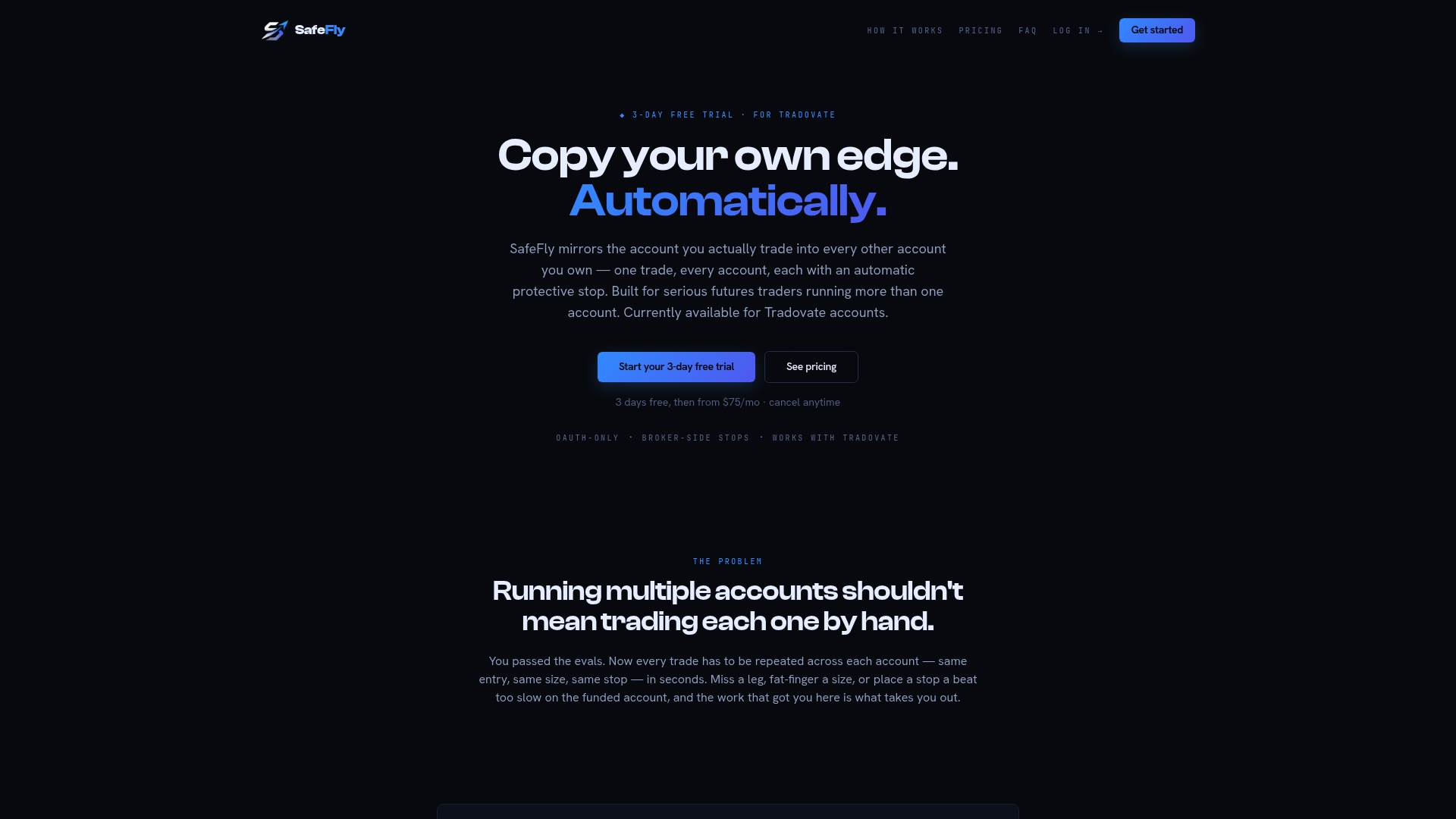
Plans are listed on the pricing page with tiered monthly subscriptions: Basic, Pro, and Ultra, the last of which adds a dealer gamma-exposure screener. Review the how it works page for setup details before starting a trial.
Sources
For background on retail trading risk, see the CFTC's retail futures report, the SEC's day trading guidance, and CME Group's risk management education.
This article is general information, not a substitute for advice from a qualified financial advisor. Consult a qualified financial professional about your own circumstances before acting on anything here.
FAQ
Is it possible to make $200 a day day trading?
It depends entirely on account size, strategy, and risk tolerance rather than being a fixed outcome. The SEC's guidance on day trading warns that early losses are common, so any daily target should be sized to the account rather than set as a flat goal.
What is the 3-5-7 rule in day trading?
Definitions of this rule vary across trading communities and it is not defined by a regulator or exchange, so there is no single authoritative version.
Can I lock my Tradovate account for the day?
Lockout availability depends on the specific settings or third-party tools connected to the account rather than a single universal feature. Automation platforms that integrate with Tradovate, such as SafeFly, can apply daily profit and loss lockouts across connected accounts through a secure OAuth connection.
Is it possible to make $1,000 a day day trading?
This depends on account size, position sizing, and market conditions, and it is not a realistic baseline for most accounts. The CFTC's report on retail futures trading found that larger early losses are linked to traders leaving the market, which argues for sizing targets to account risk rather than a fixed dollar figure.