
The fastest way to stop revenge trading is a non-negotiable lockout, ideally one that enforces itself automatically instead of relying on willpower. Some trading tools can trigger this through daily profit-and-loss limits and broker-side stops. The rest of this article lays out the exact thresholds, cooldown periods, and re-entry rules that make a lockout hold under pressure.
TL;DR:
- Lockouts should be automated, based on specific thresholds such as two consecutive losses or a set daily loss percentage, to prevent impulsive decisions.
- A 24-hour ban or cooldown is crucial after rule-breaking sessions, with half-position re-entries to limit risk once trading resumes.
- External enforcement tools, like platform alerts, auto-flatten features, and external blockers, significantly reduce the chance of rule violations during emotional moments.
- Traders who log lockout triggers, emotions, and follow strict re-entry checklists tend to recover from setbacks faster and avoid repeat violations.
- Combining system-based lockouts with coaching, accountability partners, and written protocols creates a robust defense against revenge trading patterns.
Table of Contents
- What Revenge Trading Is and How to Spot It
- Why Lockouts Work: The Neuropsychology and the Cascade Problem
- Actionable Lockout Protocols Traders Can Use Right Now
- How to Implement Enforcement: Manual Steps and Automation Options
- How to Bake the Lockout Into Your Trading Plan and Session Routine
- How SafeFly Operationalizes Lockouts for Multi-Account Futures Traders
- Examples of Lockout Protocols Working in Practice
- Where Counseling and Coaching Fit Into Recovery
- Common Pitfalls That Cause Relapse After a Lockout
- Why Systems Beat Willpower After a Bad Session
- Let SafeFly Enforce the Lockout So You Don't Have To
- Sources
What Revenge Trading Is and How to Spot It
Revenge trading is the attempt to recover a loss immediately, using a decision-making process that the loss itself has already degraded. It is not simply "trading angry." It is a specific failure pattern: the goal shifts from following your edge to getting back to even, and every subsequent choice bends toward that distorted objective. That shift in intent, more than the emotion itself, is what separates a bad trade from a revenge trade.
The behavioral signature is recognizable in real time if you know what to look for:
- Re-entering a position within seconds or minutes of a stop-out, with no new setup.
- Increasing size on the next trade instead of keeping it constant or reducing it.
- Skipping or widening a stop-loss "just this once."
- Trading a symbol that was never on your watchlist that morning.
- Rushing to place one more trade before the session or the market close.
A single bad trade rarely stays single. A trader who loses $400 on a planned setup, then doubles size to "make it back," then doubles again after that fails, can turn one loss into a five-figure drawdown inside twenty minutes. The cascade from one loss to ten trades is a well-documented pattern, not a personal failing unique to undisciplined traders.
Why Lockouts Work: The Neuropsychology and the Cascade Problem
A loss triggers a real physiological stress response. Cortisol rises, the amygdala becomes more reactive, and the prefrontal cortex, the part of the brain responsible for weighing risk and delaying gratification, becomes measurably less effective at doing its job. Behavioral finance research has long shown that emotional arousal systematically distorts financial judgment, and trading losses are one of the more reliable triggers for that arousal.
This creates a specific mechanical problem. Each trade after a loss is evaluated by a slightly more impaired version of the same decision-maker who just lost money. The second trade is judged worse than the first would have been. The third is judged worse than the second. Position size tends to climb precisely as judgment quality falls, which is the opposite of what good risk management requires.
This is why asking a trader to "just have more discipline" in the moment is asking the wrong person to solve the wrong problem. The rational, rule-following self that wrote the trading plan is not the self that's active fifteen minutes after a $2,000 loss. External enforcement works because it does not depend on the impaired self choosing to behave. A lockout that fires automatically, whether from a broker setting or a platform-side detection system, removes the decision from the person least equipped to make it well at that moment.
Actionable Lockout Protocols Traders Can Use Right Now
A protocol only works if it's written down before you need it and enforced without exception once you do. Here are five rules worth adopting, in rough order of how often they'll fire:
- Two consecutive losses ends the session. This is the single most cited kill-switch rule in practitioner guides, and for good reason: two losses in a row is an early, reliable signal that either the market regime or your own state has shifted.
- Daily max loss set at a small fixed percentage of your account equity appropriate for your risk tolerance. Tie the number to your actual per-trade risk. If you risk 0.5% per trade, a 2% daily cap gives you roughly four losing trades before the day is over, which is enough room for normal variance without enough room for a spiral.
- A 24-hour lockout after a genuine blow-up. Reserve this for sessions where you broke your own rules, not just lost money on a valid setup. Losing within your plan is trading. Losing while ignoring your plan is the trigger.
- A mandatory cooldown period for any flagged session, typically lasting several hours to allow emotional recovery., even one that doesn't hit the daily max but shows the behavioral red flags from the section above.
- A half-size comeback rule. When you're cleared to trade again, the first session back runs at half your normal position size, regardless of how confident you feel.
Thresholds should scale to your account and your normal per-trade risk, not to an arbitrary percentage copied from someone else's plan. What matters is that the number is fixed in advance and never adjusted mid-session.
The behavior during the lockout matters as much as the trigger itself. Practitioner guidance consistently recommends a short written re-entry checklist, a mandatory period of physical activity away from the screen, and a hard rule against opening charts until the cooldown timer expires.
Pro Tip: Write your kill-switch thresholds on a sticky note on your monitor, not just in a settings menu. The friction of seeing the number in your own handwriting during a loss adds a beat of pause that a buried setting doesn't.
How to Implement Enforcement: Manual Steps and Automation Options
Rules that live only in your head get broken. Rules that live in a system you can't easily override tend to hold. Start with whatever your trading platform already offers:
- Daily loss alerts that push a notification once you hit a preset dollar or percentage threshold.
- Account-level caps that block new order entry once the daily max loss is reached.
- Auto-flatten features that close all open positions the moment a limit is hit, rather than just alerting you.
- Order-blocking settings that require a manual override step, adding friction to impulsive re-entry.
If your platform doesn't offer native enforcement, layer in outside tools. Screen-time blockers and app-limit features on your device can lock you out of your trading platform for a set window. Some traders go further and physically disconnect, closing a laptop and handing a phone to a partner for the length of the cooldown. It sounds extreme until you've watched someone try to "just check one chart" turn into another open position twelve minutes later.
The most reliable setups combine three layers: an automatic alert, an automatic block or flatten action, and a human accountability check, whether that's a trading buddy, a coach, or a scheduled check-in call. Removing any one layer gives your impaired decision-maker a gap to work through. Combining alerts with automated blocking and human accountability is exactly the layered approach risk-management practitioners recommend, and it's also the logic behind automated risk rules built for multi-account setups.
How to Bake the Lockout Into Your Trading Plan and Session Routine
A lockout rule that exists only as an intention isn't a rule. Write it into your trading plan document with the same specificity you'd use for an entry strategy: the exact trigger (two losses, a dollar amount, a specific behavior), the exact consequence (session ends, account locks for 24 hours), and the exact re-entry condition.
Your session journal should capture four fields every time a lockout fires: the trigger that caused it, an emotion rating from one to ten, whether you actually adhered to the rule or fought it, and one corrective step for next time. This turns every stopped-out session into data instead of just a bad memory.
Re-entry deserves its own short checklist, filled out in writing before the next trade goes live: What's the exact entry, stop, and size? What's the risk-to-reward ratio? Is the size cut to half of normal? And the single most useful question a trader can ask themselves: "Would I take this trade if I hadn't lost anything today?" If the honest answer is no, the setup isn't the problem. The rule for preventing overtrading across accounts works on the same logic: friction and a written check beat a mental promise every time. An accountability partner who has to approve your re-entry checklist before you're cleared to trade adds a layer that's much harder to talk your way around alone.
How SafeFly Operationalizes Lockouts for Multi-Account Futures Traders
Written protocols only hold up if something enforces them when you're least able to enforce them yourself. Certain platforms build that enforcement directly into the account, rather than leaving it to a setting you have to remember to check.
Daily profit-and-loss lockouts sit at the core of the system: once an account hits its preset limit, SafeFly auto-flattens open positions, blocks new order placement, and logs the event for review. Because the platform mirrors trades from a lead account across every linked Tradovate account, that enforcement applies everywhere at once instead of requiring a trader to manually check and lock each account individually.
Broker-side protective stops add a second layer. Every mirrored trade carries its own stop at the broker level, which means a position stays protected even through a disconnection, not just a dropped app or a closed laptop. Connections through secure OAuth links can keep account access controlled without manual credential sharing across accounts. Detailed trade analytics and AI-driven coaching can turn each locked-out session into a reviewable data point, supporting journaling discipline built into the account rather than tracked separately.
Examples of Lockout Protocols Working in Practice
Consider a trader running three funded futures accounts who loses on a valid morning setup, then loses again fifteen minutes later after widening a stop "just to give it room." Under a two-consecutive-loss kill switch, the session ends there. Without one, the same trader's own account history shows what typically happens next: a third trade at double size, a fourth at triple, and a drawdown that erases two weeks of gains in under an hour.
The traders who avoid that outcome tend to share one habit: they treat the lockout as an event to log, not a punishment to argue with. A trader hitting a daily max-loss cap writes down the trigger and the emotional state at the time, closes the platform, and does something physical, a walk, a workout, anything that isn't a screen, until the cooldown clock runs out. That gap does real work. Cortisol clearance for a routine loss generally settles within twenty to thirty minutes, but a genuine spiral, the kind involving broken rules and outsized losses, needs hours, sometimes a full day, before judgment returns to baseline.

The pattern that separates a contained bad day from a account-blowing week is almost always the same: the lockout fired before the third trade, not after the tenth. Traders who set thresholds in advance and let an automated system enforce them consistently report shorter, cheaper bad days than traders relying on in-the-moment self-control. The rule doesn't need to be complicated to work. It needs to fire on time.
Where Counseling and Coaching Fit Into Recovery
A lockout stops the bleeding for one session. It doesn't address why the bleeding started, and that's where outside support earns its place. If revenge trading shows up repeatedly rather than once in a while, that's a pattern worth examining with someone trained to spot it, not just a habit to white-knuckle through alone.
A trading coach who reviews your journal entries, not just your P&L, can often spot the trigger pattern faster than you can, because they're not the one whose decision-making was impaired at the time. Coaches who specialize in trading psychology tend to focus on the gap between your written plan and your actual execution, which is exactly where revenge trading lives. That's a different service than a strategy coach who only reviews entries and exits.
For traders where the loss-chasing pattern connects to broader anxiety, compulsive behavior, or difficulty regulating emotion outside of trading too, a licensed counselor or therapist is worth involving. Trading psychology and clinical mental health aren't the same field, and a coach isn't a substitute for one when the pattern runs deeper than the charts. There's no shame in treating a recurring revenge-trading pattern the same way you'd treat any other behavior that keeps overriding your own stated intentions: as something worth getting outside help with, rather than something to solve through sheer effort on the next attempt.
Accountability doesn't have to be clinical to help. A trading buddy who has to see your re-entry checklist before you're cleared to trade again adds real friction, and friction is often the entire point.
Common Pitfalls That Cause Relapse After a Lockout
The most common failure isn't ignoring the lockout. It's honoring it once and then quietly loosening the rule the next time it's inconvenient. A trader who follows a 24-hour lockout perfectly after one blow-up, then talks themselves into a "special exception" during the next one, hasn't built a system. They've built a suggestion.
Watch for these specific relapse patterns:
- Threshold creep. Raising the daily loss cap after a string of profitable weeks, on the logic that "I've earned more room," right before the account needs the tighter limit most.
- Cooldown shortening. Cutting a four-hour cooldown down to twenty minutes because the market "looks too good to sit out," which is precisely the thought pattern the rule exists to override.
- Re-entry without the checklist. Skipping the written entry, stop, size, and reward check because the setup "feels obvious," which is the same feeling that preceded most past revenge trades.
- Treating one clean week as proof the problem is solved, then dropping the accountability check that made the clean week possible in the first place.
The fix for all four is the same: automate what you can, so the rule doesn't depend on your mood that day, and review your journal weekly, not just after a bad session, so drift shows up before it becomes a pattern again. A rule you can quietly renegotiate in the moment isn't a circuit breaker. It's a suggestion with extra steps.
Why Systems Beat Willpower After a Bad Session
The conventional advice, "just be more disciplined," gets the sequence backward. Discipline is what you have before a loss. It's largely gone in the fifteen minutes after one. Betting a trading account on willpower recovering fast enough to stop a cascade is a bet against your own physiology, and physiology tends to win.
The traders who handle bad sessions well aren't more disciplined than everyone else. They've simply moved the decision earlier, into a calm moment when a rule can be written clearly, instead of leaving it for the exact moment they're least equipped to make it. After a rough session, a short walk away from every screen, followed by writing down what actually happened, tends to do more for the next day's trading than any amount of resolve summoned in the moment itself.
Build the rule when you're calm. Let something outside your own judgment enforce it when you're not.
— Arturo
Let SafeFly Enforce the Lockout So You Don't Have To
Some platforms are built for the exact moment a written protocol needs to become automatic: mirroring trades across linked Tradovate accounts, applying broker-side protective stops, and enforcing daily profit-and-loss lockouts so a losing session can't quietly become a losing week.
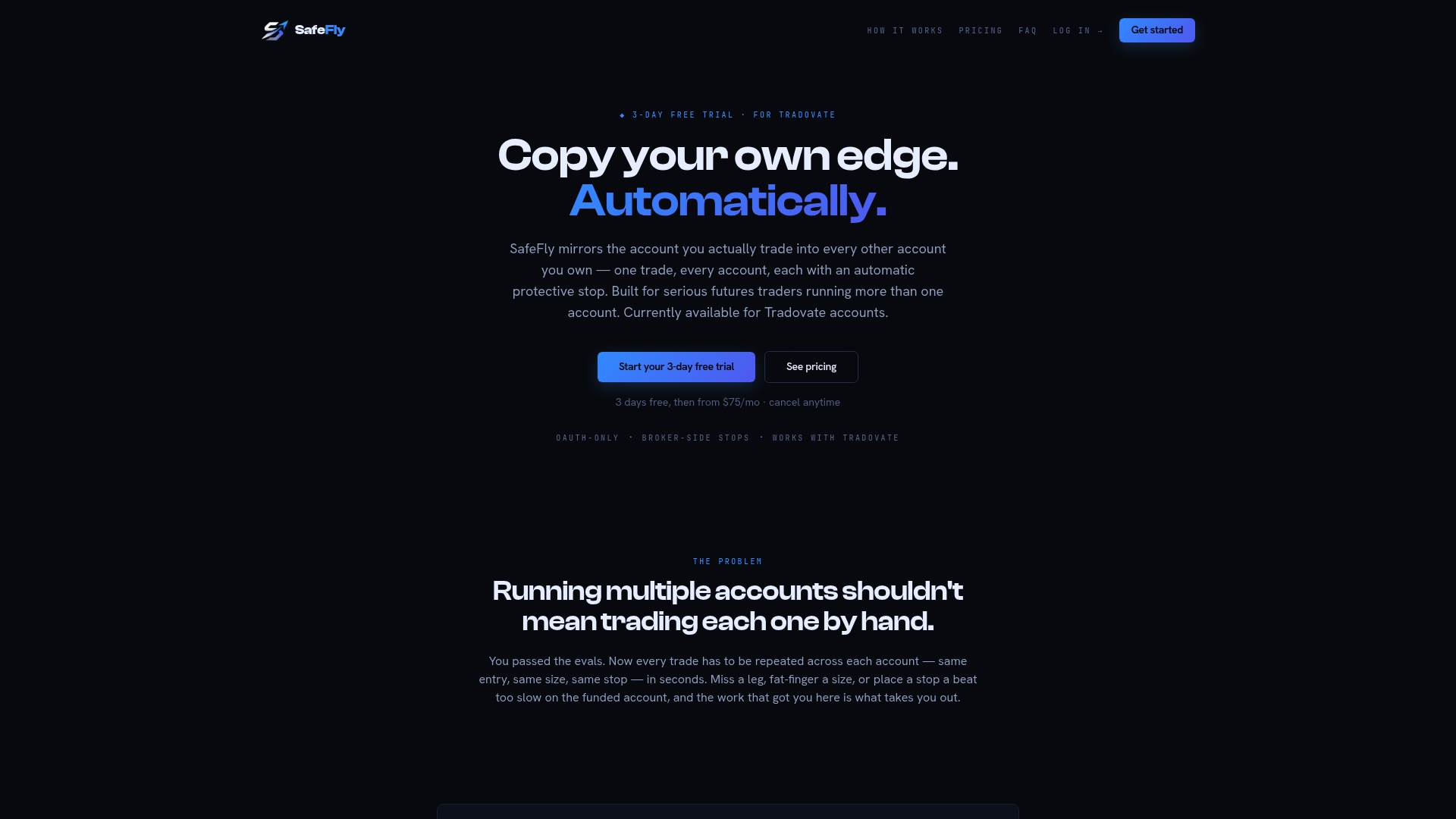
Instead of manually checking multiple accounts for a threshold breach, or trusting yourself to close the platform after two losses, SafeFly auto-flattens positions and blocks new orders the moment a preset limit is hit, then logs the event for your own review. Secure OAuth connections keep account access controlled without shared credentials, and built-in trade analytics turn every locked-out session into something you can actually learn from instead of just survive. See exactly how the enforcement works on the SafeFly product walkthrough, and start a trial to put a real circuit breaker between you and your next bad session.
Sources
- Behavioral finance definition and overview — Investopedia
- One loss becomes ten trades — EmotionLock
- Revenge trading psychology and practical defenses — TrailingStopLoss