

A stop loss can still protect you during a disconnect, but only if the order was already accepted by the broker or exchange server before the connection dropped. A stop sitting only in your local trading app's interface, unacknowledged by the server, is not a working order. Whether it holds also depends on order type and whether the venue's Cancel on Disconnect feature is configured to cancel or preserve it.
TL;DR:
- Stop orders must be accepted and acknowledged by the broker server before they provide protection; displaying in your app alone is not enough.
- Stop-market orders can fill at unpredictable prices during fast or gapping markets, creating significant slippage, especially overnight.
- Cancel on Disconnect settings vary by venue and may not cover all order types or automatically restore canceled orders after reconnection.
- Relying solely on visual confirmation in the trading app is risky; verification through order IDs and acknowledgment timestamps is critical for protection.
- SafeFly operates in the cloud to enforce broker-side stops per account, offering recording and confirmation that can reduce disconnect-related losses across multiple accounts.
Table of Contents
- Stop Loss on Disconnect: How Stop-Market and Stop-Limit Orders Behave
- Cancel on Disconnect: What Exchanges Actually Do When You Drop
- Broker-Side Stops and the Race Between Entry and Protection
- A Practical Checklist for Reducing Disconnect Risk
- How SafeFly Reduces Disconnect Risk Across Multiple Accounts
- Why Verification Beats Optimism in Automated Trading
- Get Server-Side Stop Protection With SafeFly
- Sources
- FAQ
Stop Loss on Disconnect: How Stop-Market and Stop-Limit Orders Behave
The order type you choose determines what happens once a stop triggers, disconnect or not. A stop-market order converts to a plain market order the instant your trigger price is touched, and it will fill at whatever price the market offers next. FINRA's guidance on stop orders states plainly that execution can differ materially from the stop price once that conversion happens, particularly in fast or thin markets.
A stop-limit order behaves differently. It converts to a limit order at your specified price, which protects you from a runaway fill but introduces a new risk: if the market gaps past your limit, the order sits unfilled while price keeps moving away from it.
Pro Tip: If you trade overnight futures sessions, treat every stop-limit as conditional protection. A limit order guarantees price, never execution.
Two scenarios show the gap in real terms:
- Overnight gap down: An equity index gaps 40 points below your stop-market trigger at the open. The order fills near the gap price, not your intended stop level, producing far larger slippage than expected.
- Rapid intraday move: A futures contract spikes through your stop-limit price in seconds during a news release. The limit order never fills, and you carry the full position through the reversal.
Investor makes the same point for retail accounts: a triggered stop is a promise to trade, not a promise of price. That distinction becomes critical the moment you lose your connection and can't intervene.
Cancel on Disconnect: What Exchanges Actually Do When You Drop
Cancel on Disconnect, usually shortened to CoD, is an exchange or gateway feature that automatically cancels certain resting orders when it detects an involuntary loss of connectivity. It is not universal, and it is not automatically comprehensive across every order you have working.
CME Group's Cancel on Disconnect documentation describes several caveats every futures trader should check before assuming protection:
- CoD typically cancels session or trader-tagged resting orders, not necessarily every order type on the account.
- Good-Til-Canceled and Good-Til-Date orders can be excluded from cancellation on some venues, meaning they may survive a disconnect when you expected otherwise.
- A cancellation request can arrive Too Late to Cancel if the exchange already matched a fill on the host side before your disconnect was detected.
Detection itself relies on a few signals: an abrupt TCP connection closure, a missed heartbeat sequence, or a session displacement when a second login takes over. Deribit's Cancel on Disconnect documentation explains that CoD is opt-in per order or per session on many platforms, and that it doesn't restore your canceled orders automatically after you reconnect. You have to resubmit and reapply your flags manually.
Before you rely on CoD for anything, confirm in your platform's connection settings whether your specific session, order type, and time-in-force are actually covered.
Broker-Side Stops and the Race Between Entry and Protection
The order you see displayed in your trading app is not proof of protection. What matters is whether the broker or exchange server has actually acknowledged and accepted that stop order. Client-side state can show a stop as "working" when the server has rejected it, never received it, or is still processing it. That gap is where most disconnect-related losses actually happen.
A second failure mode is the race between entry and stop. In many automated setups, the entry order fills first, and the protective stop is submitted as a separate message afterward. If the connection drops in that window, you can end up with a live, unprotected position and no way to know it until you reconnect.

This gets worse across multiple accounts. If you mirror trades from a lead account to several others, an accepted stop on the lead account tells you nothing about whether the mirrored accounts received and acknowledged their own stops. NinjaTrader's connection loss handling documentation shows how strategy-level settings like KeepRunning, Recalculate, or StopStrategy can behave differently depending on disconnect duration, which adds another variable when you're running the same logic across accounts.
Three operational habits close most of that gap:
- Record the order ID and acknowledgment timestamp for every stop, on every account, not just the lead.
- Flag any account where the stop's "working" status hasn't been confirmed within a defined time window.
- Halt further mirroring the moment one account diverges from the others until the divergence is resolved.
Pro Tip: A stop you can't confirm with an order ID and an ACK timestamp is a hope, not a hedge.
A Practical Checklist for Reducing Disconnect Risk
Reducing your exposure to disconnect failures comes down to what you set up beforehand, what you monitor during the session, and what you audit afterward.
Before you trade:
- Require server-side stop acceptance before treating any position as protected, and verify your broker actually confirms this rather than just displaying it.
- Enable Cancel on Disconnect where the venue offers it, and check whether it covers your specific order types and time-in-force settings.
- Use bracket or OCO orders where your broker supports them, since these submit entry and protection as a linked unit rather than sequential messages.
- Confirm your platform's default heartbeat and session timeout settings; the defaults are not always conservative enough for your risk tolerance.
During the session:
- Monitor session heartbeats and set alerts for missing acknowledgments or rejected orders, not just filled ones.
- Build automation, even simple scripts, that can mass-cancel or flatten positions the instant a required stop shows as unconfirmed.
After you reconnect:
- Audit every fill and cancellation that occurred during the outage before resubmitting anything.
- Resubmit orders only after confirming current market conditions, not the conditions that existed when you disconnected.
- Log the incident, including timestamps and what failed, so the pattern is documented for the next review.
One sizing note matters here: the widely repeated 7% stop-loss rule was never designed as connectivity protection. Position size should account for realistic slippage on a stop-market fill, not just distance to an arbitrary percentage. Mass Cancel and Cancel on Disconnect work best as complementary tools, a deliberate mass-cancel message alongside the exchange's automatic disconnect handling, rather than relying on either alone.
How SafeFly Reduces Disconnect Risk Across Multiple Accounts
SafeFly was built around the operational failure modes described above, specifically for traders running multiple Tradovate accounts through trade mirroring. Every trade mirrored from a lead account carries a protective stop that must be accepted broker-side before the mirroring proceeds, and SafeFly records the acknowledgment for each individual account rather than assuming one confirmation covers the group.
That per-account verification matters because a lead account's accepted stop tells you nothing about whether a mirrored account's stop was actually acknowledged, as the earlier section on the entry-stop race explains in detail.
SafeFly's approach includes:
- Broker-side protective stops enforced before trades propagate to mirrored accounts.
- Daily profit and loss lockouts that stop new trading once a defined threshold is hit.
- Cloud-based operation with no local software dependency that can fail alongside a local connection drop.
- Recorded order state per account, so a missing acknowledgment is visible rather than assumed.
Traders who want the deeper mechanics behind server-side stop enforcement can review SafeFly's write-up on requiring server-side stops before any order and its breakdown of disconnection trade protection for multi-account setups.
Why Verification Beats Optimism in Automated Trading
Most disconnect losses trace back to one habit: trusting what the screen shows instead of what the server confirmed. An order display is not an acknowledgment, and a working flag you haven't verified is a guess dressed up as a fact.
Good trading operations aren't built to maximize returns under perfect conditions. They're built to minimize the damage when conditions aren't perfect, which is most of the time. That means writing a mass-cancel policy before you need it, not while your account is unprotected and you're staring at a dead connection.
Treat every automated system, whether it's a single account or ten mirrored ones, as a chain of acknowledgments. The chain is only as strong as its weakest unconfirmed link.
— Arturo
Get Server-Side Stop Protection With SafeFly
SafeFly is built specifically for futures traders running multiple Tradovate accounts who need every mirrored trade to carry a confirmed, broker-side protective stop, not just a stop that looks active on screen. Where manual replication leaves you guessing whether a stop was accepted on every account, SafeFly records that acknowledgment per account and pairs it with daily profit and loss lockouts to cap downside automatically.
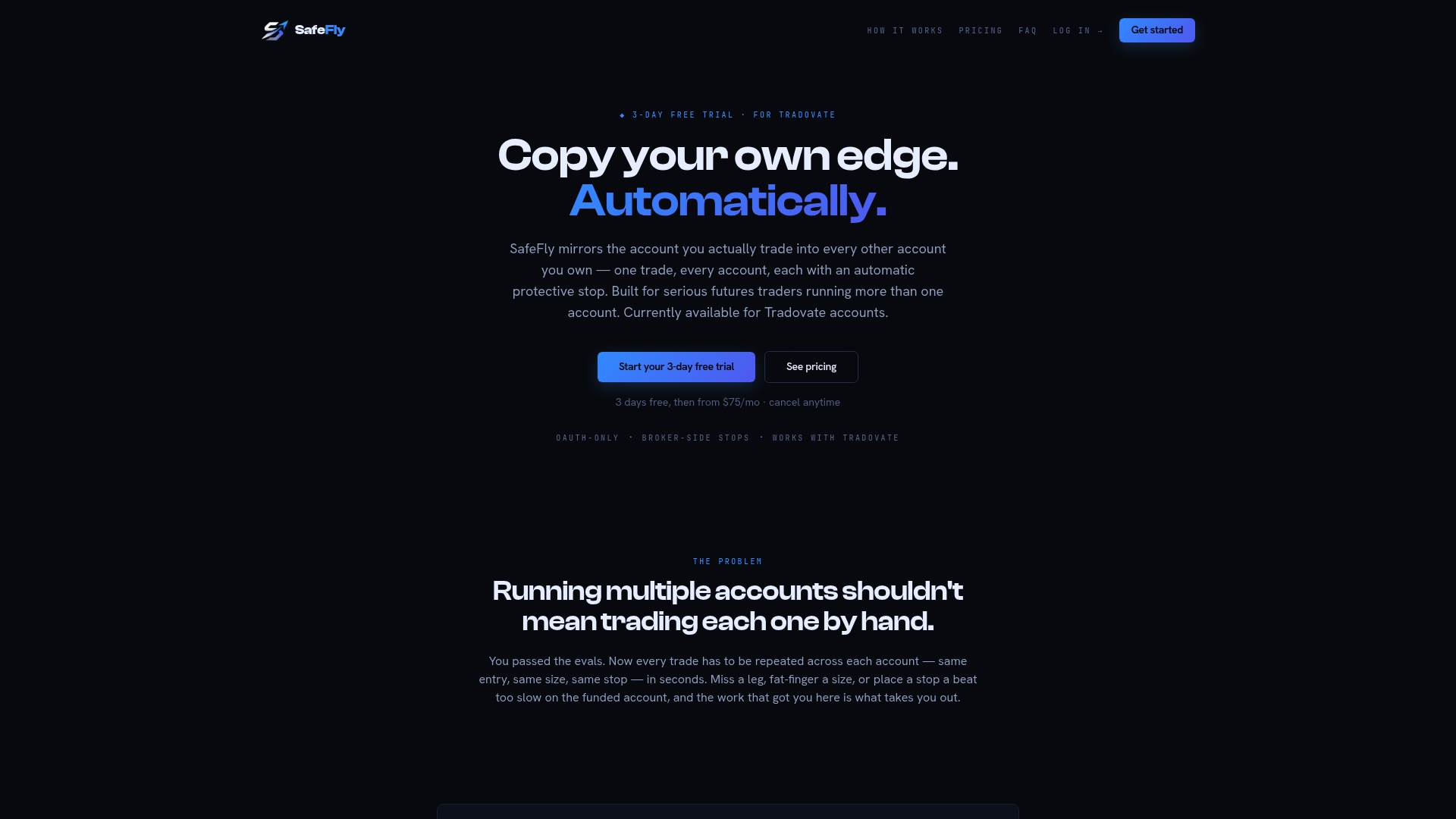
The platform connects through secure OAuth, so your broker credentials are never stored, and it runs entirely in the cloud with no local software to fail alongside a dropped connection. Plans start with Basic at $49 per month, scale to Pro at $119 per month, and top out with Ultra at $250 per month for traders who also want the built-in gamma exposure screener. Review the how SafeFly works page to see the server-side stop workflow in detail, then check current pricing to start a trial.
Sources
- Finra
- Cancel On Disconnect - CME Group Client Systems Wiki - Confluence
- cancel-on-disconnect | Deribit docs
- ConnectionLossHandling | NinjaTrader
- Investor
FAQ
What Is the Golden Rule for Stop-Loss Orders?
The closest thing to a golden rule is that a stop order only protects you once it's confirmed accepted by the broker or exchange server, not simply displayed in your trading app. Beyond that, always know whether your stop is a market or limit variant, since each carries different execution guarantees, as FINRA's guidance explains.
What Is the 7% Rule for Stop-Loss?
The 7% rule is a popular sizing guideline suggesting traders exit a position after a 7% loss, but it wasn't designed to address connectivity or execution risk during a disconnect. Position sizing should also account for realistic slippage on a stop-market fill rather than relying on a fixed percentage alone.
What Are Common Stop-Loss Mistakes?
The most common mistakes are assuming a displayed stop is server-acknowledged, using stop-market orders in thin or gapping markets without expecting slippage, and forgetting that Cancel on Disconnect features are often opt-in and session-scoped rather than automatic across every order type.
Can You Still Lose Money With a Stop-Loss?
Yes. A triggered stop-market order becomes a regular market order and can fill at a materially different price during a fast move or overnight gap, per Investor.gov's bulletin on stop orders. A stop-limit order avoids that price risk but can fail to fill entirely if the market gaps past your limit.
Does SafeFly Guarantee My Stop Survives a Disconnect?
SafeFly enforces broker-side protective stops before mirroring trades and records per-account acknowledgment, which reduces the risk of an unprotected position going undetected. No system removes execution risk entirely, since exchange-level factors like Too Late to Cancel fills still apply regardless of the platform used.