

Yes, you can copy trades across multiple futures and prop firm accounts, and the safest way to do it is with a leader to follower copier that connects accounts through secure API or OAuth access and enforces broker-side protective stops on every mirrored trade. Before any live copying, confirm per-account sizing rules, daily profit and loss lockouts, and order logging are active. These guardrails matter more than speed or convenience once real capital, or funded evaluation capital, is on the line.
TL;DR:
- Using a secure API or OAuth connection with enforced broker-side stops is essential to safely copy trades across multiple futures or prop firm accounts.
- Sizing methods include ratio, equity, fixed, or override models, with symbol mapping necessary to prevent margin issues when trading different contract sizes.
- Thorough testing with small orders on demo accounts and continuous reconciliation are vital before scaling up to live funded accounts.
- Implementing daily P&L lockouts, position limits, and automated alerts significantly reduce the risk of overtrading or unintended losses.
- Copying is most effective when accounts share similar strategies and risk profiles, while mismatched accounts should be managed separately.
Table of Contents
- How multi-account copiers work: modes, sizing, and symbol mapping
- Setting up your first copied trade across accounts
- Risk controls and compliance you cannot skip
- Keeping the copier reliable under load
- What regulators expect from automated multi-account trading
- A daily and weekly routine for running a copier safely
- When copying makes sense and when it does not
- SafeFly turns these guardrails into a running system
- Where to verify the details yourself
- Sources
- FAQ
How multi-account copiers work: modes, sizing, and symbol mapping
Two structural modes exist for copying trades across accounts. Multi-account placement sends the identical order to every connected account at once, with no per-account adjustment. Copier groups, by contrast, let each follower account carry its own sizing, symbol mapping, and risk profile, which suits traders whose accounts differ in contract allowances, such as an evaluation account paired with a funded one.
Sizing configuration determines how a single leader trade translates across followers. Traders typically choose among a handful of models:
- Ratio or multiplier sizing scales the leader's contract count up or down per follower account.
- Equity allocation sizing bases follower order size on each account's proportional equity.
- Fixed per-account size assigns a static contract count regardless of the leader's size.
- Per-account overrides let a trader lock exceptions for accounts with different margin or contract rules.
Symbol mapping handles contract differences, translating an ES trade on the leader into an MES trade on a micro-sized follower account, for instance. Without this mapping, a copier can send a mini contract order to an account only cleared for micros, producing a margin rejection or an oversized position. Broker-side protective stops close this loop: because the stop lives on the broker's servers rather than in the copier software, a dropped connection or a local outage does not leave a follower position unprotected.
Setting up your first copied trade across accounts
Before connecting anything, confirm you have API or OAuth credentials for each account, the account IDs and margin requirements for every follower, and at least one demo account to test against. Skipping this step is the most common cause of early mismatches.
- Connect the leader account and each follower account using secure OAuth tokens or API keys rather than shared logins.
- Configure sizing rules, symbol mapping, and mandatory protective stops for every follower before enabling any live copying.
- Set daily profit and loss lockouts and per-account order limits as a baseline safeguard.
- Run a small test order on demo or minimum-size contracts, then check the logs to confirm the follower fill matches the leader fill in symbol, size, and timing.
- Reconcile any mismatch immediately and escalate to manual control if the discrepancy repeats on a second test.
Pro Tip: Run at least three consecutive test trades with no mismatches before allowing the copier to touch a funded account.
Tradovate's own API documentation notes that automated order placement requires supplying the correct accountId and accountSpec fields, along with an isAutomated flag for automated orders, and that omitting these fields can cause rejected or misrouted orders.
Risk controls and compliance you cannot skip
A copier that mirrors trades without limits is a copier that scales your mistakes. Per-account order and position limits, symbol-specific risk caps, and overtrading throttles need to sit between the leader signal and the follower execution, not as an afterthought.
- Enforce hard per-account position and order limits so no single follower can exceed its margin or evaluation rules.
- Require a broker-side protective stop on every copied trade, plus a daily profit and loss lockout per account.
- Keep allocation instructions and daily confirmation records for every account in the copy group.
- Automate alerts for partial fills, symbol mismatches, or lost connectivity so a human reviews the exception quickly.
Server-side broker stops and enforced daily loss locks reduce risk exposure across funded accounts because they survive a local connection loss, unlike stops that live only in copier software running on a desktop or a browser tab.
Recordkeeping is not optional overhead. NFA Compliance Rule 2-10 requires allocation instructions for bunched orders and daily confirmation that allocation was non-preferential, with fairness reviewed at least quarterly rather than trade by trade.
Keeping the copier reliable under load
Order routing speed determines whether a follower fill matches the leader's price or trails it into slippage, particularly during fast futures moves. A copier that queues orders sequentially instead of routing them concurrently introduces exactly the kind of lag that turns a clean leader entry into a poor follower fill.
Server-side execution, paired with broker-side stops, removes the single point of failure that a purely local or browser-based copier carries. Logging every order, fill, and rejection, then reconciling those records against each account's statement, catches partial fills and symbol mismatches before they compound. Automated alerts for connectivity loss or execution failure, tied to a clear escalation step, keep a temporary outage from turning into an unmanaged position.

What regulators expect from automated multi-account trading
Two bodies of guidance shape how bunched or automated multi-account orders should be handled. The CFTC's Regulation AT material emphasizes pre-trade risk controls, testing, and ongoing monitoring for automated trading systems, including risk-based limits on position size, order size, and margin compliance. NFA Compliance Rule 2-10 separately requires that bunched order allocations be documented and reviewed for fairness, with daily confirmations and at least quarterly analysis.
Allocation fairness is judged over time, not trade by trade. If accounts in the same copy group diverge materially in results, documentation must show a reason other than the allocation method itself.
A practical compliance checklist for multi-account copying includes:
- Written allocation instructions for every connected account.
- Daily confirmation logs showing which account received which fill.
- Quarterly review of performance divergence across accounts in the same group.
- Retained audit logs covering connection status, order routing, and stop placement.
A daily and weekly routine for running a copier safely
A copier is not a set-and-forget tool. It needs a routine, the same way a funded trading account needs one.
- Each trading day, confirm connection health across all accounts, verify P&L lockouts are armed, and reconcile the prior session's fills.
- Each week, review allocation records across the group and check whether any account's sizing or symbol mapping needs adjustment.
- Each month, run a disaster-recovery test, confirm broker-side stops actually trigger as configured, and review the full audit log for gaps.
- Pause the copier and revert to manual control immediately if reconciliation turns up a repeated mismatch or if connectivity drops mid-session.
Pro Tip: Treat a single unexplained fill mismatch as a warning and a second one, on the same symbol, as a reason to pause the group entirely.
Traders who copy across multiple prop firm accounts on platforms like Tradovate routinely report partial fills and symbol mismatches during early testing, which is why small test fills and close monitoring matter before scaling to full size.
When copying makes sense and when it does not
Copying works best across accounts running the same strategy with comparable risk profiles, evaluation and funded accounts on matched contract sizes. Accounts with different strategies or mismatched drawdown limits are usually safer managed separately.
— Arturo
SafeFly turns these guardrails into a running system
Everything covered above, leader to follower mirroring, broker-side protective stops, daily P&L lockouts, and secure account connections, is what SafeFly runs automatically for traders managing multiple Tradovate accounts.
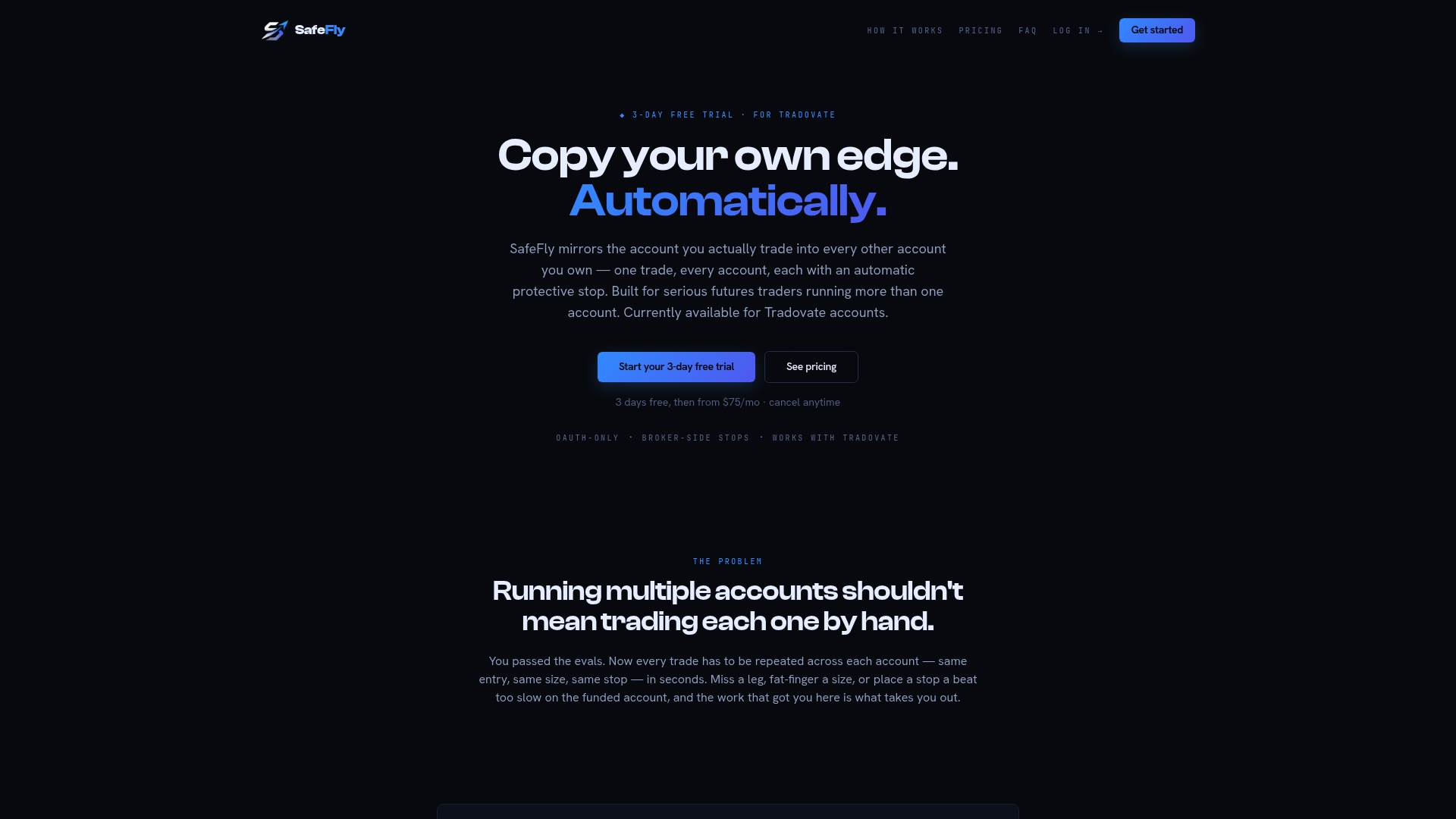
- SafeFly mirrors trades from a lead account to followers automatically, with a mandatory protective stop attached to every copied trade.
- Stops are enforced broker-side, so a follower position stays protected even if the local connection drops.
- Accounts connect through secure OAuth rather than shared passwords, and daily profit and loss lockouts cap risk per account automatically.
The how it works page walks through the OAuth setup and stop logic in detail, and current plans, Basic at $49 per month, Pro at $119 per month, and Ultra at $250 per month, are available with a trial period before committing to a funded account rollout.
Where to verify the details yourself

Consult the NFA allocation rule, CFTC Regulation AT material, and your broker's own API documentation before going live.
Sources
- NFA rulebook — Allocation of bunched retail forex orders (Rule 2-10 / 9065)
- Federal Register: Regulation Automated Trading (CFTC)
- Tradovate example API: place order tutorial (GitHub)
FAQ
What software can I use to copy trade across multiple accounts?
Dedicated copier platforms that connect through API or OAuth, such as SafeFly for Tradovate accounts, handle leader to follower mirroring with broker-side protective stops and per-account sizing. Choose a platform that supports symbol mapping and daily P&L lockouts rather than one that only duplicates identical orders.
Can you trade multiple accounts at the same time?
Yes, a copier can place orders across several connected accounts simultaneously once the leader account executes a trade. Order routing speed and concurrency handling determine how closely each follower's fill matches the leader's price.
How many accounts can I copy trade on my funded futures account?
The number of accounts you can connect depends on the copier platform's plan tier and your broker or prop firm's own rules on linked accounts. Check your funded account's contract terms and the copier's plan details, such as those on SafeFly's pricing page, before connecting multiple funded accounts.
How many funded prop firm accounts can you copy trade on?
This depends on your prop firm's specific account rules and the copier software's account limits, which vary by provider and subscription tier. Review your funded account agreement and the copier's documented limits before scaling beyond a couple of connected accounts.