

The safest way to trade multiple futures accounts at once is centralized execution: a single strategy signal mirrored to every account through a trade-copying layer, with each account governed by its own risk envelope and every order protected by a broker-side stop. Daily profit-and-loss lockouts prevent one bad session from cascading across the fleet. Platforms like SafeFly build this exact model for Tradovate traders managing several accounts in parallel.
TL;DR:
- Using centralized execution layers ensures account-specific risk management, including Stop protection and daily profit-lockouts, without manual re-entry.
- Automation safeguards such as per-trade risk caps and account-specific drawdown limits prevent small accounts from blowing up and ensure compliance.
- Connecting accounts through secure OAuth and setting explicit contract normalization before trading are critical to avoid sizing errors and maintain security.
- Reconciliation, real-time alerts, and staged testing are essential to prevent operational failures during high-volatility markets.
- Proper tax reporting requires exporting and consolidating trade logs across all accounts, with regulatory guidance emphasizing transparency over account separation.
Table of Contents
- What Are the Best Ways to Manage Multiple Futures Accounts?
- What Risk Controls Should Every Multi-Account Trader Enforce?
- How Do You Set Up Safe Multi-Account Automation?
- How Does SafeFly Handle Multi-Account Execution?
- What Are the Tax Implications of Trading Multiple Futures Accounts?
- How Do You Configure Multi-Account Support on Major Futures Platforms?
- An Operations-First View on Scaling Futures Accounts
- Get Started With Automated Multi-Account Futures Trading
- Sources
What Are the Best Ways to Manage Multiple Futures Accounts?
Traders scaling past one account typically choose from four execution models, and the right one depends on account count, broker mix, and how much operational risk you can tolerate.
Manual replication means placing each trade by hand in every account. It works for two accounts and falls apart at five. Fat-finger errors multiply with every additional window open on your screen, and fills across accounts will never match exactly because human reaction time varies trade to trade.
Broker-native copy features exist on some platforms and handle basic mirroring within a single broker's ecosystem. They're convenient when every account sits on the same platform, but they rarely offer account-specific risk overrides, meaning a signal that's fine for a $150,000 account might blow through the daily loss limit on a $25,000 evaluation account.
Third-party trade copiers sit between your signal source and multiple destination accounts, often across brokers. They solve the cross-broker problem but introduce a new one: if the copier doesn't normalize contract sizes, an ES signal firing into a micro-account fleet without automatic MES conversion will oversize every position.
Centralized execution layers (sometimes built as expert advisors or middleware) treat the signal and the account rules as separate systems. One trade decision, many account-specific outcomes.
- Manual replication: fine for one or two accounts, breaks down fast beyond that.
- Broker-native copy tools: convenient within one broker, weak on per-account risk logic.
- Third-party copiers: solve cross-broker mirroring but need normalization to avoid sizing errors.
- Centralized execution/middleware: best for prop fleets and mixed-broker setups where latency and fill consistency matter most.
For anyone running a fleet of funded or prop accounts, latency and fill consistency separate the systems that survive an audit from the ones that trigger a margin call.
What Risk Controls Should Every Multi-Account Trader Enforce?
Automation without account-level guardrails doesn't scale a strategy. It scales the failure mode. A modern risk-management framework for futures traders centers on four elements: position sizing, stop-loss methodology, drawdown protocols, and correlation controls. Every one of those needs to be enforced per account, not just at the portfolio level.
Here's the minimum rule set before you connect a second account to your execution layer:
- Per-trade risk cap. Industry guidance consistently points to risking no more than 1 to 2 percent of account equity per trade, and that ceiling should apply independently to each account, not to your combined balance.
- Daily loss limit. Set it as a multiple of your per-trade risk, not a flat dollar figure copied across dissimilar account sizes.
- Max drawdown threshold. Prop firms enforce trailing drawdown rules that differ from evaluation to funded status, so your automation needs to know which threshold applies to which account.
- Correlated-exposure limits. Five accounts all long the same NO contract isn't diversification. It's one position wearing five costumes.
Mapping portfolio rules down to the account level requires contract-size multipliers and symbol mapping, since a signal built for standard ES contracts needs automatic conversion when it lands in a micro or mini account. Practical implementation usually means a hard daily loss limit that locks trading for the day once hit, a cooling-off policy after a losing streak, and real-time alerts when any single account approaches its ceiling.
One in every two or three per-trade risk allocations should sit closer to 1% than 2% for accounts under active drawdown pressure, according to the sizing guidance from PropScorer's risk framework. That's a meaningful buffer, not a rounding error, when you're running six accounts simultaneously.
Custody matters here too. The CFTC's guidance on futures accounts makes clear that customer funds sit with a Futures Commission Merchant under segregation rules, and managed-account arrangements carry distinct obligations. The NFA's investor advisory materials go further, requiring disclosure documents for commodity pools and managed accounts. If your multi-account setup starts resembling a managed-account arrangement rather than personal trading across accounts you control, those disclosure rules apply to you.
How Do You Set Up Safe Multi-Account Automation?
Standing up automation across several futures accounts is a sequencing problem. Skip a step and you'll find out the hard way, usually during a fast market.
Connectivity first. Prefer OAuth or broker API keys over shared logins or screen-scraping tools. OAuth tokens can be revoked instantly if something looks wrong, and they don't expose your actual broker password to a third-party service. Confirm session renewal happens automatically, since a token that silently expires mid-session leaves follower accounts unmirrored without warning.
Build the technical stack deliberately.
- Use WebSocket or streaming order paths rather than polling, since polling introduces lag that compounds across every account in the fleet.
- Consider a VPS or co-located server if you're running signals off a home connection, particularly during high-volatility opens.
- Build a reconciliation pipeline that checks, at minimum every few minutes, that each account's positions match what the lead account dictates.
Map orders correctly. Contract-size normalization has to happen automatically. An ES-to-MES conversion that requires manual math during a live session is a conversion that will eventually get skipped.
Govern the automation, don't just deploy it. Run staged dry tests before connecting real capital, build a kill-switch that halts all follower accounts with one action, and set alerts for any order-failure event. Reconcile every account at day's end against the lead account's trade log.
Pro Tip: Test your kill-switch during a slow market before you ever need it in a fast one. A fail-safe you've never triggered is a fail-safe you don't actually trust.
Background separation from the source signal, so that account-specific constraints never touch the strategy logic itself, is what keeps a stricter account from breaching its own rules just because a looser account can absorb more risk.
How Does SafeFly Handle Multi-Account Execution?
SafeFly was built around the exact operational model this guide describes: one lead account, multiple mirrored followers, each protected independently. The platform automates trade replication for Tradovate accounts so a trader isn't manually re-entering the same position five or six times under time pressure.
The features map directly onto the checklist above:
- Automated mirroring propagates every lead-account trade to connected Tradovate followers without manual re-entry.
- Broker-side protective stops attach to every mirrored order, so a position stays covered even if the platform disconnects mid-session.
- Secure OAuth integration avoids storing raw broker credentials anywhere in the automation layer.
- Daily profit-and-loss lockouts halt trading account-by-account once a preset threshold hits, rather than applying one blanket rule to accounts of different sizes.
- Trade analytics and AI coaching give traders visibility into which accounts are drifting from the intended risk profile before it becomes a breach.
The separation between signal and account rules is the operational core of it: the lead account's trade decision stays untouched, while each follower enforces its own drawdown ceiling and daily limit. Traders who want the product-level mechanics can review the how it works page, and anyone evaluating the platform's boundaries should read the risk disclosure before connecting live accounts.
What Are the Tax Implications of Trading Multiple Futures Accounts?
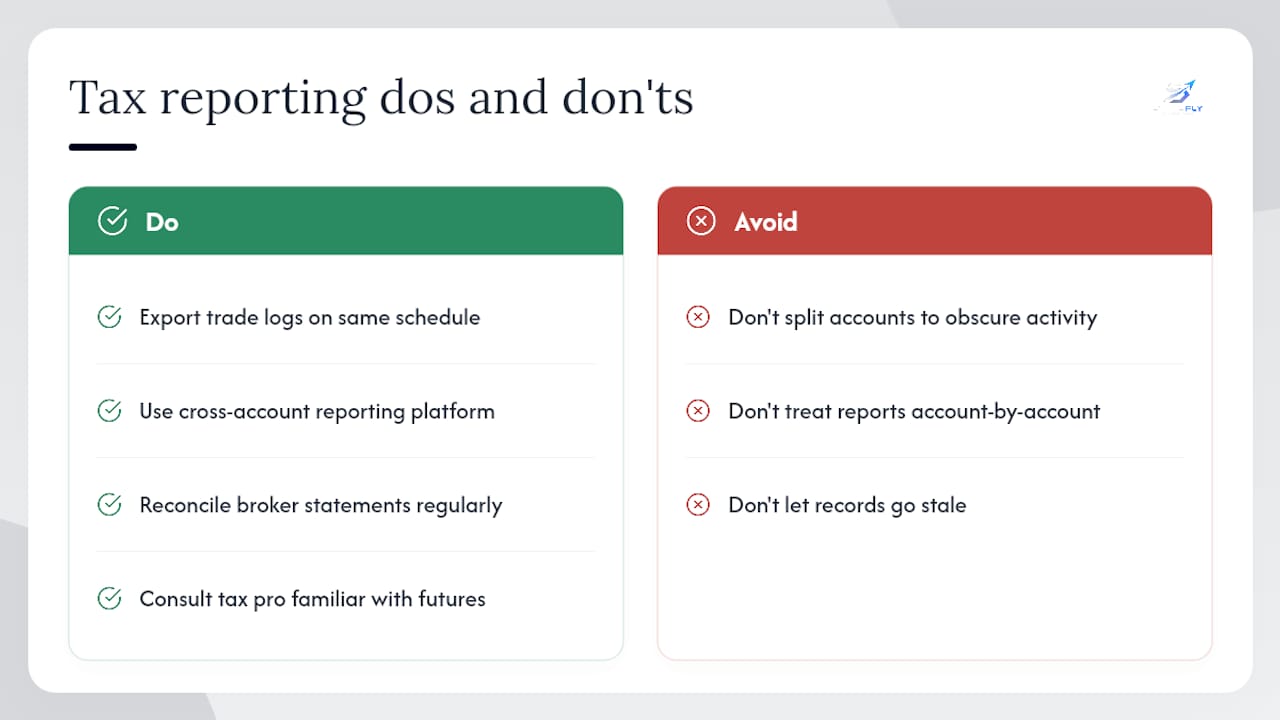
Every futures account you trade generates its own set of transaction records, and most tax jurisdictions require you to report gains and losses in aggregate across all accounts you control, even when those accounts sit at different brokers or under different account numbers. Consolidating that reporting is a bookkeeping problem long before it's a filing problem.
The practical risk is fragmentation. If you're mirroring trades across four or five accounts, you now have four or five separate 1099 forms (in jurisdictions that issue them) or equivalent statements, each reflecting only that account's activity. Reconciling those into a single accurate tax position means either exporting from every broker separately or using a platform that logs cross-account activity in one place.
Traders classified as engaging in a trade or business of trading, versus those treated as investors, face different rules in many jurisdictions regarding loss deductions and expense treatment, and that classification doesn't change just because you split activity across multiple accounts. Regulators generally look at your trading activity in aggregate, not account by account, so spreading trades across several accounts to obscure volume or frequency doesn't change your underlying tax treatment. It just makes the paperwork harder.
Work with a tax professional familiar with futures trading before scaling to multiple accounts, particularly if some accounts are funded or prop arrangements where payouts may carry different treatment than gains in a personally funded account. The record-keeping habit that saves the most trouble is simple: export trade logs from every account on the same schedule, whether weekly or monthly, so nothing goes stale by tax season.
How Do You Configure Multi-Account Support on Major Futures Platforms?
Most futures trading platforms that support multi-account management follow a similar setup sequence, though the exact menus differ.
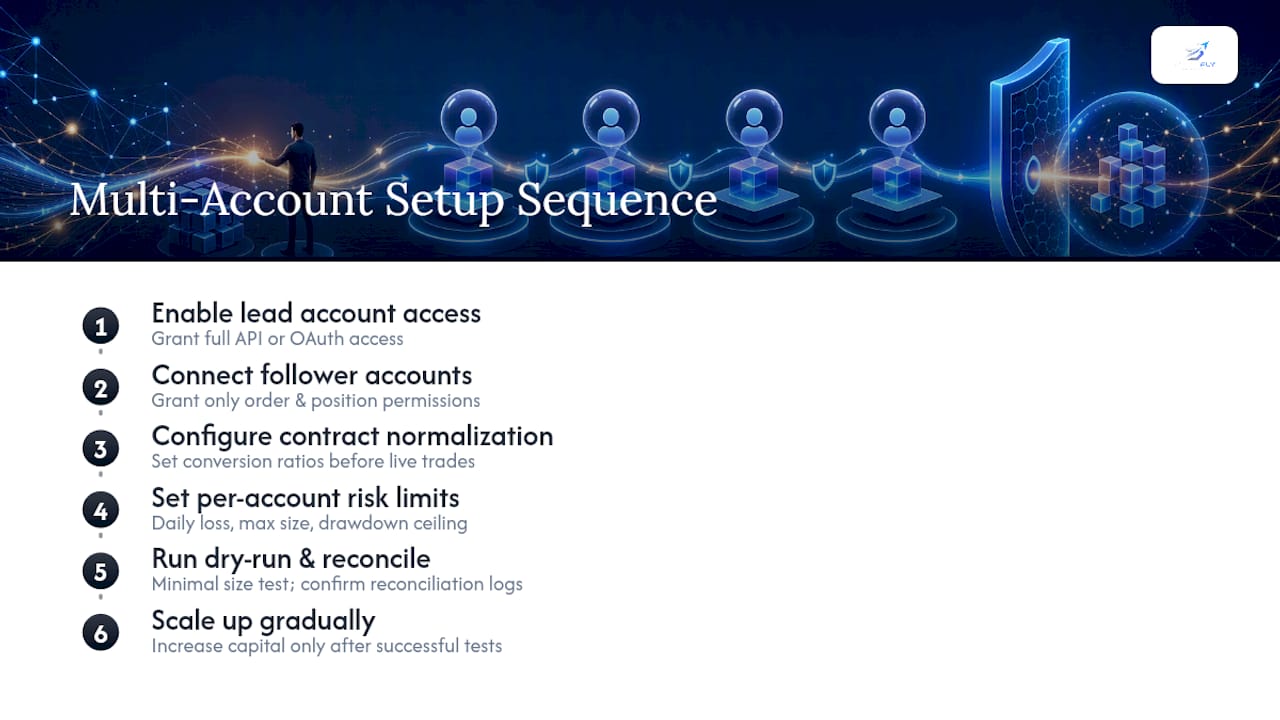
Start with the lead account, the one whose trades will be mirrored, and confirm it has full API or OAuth access enabled in the platform's account settings. Tradovate, for instance, supports OAuth-based third-party connections, which is the credential model SafeFly uses rather than shared logins.
Next, connect each follower account individually, granting only the permissions the automation actually needs, typically order placement and position monitoring, not withdrawal or fund-transfer rights. Broader permissions than necessary are a common oversight that turns a minor credential leak into a major one.
Configure contract normalization at this stage, not after you've gone live. If your lead account trades standard-size contracts and a follower account is a micro-account, the platform needs an explicit conversion ratio set before the first mirrored trade fires, not calculated on the fly.
Set per-account risk parameters directly in the platform: daily loss limit, max position size, and drawdown ceiling, each tuned to that specific account's rules rather than copied from the lead account's settings. This is where automated risk rules do the heavy lifting, since manually re-entering limits across six accounts invites transcription errors.
Finally, run a dry-run session with minimal size before committing full capital, confirm that reconciliation logs are populating correctly, and only then scale up. Platforms supporting Tradovate copy trading generally expose this entire sequence through a single dashboard rather than requiring separate configuration per account.
An Operations-First View on Scaling Futures Accounts
Traders who scale successfully across multiple futures accounts tend to treat the job as operations management, not signal generation. The edge isn't finding a better entry. It's enforcing the same risk rule on every account, every day, without fatigue or shortcuts creeping in.
Three habits separate operators who last from those who don't: keeping an exposure buffer relative to your most restrictive account's drawdown limit rather than your average account, enforcing a cooldown after a losing streak instead of trading through it, and running a payout-readiness audit before assuming any funded account can actually withdraw. Signal-chasing gets attention. Consistent enforcement is what keeps six accounts alive at once.
— Arturo
Get Started With Automated Multi-Account Futures Trading
Manual replication and generic copy tools both leave gaps: one invites human error under pressure, the other rarely enforces account-specific risk limits the way a funded or prop account demands. SafeFly closes that gap for Tradovate traders specifically, mirroring trades from one lead account to every connected follower while attaching a broker-side protective stop to each order, so a position stays covered even through a disconnection.
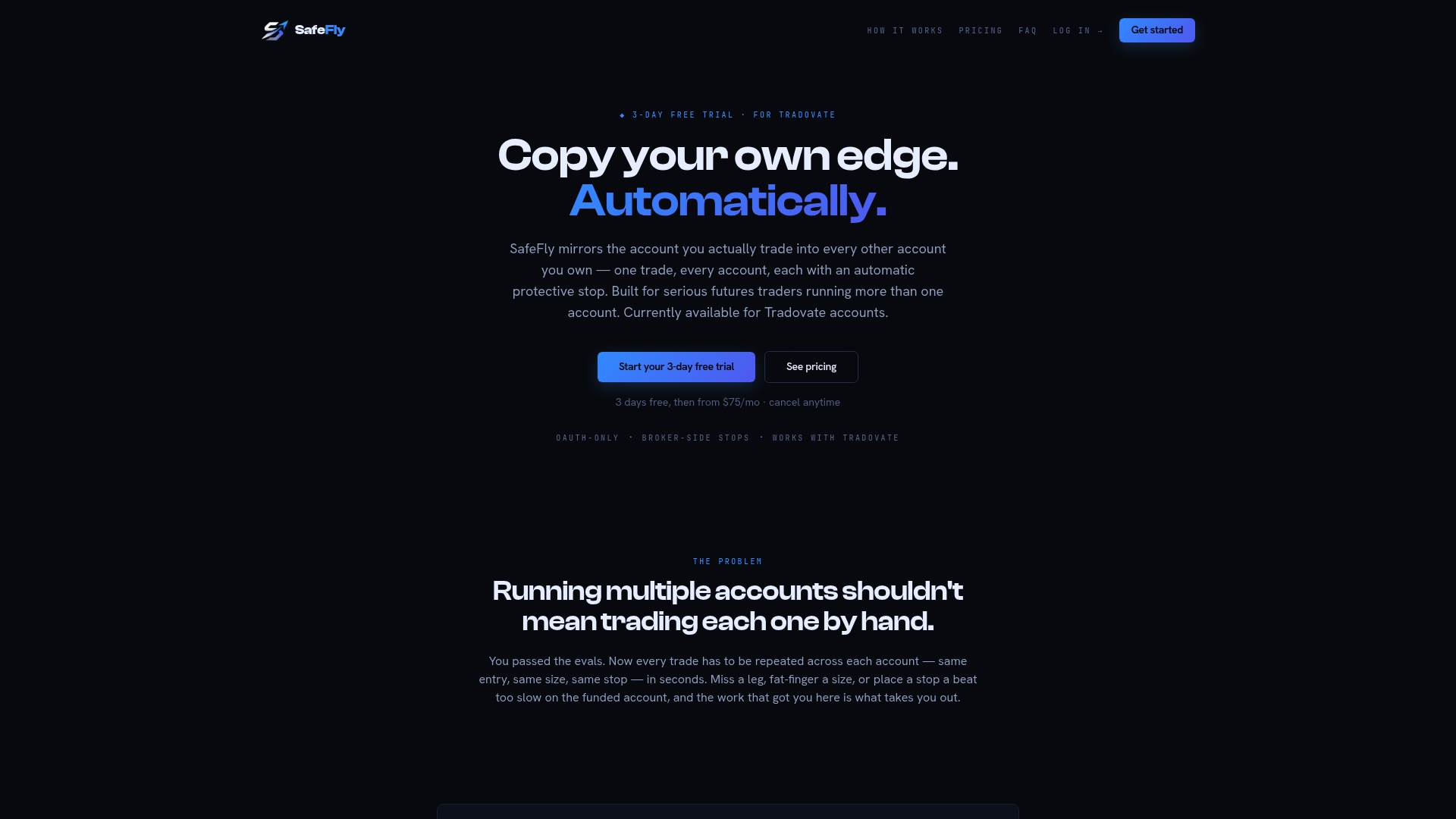
Daily profit-and-loss lockouts run independently per account, meaning a rough session on one account never forces a shutdown across accounts that are still performing fine. Secure OAuth connections mean you're never handing over raw broker credentials to make the automation work, and the built-in trade analytics show exactly where risk is drifting before it becomes a violation. If you're managing more than one Tradovate account and tired of manually re-entering the same trade under time pressure, review how SafeFly works and start the trial to see your first mirrored trade execute with its protective stop already attached.
Sources
- CFTC digital assets and investor resources
- NFA investor advisory and best practices
- Risk Management Framework for Futures Traders (2026)
- Risk Management for Futures Traders: The Complete Guide — PropScorer Academy