

Per-symbol risk limits cap the exposure a trader can carry on a single futures root, whether that exposure comes from one order, several fills, or trades mirrored across a dozen accounts. The essential enforcement stack is threefold: pre-order validation that rejects oversized orders, broker-side protective stops that survive a disconnection, and daily profit-and-loss lockouts that shut a symbol down before losses compound. Exchanges like Cboe/CFE enforce their own symbol and EFID-level limits underneath all of this, and any copier configuration has to work with those constraints, not against them.
TL;DR:
- Per-symbol risk limits cap total exposure across all accounts, preventing correlated losses from multiple identical trades.
- Calculating position size should be based on dollar risk, risk per contract, and account equity, always rounding down to avoid sizing errors.
- Exchange enforcement varies: risk root limits operate instantaneously inside matching engines, while EFID group limits may lag slightly behind breaches.
- A robust copier setup needs pre-order validation, broker-side stops, flexible sizing modes, and daily lockouts to manage risk effectively.
- Starting with three to five accounts is advisable to test and refine risk controls before scaling to larger account groups.
Table of Contents
- Why Per-Symbol Risk Limits Matter for Multi-Account Copy Trading
- How Do You Calculate Per-Symbol Risk Limits?
- How Exchanges Enforce Symbol-Level Limits
- Enforcing Per-Symbol Limits Inside a Multi-Account Tradovate Copier
- Testing and Monitoring Your Symbol Risk Limits Before Going Live
- What Scaling Multi-Account Risk Actually Teaches You
- Putting These Controls Into a Working Copier Setup
- Sources
- FAQ
Why Per-Symbol Risk Limits Matter for Multi-Account Copy Trading
Mirroring the same trade across ten accounts does not diversify risk. It concentrates it. A single bad ES trade replicated across every follower account produces ten correlated losses at once, not ten independent bets. That is the core problem symbol risk limits solve: they cap how much exposure any one instrument can accumulate across your entire account group, not just within a single account.
Operational failure compounds the danger. A partial fill on the lead account, a stuck exit on a follower, or a few seconds of copier lag can leave one account flat while another is still holding a full position. At scale, these small glitches turn into meaningful account-level discrepancies.
Prop-firm rules add another layer of pressure. Daily drawdown limits and account-level trailing thresholds mean a single oversized symbol position can breach a rule that has nothing to do with the trade itself.
- Correlated exposure across accounts multiplies loss rather than spreading it.
- Copier lag and partial fills create desynchronized positions that per-symbol caps catch early.
- Prop-firm daily drawdown limits force hard, non-negotiable position ceilings per instrument.
How Do You Calculate Per-Symbol Risk Limits?
Start with dollar risk, not contract count. The standard position-sizing formula for futures traders converts account equity and stop distance directly into a contract limit, and it works the same way whether you are sizing one account or twelve.
- Dollar risk = Account Equity × Risk Percentage (commonly 0.5% to 1% per trade).
- Risk per contract = Stop Distance in Ticks × Dollar Value Per Tick (DVPT). For ES, DVPT is $12.50 per tick.
- Contracts = floor(Dollar Risk ÷ Risk Per Contract). Always round down, never up. Rounding up on a copier that fans out to multiple accounts multiplies the sizing error by every follower.
- Margin check: confirm the contract count fits within the broker's margin requirement for that symbol. Margin is a clearing constraint, not a measure of how much risk you can actually absorb, so treat it as a ceiling check, never the primary sizing input.
- Drawdown check: confirm the position size does not push the account, or the account group, past its daily or trailing drawdown limit.
- Final size = the minimum of the risk-based, margin-based, and drawdown-based contract counts.
Pro Tip: Recalculate dollar risk against today's actual account balance, not last week's high-water mark. A copier that scales off a stale balance will oversize every trade after a losing streak, which is exactly when you need it to size down.
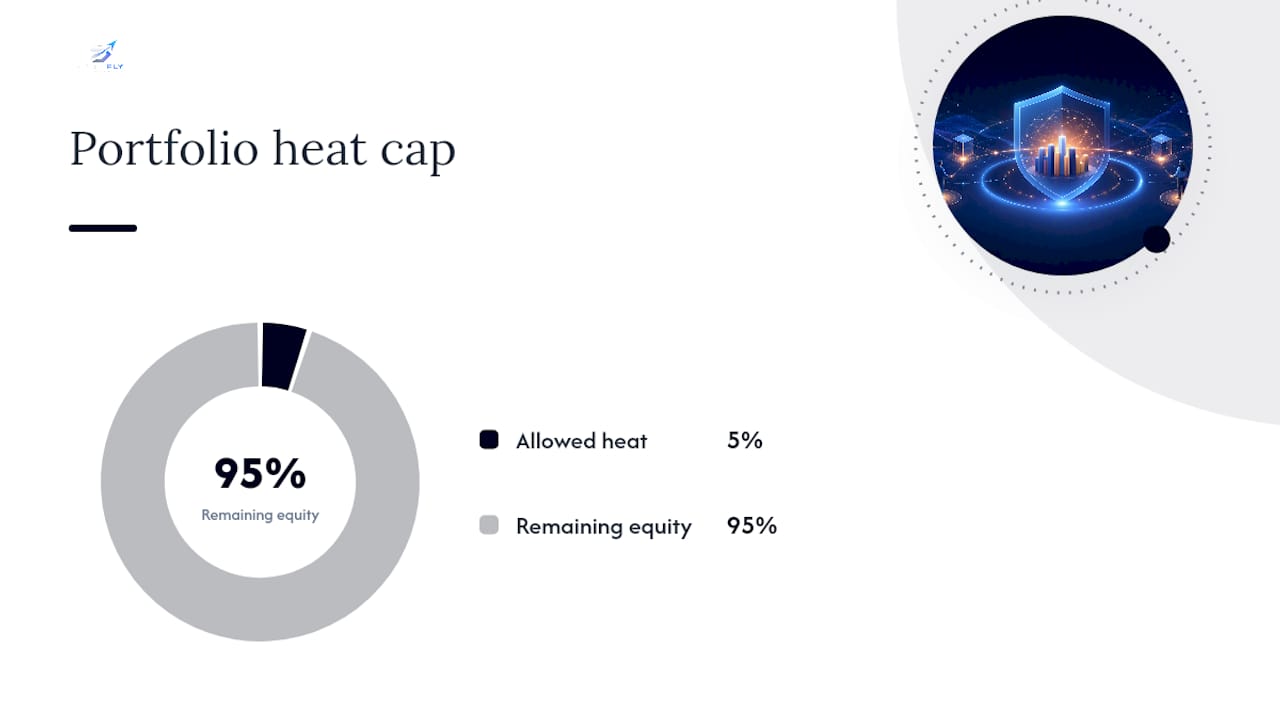
Portfolio heat, the sum of dollar risk across every open symbol at once, should stay at or below 5% of total equity. Taking the minimum across risk, margin, and drawdown constraints rather than any single one of them is what keeps an unexpected margin call or a prop-firm DLL breach from catching you off guard.
How Exchanges Enforce Symbol-Level Limits
Every futures exchange enforces its own hard limits underneath whatever rules you build into a copier, and Cboe's CFE technical specifications lay out the mechanics in detail. Two concepts matter most: Risk Root, which groups related contracts under a single symbol-level risk bucket, and EFID (Executing Firm ID), which groups exposure by the entity routing the order.
The enforcement mechanics differ sharply between the two. Risk Root limits run atomically inside the exchange's matching engine, meaning a breach triggers an instant reject with no gap for a race condition. EFID group limits, by contrast, are enforced on a best-effort, distributed basis across the exchange's infrastructure, which introduces a small but real lag between breach and enforcement.
- Max order size: caps the contract count on a single order.
- Max notional: caps total dollar exposure regardless of contract count.
- Net long/net short: caps directional exposure across all open positions in a root.
- Rate trips and absolute trips: halt trading temporarily when order rate or cumulative volume exceeds a threshold.
The Cboe/CFE specification also distinguishes immediate cancels from delayed lockouts. An immediate cancel rejects the order at submission; a lockout blocks all new orders on that symbol until the condition clears. Your copier's monitoring layer needs to detect both event types and react within seconds, since a follower account left unaware of an exchange-side trip can end up holding an unprotected position.
Enforcing Per-Symbol Limits Inside a Multi-Account Tradovate Copier
Building this correctly means layering four distinct controls, each catching a different failure mode.
- Pre-order validation. Before any mirrored order reaches Tradovate, check it against the per-symbol cap for that specific follower account. Rejecting at the validation layer is cheaper and faster than canceling after the exchange has already accepted the order, and it avoids leaving a partial position on the books.
- Broker-side protective stops. Every copied trade needs a stop that lives on the broker's servers, not just in your copier's local logic. If the copier disconnects, a client-side stop dies with it. A broker-side stop keeps working regardless of what happens to your internet connection or your machine.
- Per-account sizing modes. Not every follower account should get an identical contract count. A ratio mode scales by a fixed multiple of the lead account, fixed mode sends the same contract count everywhere, account-value mode scales proportionally to each account's equity, and position-size mode lets you set an absolute cap per symbol per account. Use ratio mode for accounts of similar size, account-value mode when balances vary widely, and fixed or position-size mode when a specific account needs a hard ceiling regardless of what the lead account does.
- Daily P&L lockouts and a portfolio kill-switch. Set a daily loss threshold at both the individual account level and across the whole portfolio. Once either trips, block new entries on that symbol, or across all symbols, for the rest of the session.
Pro Tip: Build retry logic for partial fills that re-checks the current position against the source of truth on Tradovate's side before sending a correction order. Guessing at the fill state instead of re-syncing is how small discrepancies turn into duplicate positions.
Testing and Monitoring Your Symbol Risk Limits Before Going Live
Run a dry-run period of 30 to 90 days before committing real capital across every follower account. Staged rollout with isolated per-account parameters catches configuration errors while the financial stakes are still small, and it gives you time to reconcile fills across accounts daily rather than discovering a drift after weeks of compounding.
A working checklist covers the per-symbol cap table for every account, account groupings by risk profile, daily loss limit (DLL) settings, monitoring endpoints for exchange trip events, alert thresholds for approaching a cap, and a documented manual override procedure for when something needs a human decision.
- Confirm the per-symbol cap table matches current account equity, not a figure from onboarding.
- Verify broker-side stops are attached to every mirrored order, not just the lead account's order.
- Set alert thresholds at 75% of the daily loss limit, not just at the limit itself.
- Test the kill-switch manually before relying on it in a live session.
When a limit trips, the automated response should be immediate: cancel resting orders on that symbol, flatten if the trigger was a daily loss threshold rather than a single-order rejection, and send an alert rather than a silent log entry.
What Scaling Multi-Account Risk Actually Teaches You
Most traders overestimate how much can be automated safely on day one. Start with three to five accounts, prove the math holds under real market conditions for a few weeks, then scale. Trying to run twenty accounts before the first five have survived a genuinely bad trading day is how a manageable mistake becomes an account-wide one.
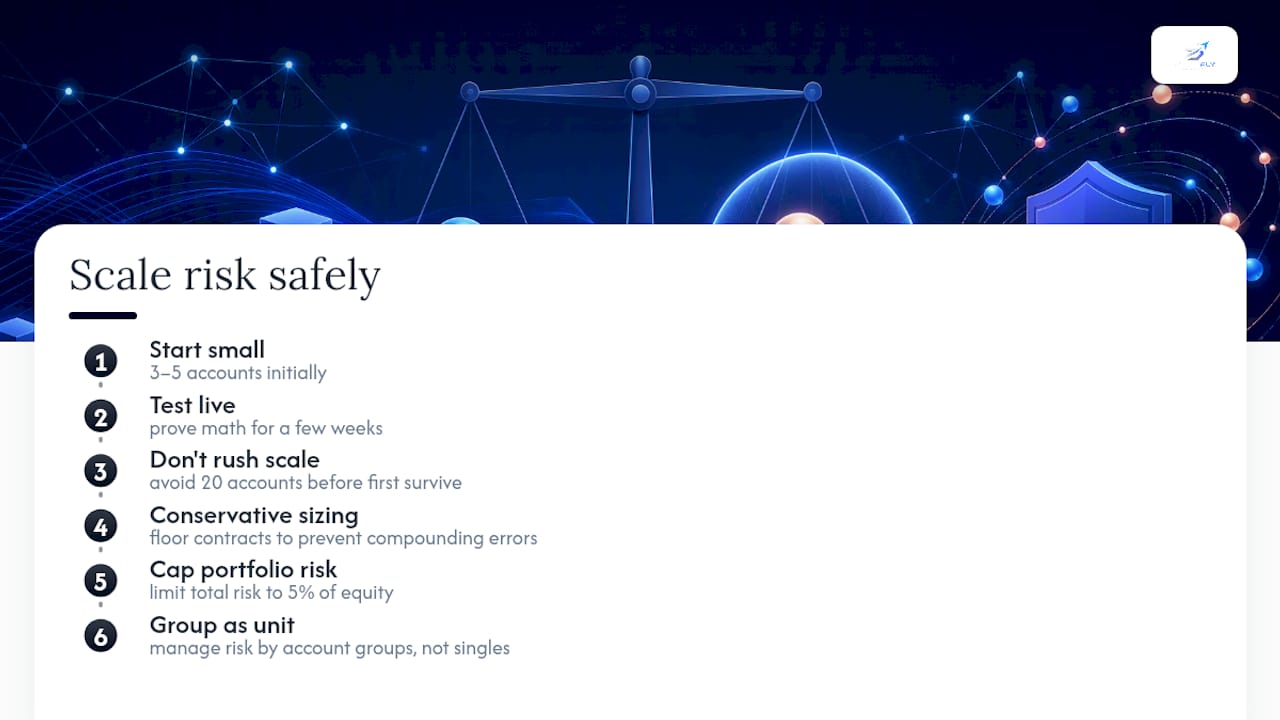
Conservative rounding matters more than it looks. Flooring your contract calculation instead of rounding to the nearest whole number costs you a small amount of upside on quiet days. It also means a sizing error never compounds across every follower account at once. The same logic applies to portfolio heat: capping total risk at 5% of equity feels restrictive until the day three correlated symbols move against you simultaneously.
The traders who scale successfully tend to treat account groups, not individual accounts, as the unit of risk. For deeper reading on how netting and per-trade caps interact across accounts, see SafeFly's guide on enforcing per-trade risk limits and the comparison of pre-order versus post-execution controls.
— Arturo
Putting These Controls Into a Working Copier Setup
Everything above describes what a well-built system needs: pre-order validation, broker-side stops, per-account sizing modes, and daily lockouts working together. SafeFly is built around exactly that stack for traders mirroring trades across multiple Tradovate accounts.
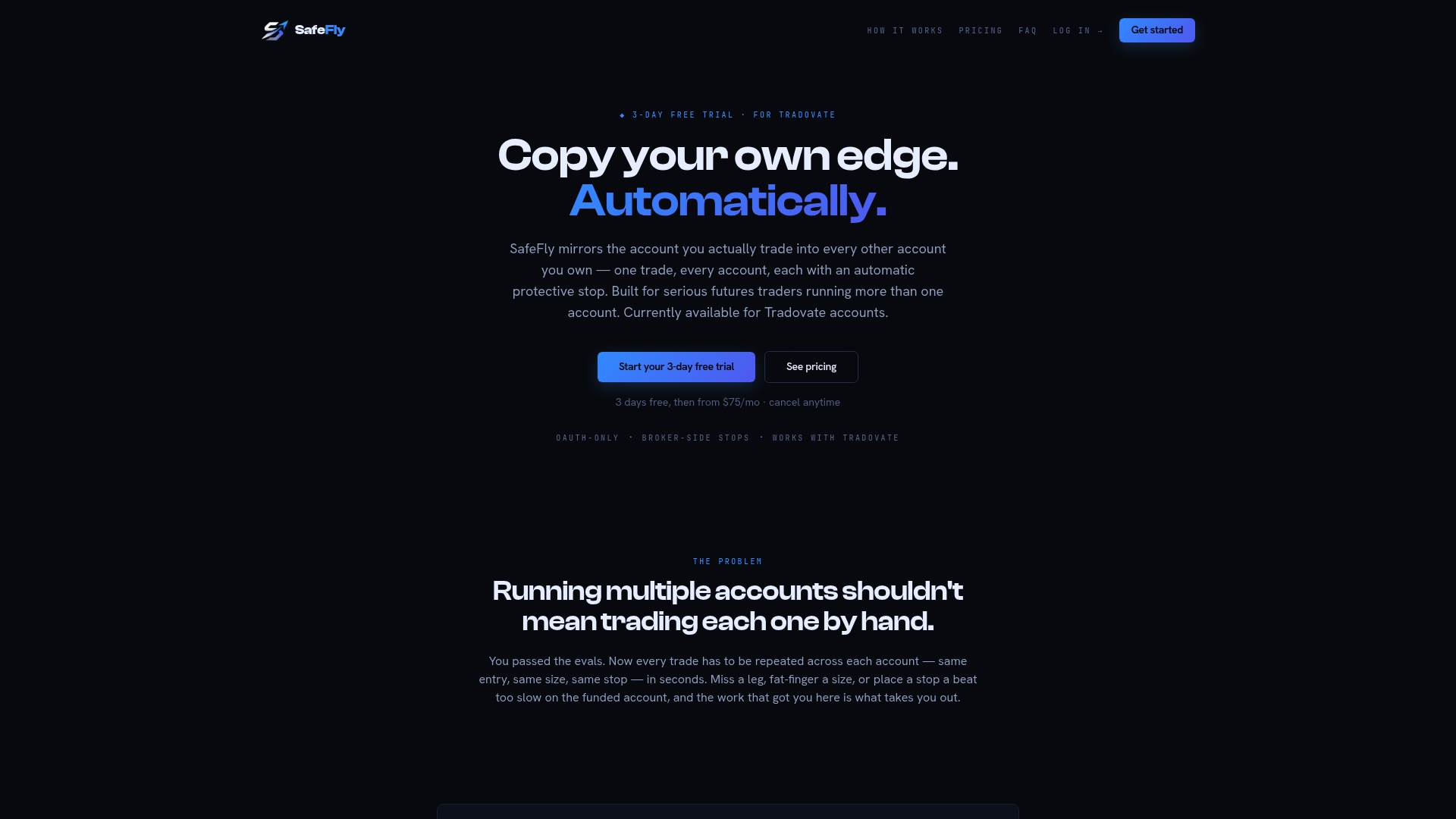
SafeFly only copies trades you place yourself, never third-party signals, and it attaches a mandatory protective stop that lives broker-side on every mirrored order, so a dropped connection never leaves a follower account unprotected. Per-account scaling modes let you run ratio-based, fixed, or account-value sizing across your whole group, and daily P&L lockouts shut a symbol or an entire account down before a bad session turns into a bad week. Every connection runs through secure OAuth, so no broker password ever touches SafeFly's servers, and the whole setup runs in the cloud with nothing to install locally.
Traders who also want dealer gamma-exposure data alongside their risk controls can find it built into the Ultra plan's market-data tools. Full plan details, including Basic, Pro, and Ultra pricing, are on the SafeFly pricing page, where a trial gets you configured across your accounts in one session.
Sources
- Cboe Titanium U.S. Options Risk Management Specification
- Position Sizing for Futures Trading: The Complete Formula and Framework - NexusFi Academy
- Mastering Automated Futures Trading Scalability Across Multiple Accounts | ClearEdge Trading
- Futures Trade Copier — How to Copy Trades Across Multiple Futures Accounts
This article is general information, not a substitute for advice from a qualified financial advisor. Consult a qualified financial professional about your own circumstances before acting on anything here.
FAQ
What Are Symbol Risk Limits in Futures Trading?
Symbol risk limits, also called risk-root limits, cap the total exposure a trader or account group can carry on a single futures instrument at any given time. They're enforced both by exchanges like Cboe/CFE through mechanisms like max notional and net position caps, and by traders themselves through copier-level pre-order checks and lockouts.
How Do I Calculate the Right Position Size for a Symbol?
Multiply your account equity by your risk percentage per trade, then divide by the dollar risk per contract based on your stop distance. Always round the result down using floor(), never up, and take the minimum of your risk-based, margin-based, and drawdown-based contract counts.
What's the Difference Between Pre-Order and Post-Execution Enforcement?
Pre-order validation rejects an oversized order before it reaches the exchange, which is faster and avoids leaving a partial position on the books. Post-execution controls, like a daily lockout, react after a trade has already filled, which is necessary for cumulative limits that can only be measured once positions are open.
Does SafeFly Enforce Per-Symbol Risk Limits Across Tradovate Accounts?
SafeFly mirrors trades across Tradovate accounts with per-account scaling modes, broker-side protective stops on every copied trade, and daily profit-and-loss lockouts. Pricing for the Basic, Pro, and Ultra plans is listed on the SafeFly pricing page.
How Many Accounts Should I Start With Before Scaling Up?
Most traders should start with three to five accounts to validate their sizing formulas and lockout thresholds under real conditions before adding more. This staged approach, recommended for automated multi-account scaling, limits the damage a configuration error can cause while it's still being caught.