

A per trade risk limit, in a mirrored multi-account Tradovate setup, is a broker-side protective stop attached automatically to each copied trade so the maximum dollar loss is fixed the instant the order fills. The immediate action for any serious operator: switch to signal-mode bracket transmission, size each follower account by contract ratio, and confirm every stop persists on the broker's servers rather than inside your own software. FCM and exchange controls exist as a second layer behind that decision, not a substitute for it.
TL;DR:
- Broker-side stops must persist on the exchange to prevent orphaned positions during disconnections or software failures.
- Signal-mode delivery is essential to transmit complete risk brackets, including stops, to follower accounts accurately.
- The maximum loss per trade should be managed through fixed dollar limits and size ratios, not manual re-entry or account-wide percentage rules.
- Exchange thresholds can trigger automatic order rejections, requiring traders to build in handling for potential upstream order purges.
- Reconciliation and daily lockouts are critical to detect and prevent unprotected positions and excessive losses across mirrored accounts.
Table of Contents
- What Counts as a Per Trade Risk Limit in Multi-Account Trading
- How Do Broker and Exchange Controls Support Trader Software Limits?
- How to Implement Per-Trade Risk Limits Across Mirrored Accounts
- What Operational Failures Break Per-Trade Risk Limits?
- Why Broker-Side Persistence Changes How You Think About Risk
- Getting Started With Automated Per-Trade Stop Enforcement
- Sources
What Counts as a Per Trade Risk Limit in Multi-Account Trading
A per trade risk limit, in this context, is a specific technical mechanism: a maximum dollar loss (or a percentage translated into a dollar figure at execution) enforced through a broker-side protective stop order attached to each individual trade as it gets mirrored across accounts. This is distinct from the older, more familiar advice about capping a percentage of total account capital on any single position. That guidance still matters for position sizing, but it isn't what this article covers. The scope here is narrower and more mechanical: futures trades executed and mirrored across multiple Tradovate accounts, where the goal is consistent, automated enforcement rather than manual discretion.
The limit does three specific jobs:
- Caps the maximum loss on a single mirrored execution, expressed as a fixed dollar amount per contract or per trade
- Persists on the broker or exchange side, so it survives a dropped connection, a crashed application, or a network outage on the trader's end
- Applies uniformly across every follower account tied to a lead account, adjusted only by contract ratio, not by manual re-entry
Anything outside that definition, including account-wide percentage risk rules or discretionary stop placement, belongs to a different conversation.
How Do Broker and Exchange Controls Support Trader Software Limits?
Trader-level software limits don't operate in isolation. Futures commission merchants (FCMs) are legally required to run their own risk controls, and understanding that layer changes how you design your own.
- FCM pre-trade screening is mandatory, not optional. 17 CFR § 1.73 requires clearing FCMs to establish risk-based limits and apply automated pre-trade screening, intra-day monitoring, and weekly stress tests across customer and proprietary accounts.
- FIA guidance places trader software first in line. The FIA's 2024 best practices for automated trading recommend multi-layered defenses, with strategy-level software limits acting as the primary control and broker or exchange systems providing structural backup.
- Exchanges enforce hard, automated cutoffs. NASDAQ Futures, for example, runs dynamic pre-trade risk parameters covering maximum order size and open exposure, with system behavior that changes as usage climbs.
At 70%, 80%, and 90% of a set exposure threshold, the exchange issues escalating warnings before enforcing a hard cutoff at 100%, where orders can be rejected or purged outright, according to NASDAQ Futures' pre-trade risk documentation. That means your mirrored trade can be blocked or canceled by a layer you don't control, regardless of what your own software intended. Plan for it: build in expected order rejection handling, account for latency between signal and fill, and confirm that any stop already on the exchange stays there even if the parent order gets purged upstream.
How to Implement Per-Trade Risk Limits Across Mirrored Accounts
Getting this right is mostly a sequencing problem. Do these steps out of order and you end up with unprotected positions on follower accounts even when your lead account looks fine.
- Choose signal-mode delivery over execution-fill copying. Signal or order-mode transmission preserves the full bracket, including stop and target, so the follower account receives the same protective structure the lead account has, according to CrossTrade's Tradovate copier documentation. Fills-only copying replicates the entry but often drops the bracket logic entirely.
- Attach the stop through the OAuth-connected API at order submission, not after the fact. A stop bolted on seconds later leaves a window where the follower position sits naked.
- Confirm server-side persistence. The stop needs to live on the broker's infrastructure, not inside a desktop app that can crash or lose its connection.
- Size by contract ratio, not by re-entering dollar amounts per account. Use fixed contract ratios or capped quantities so a $500 per-trade limit on the lead account maps to an equivalent dollar exposure on every follower, adjusting only for contract multiplier differences. Tools built for trade size calculation can help formalize this math before you automate it.
- Set hard caps on max quantity per copy and per-follower execution limits to prevent an oversized fill from slipping through during a volatile fill or a fat-fingered lead trade.
- Build self-healing reconciliation. Poll open positions and working orders on a fixed cadence, reconcile against what the lead account shows, and reattach any missing stop automatically. A cadence of 5 to 15 seconds suits high-frequency operations; 30 to 60 seconds is reasonable for smaller setups.
- Layer in daily PnL lockouts and account-level kill switches. These stop the bleeding when several per-trade losses compound into a bad day, which a single-trade stop can't prevent on its own.
- Stage the rollout: demo, then small live size, then scale. Run pre-mortem scenarios, disconnect the platform mid-trade, kill the network, and confirm the stop survives before you trust it with real size.
Pro Tip: Test your symbol replacement logic (ES to MES, for example) in simulation before going live. Price-scale mismatches on substituted contracts can quietly shift your bracket prices without triggering any obvious error, and you won't notice until a stop fires at the wrong level.
Configuration details on copy trading risk management for Tradovate accounts go deeper into the difference between copying entries and placing true broker-side stops, worth reviewing before you finalize your architecture.
What Operational Failures Break Per-Trade Risk Limits?
Most stop failures aren't caused by bad strategy logic. They come from operational gaps between the lead account's intent and what actually lands on the follower account.
Execution-mode copying (replicating fills without brackets) carries a fundamentally different risk profile than signal-mode copying. Fills-only replication can leave a follower account holding a position with no stop attached at all if the bracket doesn't transmit cleanly, creating what's typically called an orphaned position: a live trade with no corresponding protective order anywhere in the system. Signal-mode transmission, paired with broker-side stops, closes most of that gap because the stop travels with the trade rather than getting bolted on afterward.
Loop-guard reconciliation is your backstop for the cases signal-mode doesn't catch. Poll positions and working orders on a fixed interval, compare against the lead account's state, and if a stop is missing, retry attachment with bounded logic (cap retries, then escalate to a human or a kill switch rather than looping indefinitely).
Track these metrics daily, not weekly:
- Stop-attach success rate across all follower accounts
- Copy latency at the 95th and 99th percentile, not just the average
- Rejected order rate, since exchange-side rejections (see the NASDAQ Futures thresholds above) will show up here first
- Daily PnL lockout hit frequency, which signals whether per-trade limits are set too loose
Run smoke tests daily and full stress tests weekly, and check exchange or FCM policy notices before each session, since pre-trade parameters can change without much warning. On sizing, lean on micro and mini contracts with ratio adjustments rather than trying to hand-tune a custom stop distance per account. The NinjaTrader ATM approach to multi-account bracket scaling illustrates why ratio-based sizing, not per-account stop customization, is the more reliable lever.
Why Broker-Side Persistence Changes How You Think About Risk
The single biggest lesson from watching mirrored accounts fail isn't about strategy. It's about where the stop actually lives. A stop sitting in application memory, waiting for your software to manage it, is a stop that disappears the moment your connection drops, your VPS reboots, or your platform hangs during a news spike. An orphaned position from a dropped signal-mode connection during a fast market is a specific, recurring failure, and it's entirely preventable if the stop is already resting on the broker's servers before the disconnection happens.
That's why layered controls matter more than any single clever piece of logic. Trader software should carry the primary responsibility for setting and transmitting the limit, exactly as the FIA's guidance recommends, but the broker and exchange layers exist because software fails in ways you can't always predict. Daily PnL lockouts add a third layer that per-trade stops can't provide: protection against a string of small, individually acceptable losses that add up to an unacceptable day.
None of this is theoretical for anyone running size across several accounts. It's the difference between a bad trade and a bad week. Platforms built specifically around broker-side stop persistence, automated reconciliation, and daily lockouts, which is the architecture SafeFly is built on, exist because this failure mode is common enough to design around rather than hope to avoid.
— Arturo
Getting Started With Automated Per-Trade Stop Enforcement
SafeFly maps directly onto the checklist above rather than asking you to build it from scratch. Broker-side protective stops attach at order submission through a secure OAuth connection to Tradovate, so the stop persists on the broker's infrastructure even if your desktop app closes or your connection drops mid-session.
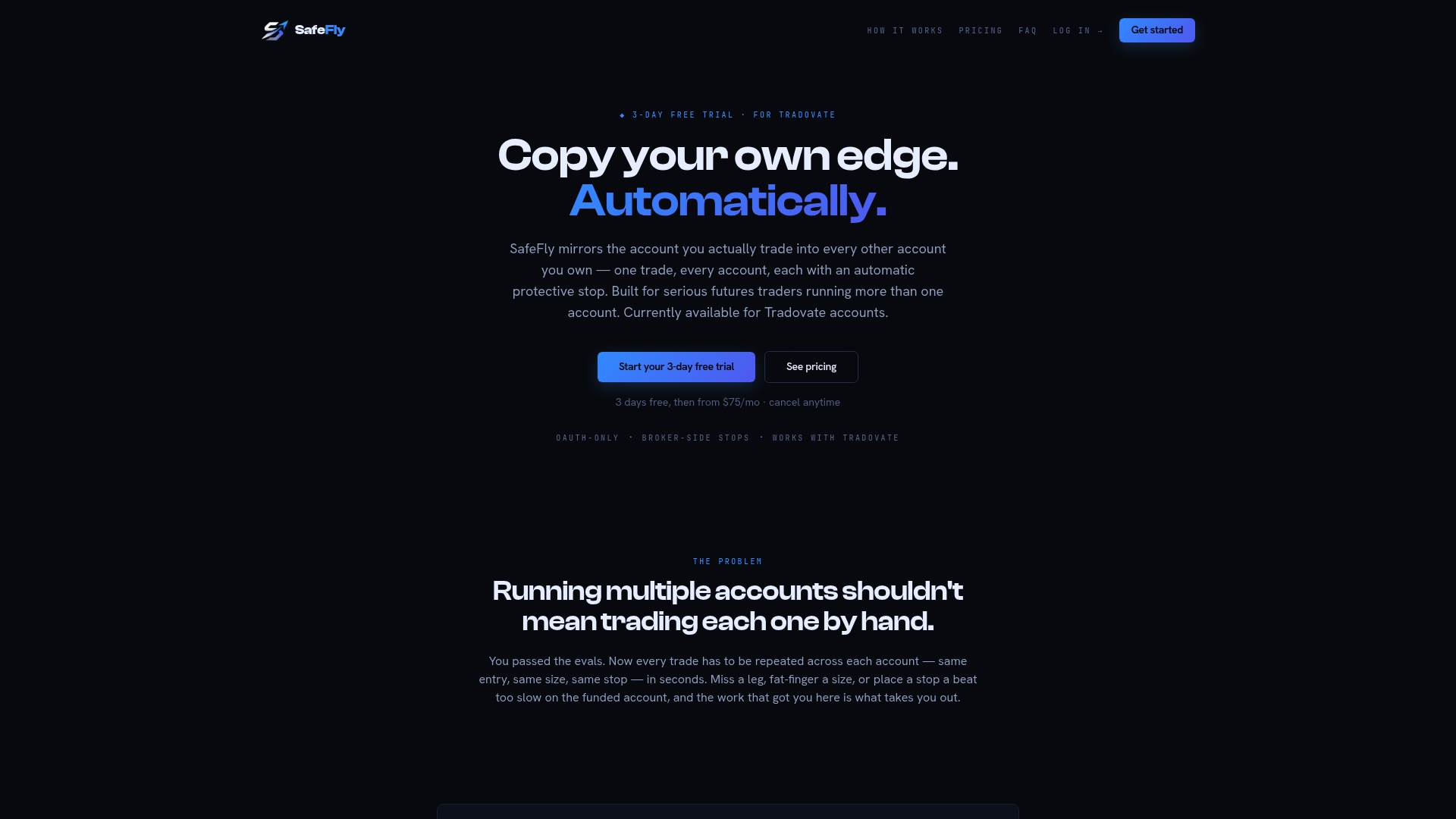
Per-follower sizing and contract ratios keep dollar risk consistent across every mirrored account without manual recalculation, and daily PnL lockouts sit on top of per-trade stops to catch the compounding-loss scenario a single stop can't. Reconciliation runs automatically in the background, reattaching stops if a follower position drifts out of sync, and detailed trade analytics with AI coaching give you visibility into where limits are actually working versus where they're getting tested. For anyone weighing manual copying against automation, the Tradovate copy trading configuration guide walks through the signal-mode setup in more detail.
The sensible way to evaluate any of this is the same staged approach outlined earlier: start on a demo, confirm stop persistence under a forced disconnection, move to small live size, then scale once the reconciliation logs show a clean stop-attach rate. Review the how SafeFly works page for the full technical breakdown, or check the risk disclosure for the specifics on daily lockouts before starting your trial.
Sources
- § 1.73 Clearing futures commission merchant risk management (CFR)
- Best Practices For Automated Trading Risk Controls And System Safeguards (FIA, 2024)
- NASDAQ Futures pre-trade risk management (NQF pre-trade risk PDF)
- CrossTrade Tradovate copier documentation