

A time stop closes a trade after a fixed elapsed period, regardless of price, and it works best as a complement to a price stop, not a replacement for one. It fits short and medium-horizon strategies particularly well, and it eliminates dead capital sitting in trades that stall. This article covers setup logic, backtest methodology, and a checklist for implementation.
TL;DR:
- Use time stops for trades with holding periods between one day and several weeks, aligning window choice with market regime and strategy type.
- Backtest multiple time and price stop combinations on historical data, focusing on expectancy, tail risk, and the natural clustering of winners and losers in time.
- Avoid overfitting the window to limited data, and ensure consistent rules by automating execution and logging exit reasons for accurate analysis.
- Consider a hybrid triple-barrier approach to combine the benefits of time and price stops while managing potential tail risk.
Table of Contents
- What A Time Stop Is And How It Differs From Price Stops
- When To Use Time Stops: Matching Windows To Strategy
- How To Set A Time Stop: Heuristics And Operational Rules
- How Time Stops Reshape Your Outcomes Compared To Price Stops
- Backtest And Validate Your Time-Stop Rule
- Common Pitfalls And How To Avoid Them
- Action Checklist To Implement A Time Stop Today
- Author Perspective: Why Automated Enforcement Changes The Time-Stop Conversation
- Automate Your Time-Stop And Price-Stop Rules Across Accounts
- Sources
What A Time Stop Is And How It Differs From Price Stops
A time stop exits a trade after a fixed elapsed period, measured in bars, trading sessions, or calendar days, independent of what price is doing. Three variants dominate live trading:
- Bar-count stops: exit after N price bars close, common in intraday systems.
- Session-close stops: exit at the end of the trading day regardless of open profit or loss.
- Trading-day stops: exit after N trading days have elapsed, skipping weekends and holidays.
Price stops and trailing stops react to adverse price movement; a time stop reacts to the calendar. That distinction matters for a specific reason: a trade can sit flat for days, tying up margin and attention while doing nothing. Traders adopt time stops mainly to cut that opportunity cost. Capital stuck in a stagnant position is capital that cannot be deployed into a setup that is actually working.
When To Use Time Stops: Matching Windows To Strategy
The right window depends heavily on your holding period and the market regime you are trading. Day traders typically use a session close or an hours-based cutoff. Momentum traders often run windows of 1 to 3 days. Swing and mean-reversion traders tend toward 5 to 10 days, and position traders extend into weeks or months, but only when the underlying thesis genuinely justifies that patience.
- Day trading: exit at session close or after a fixed number of hours.
- Momentum: exit after 1 to 3 trading days if the move hasn't followed through.
- Swing / mean-reversion: exit after 5 to 10 days.
- Position: exit after 4 to 12 weeks, tied to a longer thesis.
Regime matters as much as strategy type. On choppy, mean-reverting days, time stops tend to outperform tight price stops because they avoid getting shaken out by noise. On trending days, price stops usually do the better job, since they let winners run while a time stop would cut them short prematurely. Reading your market's current character, not just your strategy label, should drive the final window choice.
How To Set A Time Stop: Heuristics And Operational Rules
Start with data, not intuition.
- Calculate median holding time for winners from recent trade history.
- Apply a 1.5x to 2x multiplier to set your candidate window.
- Choose trading-day counts over calendar-day counts. Weekend gaps distort calendar timers for intraday and short swing positions.
- Decide execution mechanics: market orders execute immediately but absorb slippage; contingent orders queue at the broker but can miss fills during fast markets.
- Build a hybrid rule where the first barrier to trigger, whether that's the profit target, the price stop, or the time stop, closes the trade.
That hybrid structure is known as the triple-barrier method, and it's the standard way professional systems combine time and price exits without letting one silently override the other.
Pro Tip: Log the exact reason for every exit, whether it was the time stop, the price stop, or the target, in a separate field from your P&L. Without that tag, you can't tell later which barrier is actually doing the work.
How Time Stops Reshape Your Outcomes Compared To Price Stops
The choice between a time stop and a price stop isn't primarily about which one makes you more money on average. It's about which shape of outcome distribution you're willing to live with.
Testing across thousands of intraday trades found that time stops and price stops produce similar average expectancy but very different P&L distributions. Price stops cap the left tail, meaning your worst losses stay bounded and predictable. Time stops, by contrast, produce fatter, more symmetric tails and a higher hit rate, because they let losing trades run within the time window instead of cutting them at a fixed price level.
- Price stops: bounded downside, lower hit rate, cleaner worst-case scenarios.
- Time stops: higher win rate, fatter tails on both sides, less predictable worst case.
- Triple-barrier hybrid: captures the benefits of both by letting the first trigger close the trade.
The practical decision rule comes down to your portfolio constraints. If you're running leverage or a strict max-loss-per-trade limit, weight your exit rule toward the price stop. If your capital allocation can tolerate a wider range of outcomes in exchange for a higher win rate, a time-stop-dominant approach becomes more defensible.
Backtest And Validate Your Time-Stop Rule
Don't guess at a window. Sweep it. Test a grid of time windows against a grid of price-stop distances, and record expectancy, win rate, maximum drawdown, and tail percentiles for every combination.
- Define your grid: for example, time stops from 1 to 10 trading days crossed with price stops at 1x, 1.5x, and 2x ATR.
- Run each combination through your historical trade set using triple-barrier logic, letting the first barrier hit close the position.
- Build a holding-time histogram to see where your current winners and losers naturally cluster.
- Calculate the hazard rate, the probability a trade that's still open at day N ends up a loser if held longer.
- Adjust expectancy for realistic slippage and commissions before comparing windows.
- Flag the worst-decile loss for each window to see how tail risk shifts as the window widens.
| Metric | What It Tells You |
|---|---|
| Holding-time histogram | Where winners and losers naturally cluster in time |
| Hazard rate | Odds a trade still open at day N becomes a loser |
| Slippage-adjusted expectancy | Real edge after realistic execution costs |
| Worst-decile loss | How bad your tail risk gets at each window setting |
Pick the N where marginal reward starts decaying faster than marginal risk. A post-trade review template makes this sweep far less tedious than rebuilding the histograms by hand every time.
Common Pitfalls And How To Avoid Them
Most time-stop failures come from small mistakes repeated across every trade, not one catastrophic error.
- Overfitting N to a small sample. Thirty trades is not enough to lock in a window; treat any result under 100 trades as provisional.
- Extending a stop emotionally because "it's about to turn around." That single override defeats the entire purpose of a mechanical exit.
- Mixing calendar-day and trading-day counts within the same system. Pick one standard and log it as a rule.
- Ignoring commissions, contract expiry, and after-hours fills, which can quietly distort your recorded expectancy.
Pro Tip: Keep a running tally of how many times you've manually overridden a time stop. If that number climbs above zero in a given month, your backtest results no longer reflect your live behavior.
Action Checklist To Implement A Time Stop Today
- Pull your last 100 to 200 trades and calculate the median holding time for winners.
- Build 2 to 3 candidate time windows and backtest each using triple-barrier rules against your existing price stop.
- Deploy the strongest candidate in a paper account or a small live position size.
- Log every exit reason: time, price, or target.
- Review results after 30 to 90 trades before scaling the rule to full size.
Author Perspective: Why Automated Enforcement Changes The Time-Stop Conversation
Manual time stops fail for a boring reason: traders forget to check the clock, or they're watching a different chart when the window closes. Across multiple Tradovate accounts, that lapse multiplies. Automated enforcement, including broker-side protective stops and daily P&L lockouts, closes that gap by executing the rule the same way every time, on every account, without waiting on human attention.
That consistency is what separates a backtest that looks good on paper from a rule that survives contact with live trading. The analytics layer matters too. You can't calibrate a time stop you're not measuring.
— Arturo
Automate Your Time-Stop And Price-Stop Rules Across Accounts
Testing a time-stop window is one problem. Enforcing it consistently across several Tradovate accounts, every session, without missing an exit, is a different one entirely. Trade replication from a lead account to other accounts can be automated, attaching protective stops to every position and applying daily profit and loss lockouts so a bad session ends on schedule instead of running past your risk limit.
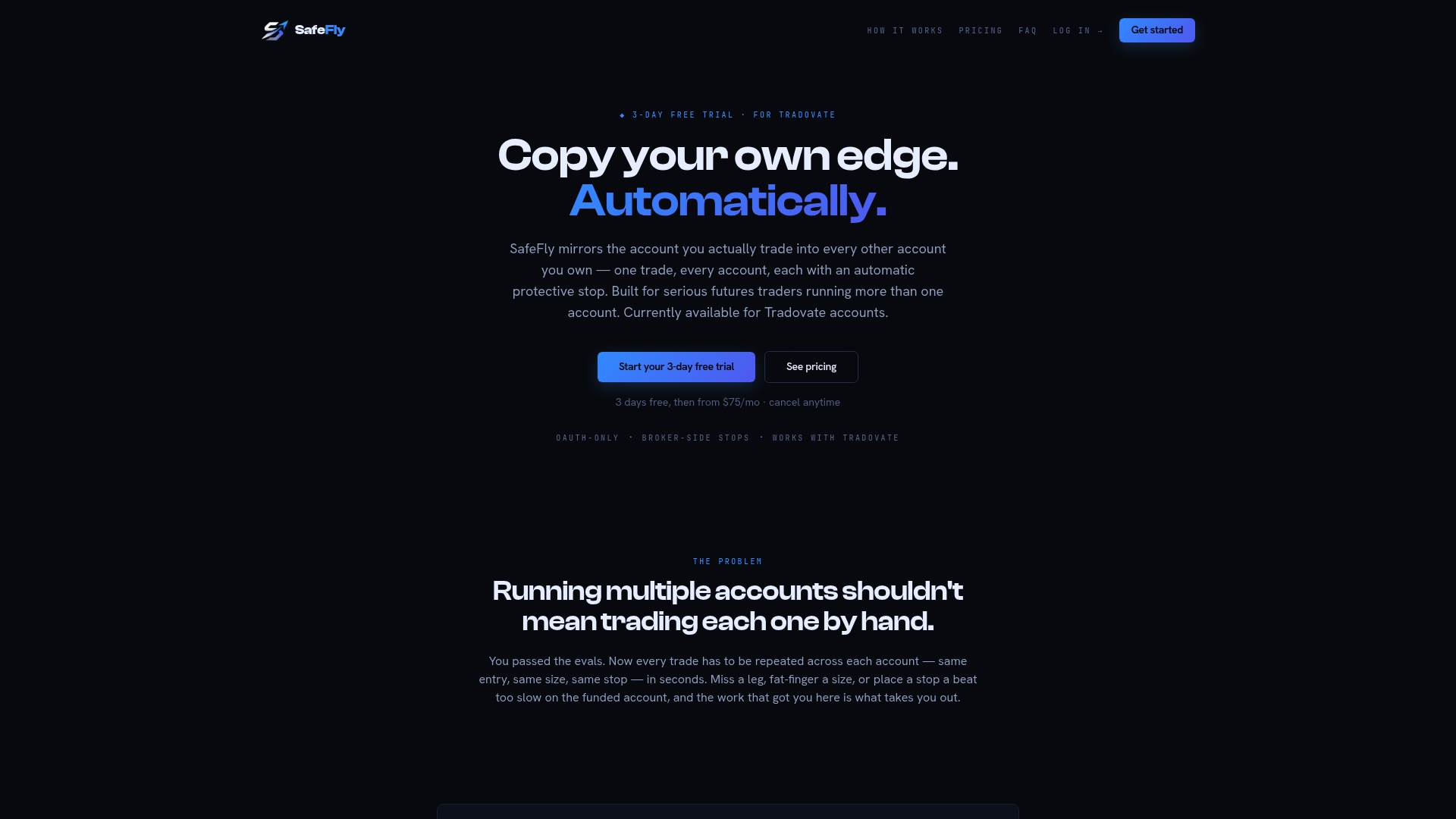
That combination matters most for the traders this article is written for: people managing time-stop and price-stop rules across multiple accounts who can't watch every clock manually. Detailed trade analytics let you see holding-time patterns and hazard rates directly from your own execution history, instead of estimating them by hand. If you're ready to see how the mirroring and broker-side stops work in practice, check out how SafeFly works and start a trial on your own accounts.
Sources
For deeper reading on the concepts covered here: the CFTC's investor resources cover market structure basics relevant to automated exits; Vortex Capital Group's analysis details the tail-shape trade-off; Finaur's exit-physics guide covers triple-barrier implementation; and The Final Tape's review template supports post-trade validation.
- The Time-Stop Premium: Your Exit Shapes the Tail, Not the Edge | Vortex Capital Group
- Stop Loss Placement: Exit Physics with Price and Time Stops
- Time Stops: Exiting When Price Stalls for Too Long | Pomegra Learn Library