

Follower disconnect behavior refers to the moment a mirrored or copied account stops receiving trade updates from a lead account, whether through a dropped session, a broker-side outage, or a revoked permission. The immediate consequence is a position that may sit unprotected while the lead account continues trading. The first action for any trader running multi-account automation is to confirm that broker-side protective stops are active on every open position or to pause copying until that confirmation is complete.
TL;DR:
- Positions without broker-side protective stops can be exposed to significant risk during disconnections, potentially leading to large losses or margin calls.
- Technical failures such as session expiry, API errors, or network outages are the most common causes of follower disconnects, with manual follower actions also creating identical symptoms.
- Continuous monitoring of order acknowledgment, fill rates, and profit and loss divergences can help detect disconnections early before losses occur.
- Implementing safeguards like mandatory broker stops, daily profit and loss limits, automated token refresh, and regular failover testing greatly reduces the risk and impact of disconnections.
- When a disconnect is detected, traders should immediately verify protective stops, pause copying, gather logs, and contact support before attempting full recovery.
Table of Contents
- What follower disconnect behavior looks like in practice
- Common causes: technical and operational triage
- Risks and impacts when copied accounts lose connection
- Detecting disconnects before they become losses
- Practical mitigation strategies to reduce disconnect risk
- Quick action checklist for the moment followers disconnect
- Lessons from operating multi-account automation
- How SafeFly addresses disconnect risk for Tradovate traders
- Primary sources and further reading
- Sources
- FAQ
What follower disconnect behavior looks like in practice
A follower disconnect is not the same as a routine session drop or a deliberate permission revocation, though all three produce similar symptoms on the surface. A session drop typically resolves on its own once connectivity returns. A permission revocation is intentional and usually traceable to the follower's account settings. A true disconnect, by contrast, leaves the follower account out of sync with the lead account for an unpredictable period, often without any alert reaching the trader.
The technical mechanics behind these events vary, but they tend to fall into a few recognizable categories.
- Missing fills on follower accounts while the lead account shows executed orders.
- Gaps in trade timestamps that do not match the lead account's activity log.
- Profit and loss figures that diverge sharply between lead and follower accounts within the same session.
- API error codes or repeated authentication failures in the automation platform's logs.
These symptoms usually trace back to session or token expiry, broker API errors, or interruptions somewhere along the order-routing path between the automation layer and the broker.
Common causes: technical and operational triage
Diagnosing a disconnect quickly means working through causes in order of likelihood and severity. The NFA's cybersecurity guidance notes that connectivity failures can originate from ISP routing problems, router or power failure, session resets, or broker-path issues, even when the local internet connection appears normal.
- Network and infrastructure failures: ISP outages, router resets, or power loss at the trading location can sever the connection without any warning from the platform itself.
- Broker-side outages or maintenance: Scheduled maintenance windows or unplanned outages on the broker's infrastructure, including Tradovate's own API paths, can interrupt order flow for all connected accounts simultaneously.
- OAuth token expiry or permission revocation: Secure OAuth connections require periodic token refresh; a missed or failed refresh cycle can silently disconnect a follower account.
- Automation misconfiguration: Missing or improperly configured server-side stops mean that even a properly connected follower account may hold an unprotected position.
- Follower-side actions: Manual unfollows, account closures, or deliberate permission changes on the follower's end will look identical to a technical disconnect in the logs.
Working through this list in order, starting with the most common infrastructure issues before assuming a deeper platform fault, shortens the time between detection and resolution.
Risks and impacts when copied accounts lose connection
The financial exposure from a follower disconnect depends entirely on whether protective stops were already in place before the connection dropped. Positions without a broker-side stop can sit exposed to further adverse price movement for as long as the disconnect persists, and in fast-moving futures markets that window can be enough to trigger a margin call or forced liquidation.
- Unprotected positions can widen losses well beyond what the lead account experiences.
- Margin calls become more likely when follower and lead accounts diverge in unrealized profit and loss.
- Traders who discover a disconnect after a loss has already occurred are more prone to revenge trading, compounding the original problem.
- Firms operating under NFA oversight carry recordkeeping and, in some cases, incident-notification obligations tied to operational disruptions.
Industry guidance from the NFA treats third-party automation and broker connectivity as operational-risk dependencies that firms are expected to document and include in incident playbooks, as outlined in its cybersecurity guidance. This framing matters because a disconnect is not just a technical inconvenience, it is an operational event with recordkeeping consequences for regulated firms.
Detecting disconnects before they become losses
Early detection depends on instrumenting the right signals rather than waiting for a trader to notice a discrepancy manually. Order acknowledgment latency, fill-rate divergence between lead and follower accounts, and the correlation between follower and lead profit and loss curves are the three metrics worth tracking continuously.
- Set alerts for repeated failed order submissions rather than waiting for a single failure to escalate.
- Flag token-expiry warnings from the OAuth layer before the token actually lapses.
- Watch for specific broker error codes that indicate session or connectivity problems rather than order-rejection issues.
- Correlate missed fills against known network or broker outage windows to separate local problems from broader ones.
Centralizing broker and automation logs with consistent timestamps makes root-cause analysis faster once an incident has already occurred, since scattered logs across multiple systems are the most common reason post-incident reviews stall.
Pro Tip: Log every OAuth token refresh event, successful or failed, so a pattern of near-misses becomes visible before an actual disconnect happens.
Practical mitigation strategies to reduce disconnect risk
Reducing the impact of a follower disconnect starts well before any incident occurs, with a set of technical and operational controls that work together.
- Require broker-side protective stops on every order and validate their presence programmatically rather than assuming they were applied correctly.
- Automate OAuth token refresh with monitoring on expiry windows, and log every authentication event for later review.
- Build retry logic and idempotent order flows so a retried order cannot accidentally duplicate a position, along with failover routing for order submission when a primary path fails.
- Enforce daily profit and loss lockouts that automatically halt trading once a defined loss threshold is reached, capping downside independent of human intervention.
- Document a follower permission policy and incident playbook, and run scheduled failover tests under simulated load rather than waiting for a live incident to reveal gaps.
The order matters. Server-side stops address the immediate financial exposure, OAuth hygiene and retry logic address the technical failure modes, and lockouts and playbooks address the operational and behavioral fallout once an incident has occurred.
Pro Tip: Test failover procedures during a low-volume session first. A failover path that has never been exercised under real order flow is not a tested path.

Quick action checklist for the moment followers disconnect
When a disconnect is detected, speed matters more than completeness. Work through this sequence first, then circle back for a full review.
- Verify broker-side protective stops are active on every open position; pause copying immediately if you cannot confirm this.
- Place manual protective orders where the platform or broker interface allows direct intervention.
- Contact broker support, gather session and error logs, and reauthorize the OAuth connection if the disconnect appears token-related.
- Reconcile fills between lead and follower accounts once connectivity is restored.
- Run a post-incident root-cause review before resuming full automation.
Lessons from operating multi-account automation
Server-side stops and daily lockouts are not optional safeguards, they are the baseline that makes multi-account automation survivable when something inevitably goes wrong. Failover paths that look sound on paper often reveal gaps only when tested under real order volume, which is why regular failover testing matters more than most operators assume. The hardest design tradeoff is balancing execution speed against the extra verification steps that protection requires, and that tradeoff should always be resolved in favor of protection.
— Arturo
How SafeFly addresses disconnect risk for Tradovate traders
For traders managing multiple Tradovate accounts, SafeFly mirrors trades from a lead account automatically and requires a broker-side protective stop on every copied trade before it executes, as described in the platform's disconnection trade protection documentation. Connections run through secure OAuth, and daily profit and loss lockouts cap downside without manual intervention, addressing the revenge-trading risk discussed in SafeFly's lockout feature notes.
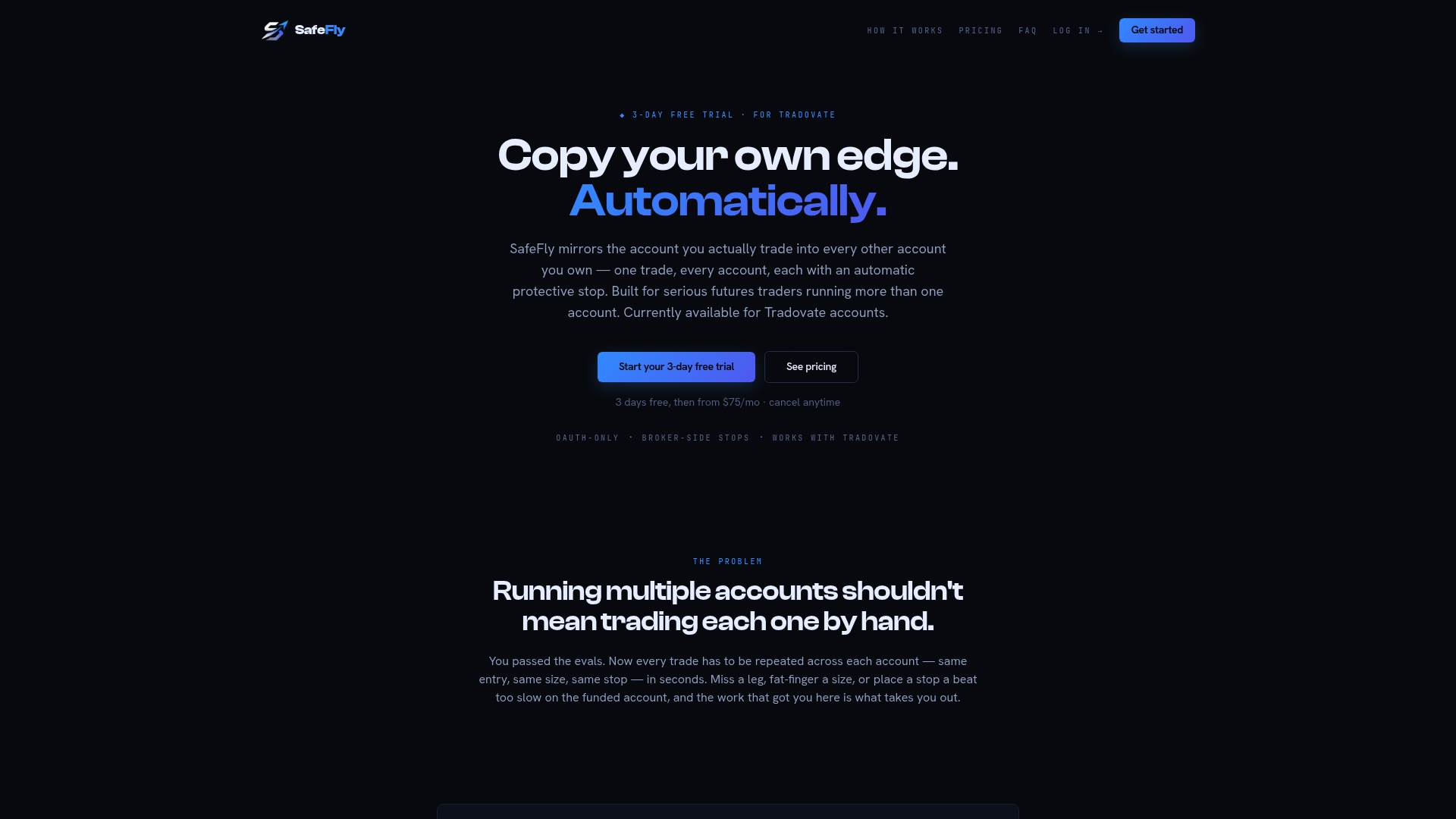
- Broker-side protective stops applied automatically to every mirrored trade.
- Secure OAuth integration with no stored passwords.
- Daily profit and loss lockouts to cap losses across accounts.
- Detailed trade analytics and AI-driven coaching to reduce reactive decision-making.
| Mitigation need | SafeFly feature |
|---|---|
| Unprotected positions during disconnect | Broker-side protective stop on every copied trade |
| Token or session hygiene | Secure OAuth connection, no stored credentials |
| Behavioral escalation after losses | Daily profit and loss lockouts |
| Detection and review | Detailed trade analytics and AI coaching |
Plans are available in tiered monthly subscriptions with details provided on the pricing page, including a trial period for evaluation before committing.
Primary sources and further reading
- NFA cybersecurity guidance on operational resilience and incident documentation.
- Sprinklr's 2026 analysis on engagement and follower attrition.
This article is general information, not a substitute for advice from a qualified financial advisor. Consult a qualified financial professional about your own circumstances before acting on anything here.
Sources
FAQ
What causes a follower account to disconnect from copy trading?
Disconnects usually come from network or broker outages, expired OAuth tokens, or automation misconfigurations, though a deliberate unfollow or permission change can look identical in the logs. Reviewing centralized logs quickly is the fastest way to tell these apart.
Are unprotected positions during a disconnect always a total loss?
No, the outcome depends on price movement during the disconnect window and whether a broker-side protective stop was already in place before the connection dropped. Positions with an active stop are limited in downside even if the connection stays down.
How often should failover procedures be tested?
There is no single fixed interval, but testing failover paths under simulated order flow on a regular schedule, rather than only after an incident, is the practice reflected in the NFA's guidance on operational resilience.
Does SafeFly apply protective stops automatically on every mirrored trade?
Yes, SafeFly requires a broker-side protective stop on every trade it copies from a lead account to follower accounts before execution, a core part of its disconnection trade protection design described on its product page.
What should a trader do first when a disconnect is suspected?
Confirm whether broker-side protective stops are active on the affected positions and pause copying if that cannot be verified immediately. From there, gather logs, contact broker support, and reconcile fills once the connection is restored.