
Partial close synchronization automatically mirrors a partial position closure from a lead Tradovate account to every linked follower account, while enforcing broker-side protective stops and portfolio-level risk controls on each account it touches. For traders running several funded or personal accounts at once, this eliminates the manual reentry that causes mismatched exposure between accounts. SafeFly and other automation layers built for this job rely on the same core engineering: signal fan-out, per-account sizing, and failover-safe stops, which the rest of this guide breaks down in operational detail.
TL;DR:
- Partial close synchronization relies on accurate proportional sizing for each follower to prevent overexposure, especially during rapid market moves.
- Latency between leader and follower orders, typically tens to hundreds of milliseconds, can cause fill divergence, making broker-side stops essential for protection.
- Detecting partial fills or stuck orders quickly requires real-time dashboards and independent broker-layer monitoring to avoid unnoticed risk buildup.
- Risk management should include portfolio-level P&L limits, individual account stops, and phased addition of new accounts to avoid cascading losses.
- Testing with small accounts and simulating disconnections before scaling can prevent widespread issues, as resilience depends on robust failover and reconciliation procedures.
Table of Contents
- How Partial Close Synchronization Works: Architecture and Execution Flow
- Failure Modes and Execution Realities in Partial Close Synchronization
- Risk Controls and Operational Checklist for Safe Scaling
- How SafeFly Applies These Controls in Practice
- What Actually Matters When You're Running This Live
- SafeFly: What to Verify Before You Commit
- Sources
- FAQ
How Partial Close Synchronization Works: Architecture and Execution Flow
Every partial close synchronization system runs on a leader/follower model. One account, the lead, generates the trading signal (a partial close on a live position), and the system fans that signal out to every connected follower account, converting it into individually sized orders. This fan-out step is where most of the engineering complexity lives.
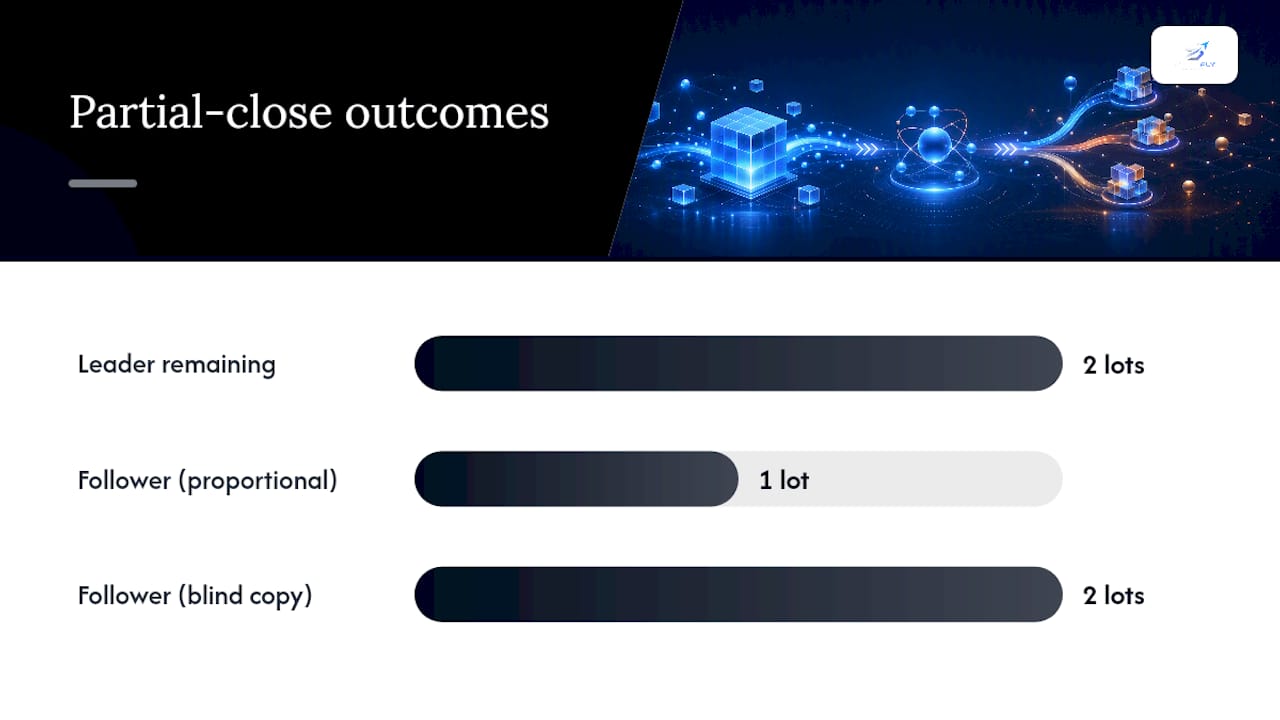
A signal does not simply repeat itself across accounts. The platform has to translate a single partial close, say, cutting a 6-lot position down to 2 lots, into proportional orders for each follower based on that account's own position size. A follower holding 3 lots gets a proportional partial close, not a blind copy of the leader's contract count. Getting this per-account sizing logic wrong is one of the fastest ways to create silent overexposure across a portfolio, since a copied lot count rather than a copied percentage can leave one account carrying far more risk than the others.
Underneath the sizing logic sits the connection layer. Each follower account needs its own OAuth broker session rather than a shared credential, both for security and because Tradovate's account architecture treats each account as a distinct execution endpoint. Losing one session should never take down the others.
Reliable systems also build in:
- Idempotency keys on every order so a retried signal never gets submitted twice.
- Retry logic with exponential backoff for transient broker rejections.
- Fair-queue or randomized submission ordering so no single follower systematically gets the best fills, a fairness point Purefinancialacademy is essential in any multi-account copier.
- Low-latency routing, since signal fan-out design determines whether follower fills stay comparable to the leader's.
Realistic latency between the leader's fill and a follower's order submission runs from tens of milliseconds to the low hundreds, depending on broker connection quality and how many accounts are in the fan-out. That gap is small, but in fast futures markets it is enough to create fill divergence, which is exactly why broker-side stops matter: if a follower's connection drops mid-cycle, the protective stop already resting at the broker keeps working regardless of what happens to the automation layer.
Failure Modes and Execution Realities in Partial Close Synchronization
Partial fills are the most common failure mode, and they compound. If the leader's partial close fills completely but three followers each get partial fills on their proportional orders, the portfolio now holds three different exposure levels on the same trade. Left unnoticed for even a few minutes, that divergence changes the actual risk profile of every account beyond what the trader intended, since replication across accounts introduces latency that can cause partial fills and state divergence.
Stuck or "working" orders are the second common issue. An order that never fully executes leaves an account in a state that no longer matches the leader, and without active reconciliation, that mismatch can persist across multiple trading sessions unnoticed.
When either failure mode appears, the response sequence matters more than the diagnosis:
- Halt new cloning immediately so the mismatch does not spread to the next signal.
- Freeze any working orders across affected followers rather than canceling and resubmitting blindly.
- Reconcile positions against the leader account, account by account, before allowing any resumption.
- Run a safe resync once every account's position and order state is confirmed clean.
Detection speed depends entirely on monitoring architecture. A fill status dashboard showing leader versus follower state in real time catches most divergence within seconds. But the dashboard should never be the only line of defense; independent broker-layer monitoring through a feed like Rithmic catches replication failures that a copier's own interface might miss, since the platform reporting the problem is sometimes the same platform that caused it. Pairing dashboard alerts with an independent check is the difference between catching a stuck order in seconds versus discovering it after the session closes.
Risk Controls and Operational Checklist for Safe Scaling
Adding accounts or increasing notional size without a portfolio-level worst-case analysis is how a single bad signal turns into a multi-account drawdown. Before scaling, run a simultaneous-drawdown scenario: what happens if every follower hits its stop on the same trade at once. If that number is uncomfortable at five accounts, it will not feel better at fifteen.
Correlated losses across many funded accounts behave like a single large position, not several small independent ones. That means portfolio-level controls, not just account-level ones, carry the real weight:
- Set a hard daily portfolio P&L lockout that halts all new order flow once the combined accounts hit a defined loss threshold.
- Set per-account equity stops at the broker level, so a single account's failure cannot exceed its own defined limit.
- Activate new followers in small groups rather than all at once, and let each group run for a defined period before adding the next.
- Build an equity buffer into each account before connecting it as a follower, since a thin account has almost no room for a rough replication cycle.
Pro Tip: Set the per-account max daily loss directly at the broker whenever the account supports it, then layer a centralized portfolio lockout on top. If the automation layer goes down, the broker-side limit still holds the line.
A short pre-session checklist catches most of what causes trouble later in the day: pull a consolidated ledger across every account, verify every broker connection is live, and check that no account is already sitting near its daily warning threshold before the first trade goes out. Traders who treat this as a five-minute habit rather than an occasional audit catch far more problems before they cost money. Reviewing copy trading risk management practices for Tradovate accounts before scaling further gives a useful baseline for how these controls should interact.
How SafeFly Applies These Controls in Practice
SafeFly's stated architecture maps directly onto the failure modes above rather than treating them as separate features. Broker-side protective stops sit at the exchange or broker level on every copied trade, so disconnect risk doesn't leave a follower account unprotected if the automation layer itself loses connection. OAuth integrations mean each follower authenticates independently, without shared or stored passwords. Daily P&L lockouts enforce the portfolio-level stop discussed above, and detailed trade analytics give a trader the reconciliation view needed to catch fill divergence before it compounds.
A short vetting process during a trial or demo tells you most of what you need to know:
- Connect one leader and two followers, and run small-contract live trades for a short period before adding size.
- Confirm the protective stop actually posts at the broker, not just inside the platform's own order book.
- Simulate a disconnection on a follower account and confirm the stop holds and the resync procedure brings the account back in line cleanly.
- Ask directly: how are idempotency keys handled on retried signals, what is expected round-trip latency between leader fill and follower order, and how frequently does the platform alert on state mismatch?
Answers to those questions, more than any marketing claim, tell you whether the platform's technical foundation holds up under real order flow.
What Actually Matters When You're Running This Live
Synchronized partial closes earn their keep when a strategy depends on tight correlation across accounts, group payout targets, or prop firm structures where every account needs to reflect the same risk posture at the same moment. Staggered or staged activation makes more sense for swing positions held over multiple sessions, where a few seconds of fill divergence barely registers against the trade's overall timeframe.
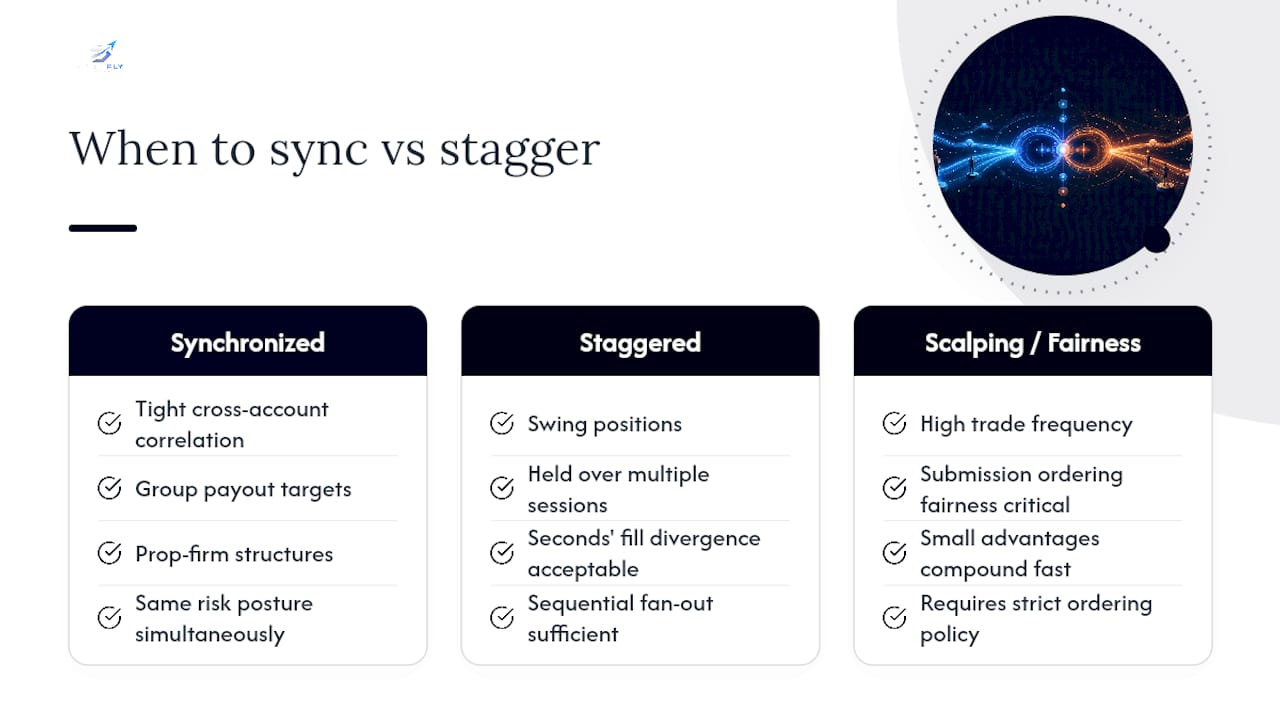
Scalping strategies are a different story. A fairness policy on submission ordering matters far more here, since even small, repeated fill advantages compound quickly across dozens of trades a day. Swing traders can generally tolerate a simpler, sequential fan-out without much cost.
The biggest mistake serious multi-account traders make is scaling account count before scaling their own operational discipline. Pilot new connections cautiously, watch the reconciliation dashboard before you watch the P&L, and only add the next account once the current group has run clean for a full week.
— Arturo
SafeFly: What to Verify Before You Commit
SafeFly's approach to partial close synchronization is built around the same controls this guide walks through: broker-side protective stops on every copied trade, OAuth connections instead of shared credentials, daily P&L lockouts at the portfolio level, and a safe resync path after any outage. Detailed trade analytics and AI coaching sit on top of that foundation, giving traders a reconciliation view rather than a blind trust exercise.
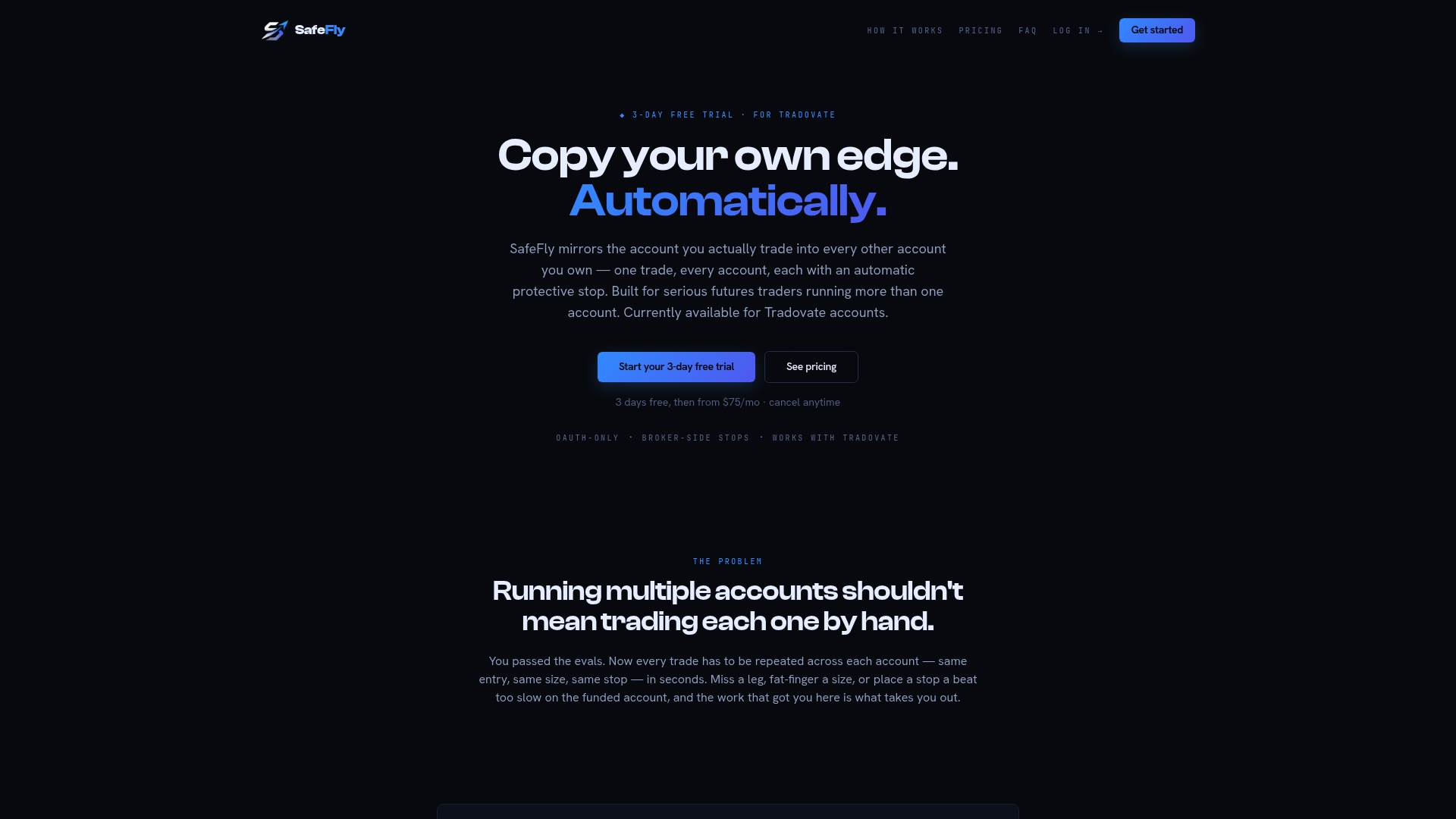
Before committing to a plan, run the same trial checklist from the vetting section above: one leader, two followers, small size, then a simulated disconnect to confirm the stop and resync both hold. SafeFly's Basic, Pro, and Ultra plans differ mainly in analytics depth and market-data tools, with Ultra adding a dealer gamma-exposure screener built into the main platform. Compare the full plan lineup and pricing and start a trial on the account structure you already run today.
Sources
For deeper detail on the mechanics covered above, NexusFi's portfolio approach to multi-account trading covers leader/follower replication risk in depth. ClearEdge Trading's scalability guide breaks down fan-out architecture and broker connection limits. Pure Financial Academy's trade copier overview explains fairness and emergency-stop features worth confirming in any platform you evaluate.
- Managing Multiple Funded Accounts: The Portfolio Approach to Prop Firm Trading - NexusFi Academy
- Mastering Automated Futures Trading Scalability Across Multiple Accounts | ClearEdge Trading
- Futures Trade Copier — How to Copy Trades Across Multiple Futures Accounts
FAQ
What Is Partial Close Synchronization in Tradovate Trading?
It's the automated mirroring of a partial position closure from a lead Tradovate account to one or more follower accounts, sized proportionally to each account's own position. Broker-side protective stops and portfolio risk controls stay active on every follower throughout the process.
Why Do Follower Accounts Get Different Fills Than the Leader?
Latency between the leader's fill and each follower's order submission, typically tens to low hundreds of milliseconds, means market conditions can shift slightly by the time a follower's order reaches the broker. Replication introduces this latency by design, which is why fill status monitoring matters more as account count grows.
How Do Broker-Side Stops Protect Against Disconnection?
A broker-side stop is placed and held at the broker or exchange level rather than inside the automation platform, so it keeps working even if the platform loses connection. This is one of the core failover protections built into SafeFly's approach to multi-account mirroring.
How Much Does SafeFly Cost?
SafeFly offers three tiers: Basic at $49 per month, Pro at $119 per month, and Ultra at $250 per month. Ultra adds a dealer gamma-exposure screener on top of the analytics and coaching features included in the lower tiers.
What Should I Test Before Scaling to More Accounts?
Start with one leader and two followers trading small size, confirm broker-side stops post correctly, and simulate a disconnection to verify the resync process before adding more accounts. Running each new account group for a full week before scaling further catches most fill and state-mismatch issues early.