

Tick size fixes the price grid, and tick value fixes the dollar effect that grid produces. Every stop order you place has to land on a valid tick, and the number of ticks between your entry and your stop, multiplied by tick value, is your actual dollar risk. Get the tick math wrong, and your "small" stop can be twice the risk you intended.
TL;DR:
- Incorrectly calculating tick distance in points instead of ticks can quadruple the intended risk level, especially on contracts like ES versus MES.
- Always verify the current tick size and value from official exchange sources before placing orders to prevent silent rounding errors that alter risk calculations.
- Using micro contracts allows finer control of risk with smaller tick value adjustments, making stop placement more precise relative to account size.
- Automated trade mirroring systems prevent rounding discrepancies across multiple accounts by enforcing broker-side, tick-correct stop orders.
- Checking the exchange's official specs and previewing orders avoids costly mistakes caused by ignored or outdated tick specifications, especially during high market volatility.
Table of Contents
- What Is Tick Size and Tick Value in Futures Trading?
- Why Does Tick Size Determine Your Actual Dollar Risk?
- How Do Platforms Handle Invalid Stop Prices?
- What's the Step-by-Step Workflow for Sizing Stops by Tick?
- What Mistakes Cost Traders the Most on Stop Placement?
- How Automation Keeps Stops Tick-Correct Across Multiple Accounts
- A Trader's Pre-Submit Checklist
- Keep Your Stops Tick-Correct Across Every Account
- Where to Verify Current Tick Specifications
- Sources
What Is Tick Size and Tick Value in Futures Trading?
Tick size is the smallest price increment a contract can move. Tick value is what that increment is worth in dollars once you factor in the contract multiplier. The two numbers are connected by one formula:
Tick Value = Tick Size × Contract Multiplier
A "point" is a different unit entirely. It's the whole-number price move, and it usually contains several ticks. Confusing a stop distance of "5 points" with "5 ticks" is one of the fastest ways to blow up a position size calculation.
Exchanges, not brokers or platforms, set tick sizes as part of each contract's official specifications, and those specs can change. The CME Group has adjusted tick sizes on several products over the years, so a value you memorized two years ago may no longer be current.
Here's how the math plays out across commonly traded contracts:
Notice that MES carries one tenth the tick value of ES, even though both track the same index. That single fact changes how you size stops on a micro account versus a standard one.
Why Does Tick Size Determine Your Actual Dollar Risk?
Your stop distance in ticks, not points and not price levels, is what converts into real dollars. The formula traders rely on is straightforward:
Dollar Risk per Trade = Ticks to Stop × Tick Value × Number of Contracts
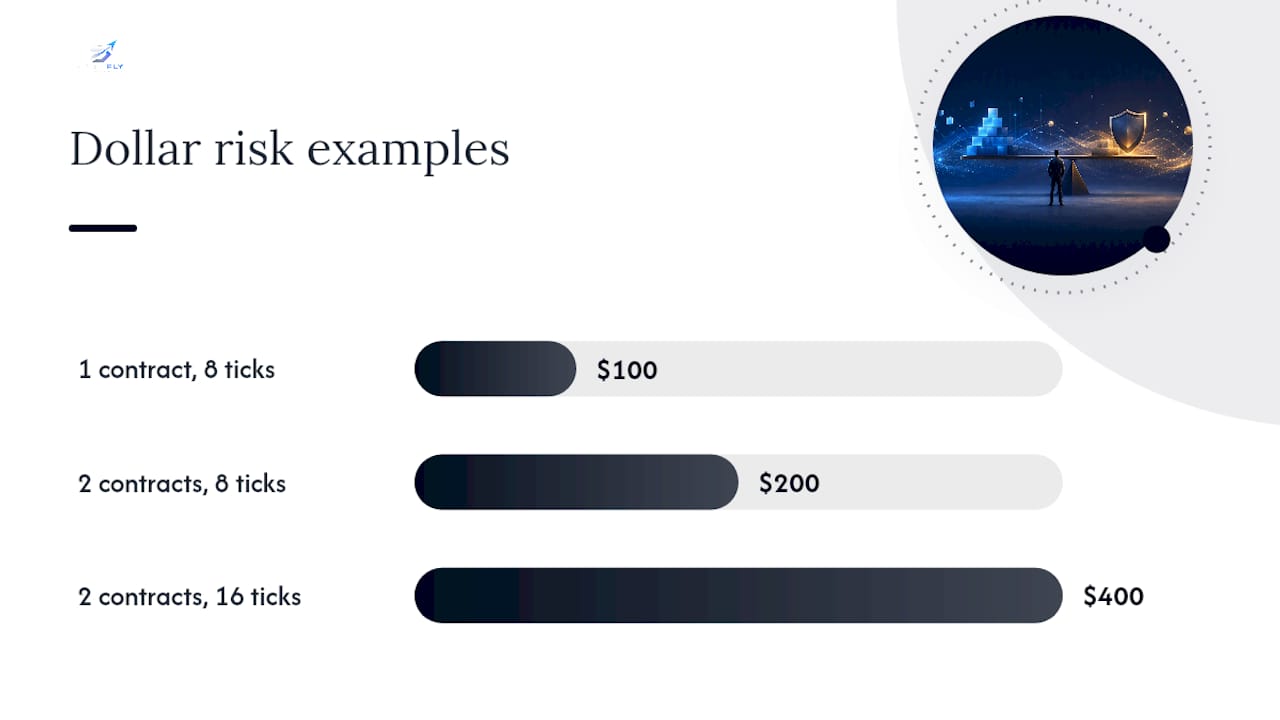
Work through an ES example. A stop set 8 ticks away, on one contract, at $12.50 per tick, produces $100 of risk as the product of these values. Add a second contract and the same stop distance now risks $200. Widen the stop to 16 ticks on that same two lots and you've quadrupled your original single-contract risk to $400.
Three numbers matter every time you size a trade:
- Ticks to stop. Count the actual increments between entry and stop, never the point distance.
- Tick value. Pull this from the current contract specification, not from memory.
- Contract count. Multiply last, after ticks and value are locked in.
Tick size also sets a floor under execution cost. The minimum bid-ask spread is one tick, and a round-trip trade costs at least twice the tick value once you cross that spread on entry and exit. On CL, the minimum round-trip cost is twice the tick value, reflecting spread crossing costs before market movement. In a low-liquidity window, that spread can widen past one tick, and your realized risk moves further from your planned risk.
How Do Platforms Handle Invalid Stop Prices?
Exchanges enforce the tick grid, and your platform will not let an order sit off it. Submit a stop price that falls between valid ticks and most platforms will auto-round it to the nearest valid tick rather than reject it outright, though some will reject the order and force you to resubmit.
The consequence shows up in your risk math, not just your order ticket. Suppose you calculate a stop at 2731.13 on a contract that only trades in 0.25 increments. The platform rounds that to 2731.00 or 2731.25. On a large position, that quarter-tick difference can shift your dollar risk by more than you'd expect once multiplied across several contracts.
A few checks before you send the order:
- Confirm the current tick size on the exchange's contract specification page, not a saved note from last quarter.
- Preview the order before submitting. Most platforms show the rounded price if one applies.
- Cross-check the fill price against your intended stop after execution, especially on fast markets.
Pro Tip: Run a test order in your platform's simulator before trading a contract you haven't used before. Watching how it rounds a deliberately invalid price teaches you more about the platform's behavior than reading the spec sheet ever will.
What's the Step-by-Step Workflow for Sizing Stops by Tick?
A repeatable process removes most of the guesswork from placing a correctly sized stop:
- Pull the current contract specs. Confirm tick size and tick value directly from the exchange or your broker's contract page.
- Set your stop distance in ticks, based on chart structure, volatility, or a fixed strategy rule, never in points.
- Calculate dollar risk per contract: ticks to stop × tick value.
- Divide your risk budget by that per-contract figure to get your maximum contract count.
- Preview the order to confirm the platform accepted your exact tick price without silent rounding.
A useful rule of thumb: measure your stop distance against the instrument's Average True Range rather than picking an arbitrary tick count. When the bid-ask spread widens relative to ATR, cut position size rather than stretching the stop wider, which keeps your reward-to-risk ratio intact.
Here's the math on a $50,000 account risking 1% ($500) per trade. On ES with an 8 tick stop at $12.50 per tick, that's $100 per contract, allowing up to 5 contracts. Switch to MES at $1.25 per tick and the same 8 tick stop only costs $10 per contract, allowing up to 50 micro contracts, a far finer level of control over the same $500 budget.
What Mistakes Cost Traders the Most on Stop Placement?
The most expensive error is mixing ticks and points when counting stop distance. A trader who means "5 ticks" but enters "5 points" on ES has just quadrupled the intended risk, since 5 points equals 20 ticks on that contract.
A second common mistake is applying the same stop distance in ticks across different instruments without checking their tick values. An 8 tick stop means something entirely different on ZB than it does on CL.
Mitigation is mostly procedural:
- Reconfirm tick value every time you switch instruments, not just once per account.
- Use micro contracts when you need finer control over dollar risk without changing your strategy.
- Build a worst-case fill assumption into your sizing around the market open and major data releases, when spreads and price impact typically widen beyond the minimum tick.
How Automation Keeps Stops Tick-Correct Across Multiple Accounts
Traders running several Tradovate accounts face a specific version of this problem: a stop that's tick-correct on the lead account can round differently once mirrored to a second or third account with a different position size. Manual replication multiplies the chance of a rounding mismatch or a missed stop entirely.
SafeFly addresses this by mirroring trades from a lead account to others automatically, attaching a broker-side protective stop to each mirrored trade. Because the stop is enforced at the broker level rather than reconstructed manually per account, the tick grid stays consistent across every account in the mirror group, even if one account disconnects. For traders managing multiple accounts under one risk plan, that consistency matters more than any single trade.

A Trader's Pre-Submit Checklist
Before any stop order goes live, run the same four checks every time: verify the current contract spec, calculate ticks to dollars using that spec, size contracts against your risk budget, and preview the order to confirm the platform didn't silently round your price. Skipping any one of these steps is how a well-planned trade turns into an unplanned loss.
The math itself isn't complicated. What trips traders up is treating tick size as a footnote instead of the first number they check. Every stop-loss strategy, every position size, and every risk budget traces back to that single grid value. Traders who build the habit of checking it first, before chart patterns or entry signals, tend to have fewer surprises when a stop actually gets hit. For a deeper look at converting volatility into tick-based stops, the expectancy formula is worth working through alongside your own trade log.
— Arturo
Keep Your Stops Tick-Correct Across Every Account
Manually recalculating tick values and resubmitting stops on three or four Tradovate accounts at once is where costly rounding mistakes happen, usually right when the market is moving fastest. SafeFly mirrors trades from your lead account to every other account automatically, attaching a broker-side protective stop to each one so the same tick-correct risk applies everywhere, even through a disconnection.
That consistency is the practical payoff: one stop calculation, enforced the same way across every mirrored account, instead of four separate manual entries that can each round differently. The system can also layer in daily profit and loss lockouts and detailed trade analytics, so you can see how your tick-based risk decisions played out after the session closes. Read through how SafeFly's mirroring and broker-side stops work and start a trial to see it applied to your own account structure.
Where to Verify Current Tick Specifications
Contract specs change, so confirm them directly rather than relying on memory. Check the exchange's own listing for the contract's official tick size and value, review the Databento microstructure guide for how rounding behaves at the order-book level, and consult Schwab's futures tick value explainer or NinjaTrader's tick size reference for platform-specific behavior before placing size-sensitive orders.
Sources
- Tick size
- Tick Size, Tick Value, and Contract Specifications
- Stock index futures tick values explained
- Tick size and tick value (NinjaTrader support)