

Most trade copiers bill either per connected account or through a tiered monthly subscription, with per-account cloud services charging a moderate fee per account each month and tiered plans covering a range of monthly prices. One-time local licenses also exist, usually requiring a one-time upfront fee that varies widely.
TL;DR:
- Per-account cloud pricing typically costs between $5 and $15 per account monthly, making it more expensive for traders with many accounts.
- Tiered subscription plans usually range from $39 to $149 per month and often offer better value for traders managing multiple accounts.
- Local licenses require a one-time fee between $25 and $175 but exclude ongoing hosting or support costs that can increase total expenses.
- Additional costs like VPS hosting, data feeds, support, and latency requirements can significantly raise total monthly spending beyond the base price.
- For high-volume or institutional traders, plans offering built-in risk management and secure OAuth connections in the cloud provide better long-term value.
Table of Contents
- How Trade Copiers Bill: Models and Price Ranges
- What Drives the Total Cost Beyond the Headline Price
- How to Choose the Right Plan for Your Setup
- Why SafeFly's Design Changes the Cost Calculation
- What Traders Consistently Underbudget
- SafeFly Pricing and How to Get Started
- Sources
- FAQ
How Trade Copiers Bill: Models and Price Ranges
Before comparing two vendors, confirm what unit they actually bill. Some charge per "connection," meaning each broker login you attach, while others count every individual trading account regardless of how many connections feed it. Those two terms sound interchangeable and are not, and mixing them up is the single fastest way to underestimate your real bill.
Four billing structures dominate the market:
- Per-account cloud pricing: Roughly $5 to $15 per connected account per month, often with a minimum of two accounts required to start. Tradecopier from about $8 to $12 per account monthly, while DaneTrades advertises $10 per account with a $20 monthly floor for two accounts.
- Tiered monthly subscriptions: A flat fee that bundles a set number of accounts, connections, or features into named tiers. Tradesyncer's pricing page shows Basic-to-Enterprise bands running roughly $39 to $149 per month.
- One-time local licenses: A single upfront fee, commonly $25 to $175, for software installed on your own machine or VPS rather than run in the cloud. Trade-copier illustrates this model with degressive per-account daily pricing.
- Per-connection engineering fees: Some vendors charge extra when you need a broker or platform integration outside their standard supported list, which matters if you trade through less common connectors alongside mainstream platforms like NinjaTrader.
Billing cadence changes the math further. Tiered plans reward stability; per-account pricing rewards traders whose account count fluctuates month to month.
What Drives the Total Cost Beyond the Headline Price
The advertised price rarely equals your final bill. Six factors typically separate the number on the pricing page from what actually leaves your account each month:
- Seat and account minimums. Many services require at least one master account plus a minimum number of followers before the plan activates, which raises the effective floor price.
- Connections versus accounts. A vendor billing per connection may let one broker login feed several sub-accounts cheaply, while a per-account model charges for each one separately.
- Latency and hosting needs. Traders who need sub-second mirroring across accounts sometimes pay for dedicated VPS hosting on top of the software fee.
- Risk-management features. Broker-side protective stops and daily profit-and-loss lockouts add engineering overhead, and providers that build these in usually price above bare-bones copiers.
- Support tier and SLAs. Priority support or guaranteed response times are frequently gated behind higher-priced plans rather than included by default.
- Data feeds and broker fees. Market data subscriptions, exchange fees, and broker commissions sit entirely outside the copier's price tag but still hit your monthly total.
A headline low fee can mask add-ons like hosting, data feeds, or support contracts that push your effective monthly spend well above the advertised base price. Free or freemium copiers exist, but they commonly strip out support and risk protections, a trade-off worth weighing before you commit to a "$0" plan, as Tradecopia's pricing comparison makes clear.
Pro Tip: *Ask every vendor to define "connection" in writing before you sign up.
How to Choose the Right Plan for Your Setup
Match the plan shape to how you actually trade, not to the lowest number on the page. A solo trader running one master and two or three followers usually fits comfortably inside an entry-level per-account plan. A prop firm manager overseeing a dozen funded accounts across multiple brokers needs a tiered plan built for volume, or risks assembling a per-account bill that balloons past what a tiered rate would have cost. Institutional desks running high-frequency mirroring across many connections typically need dedicated latency and support guarantees that only enterprise tiers include.
Before you commit, ask each vendor to answer these questions directly:
- How many accounts and connections are included in the base price, and what happens above that number?
- Is overage billed per account, per connection, or as a jump to the next tier?
- What is the refund policy if the copier misfires during the trial?
- Does the platform store your broker password, or use a secure OAuth connection instead?
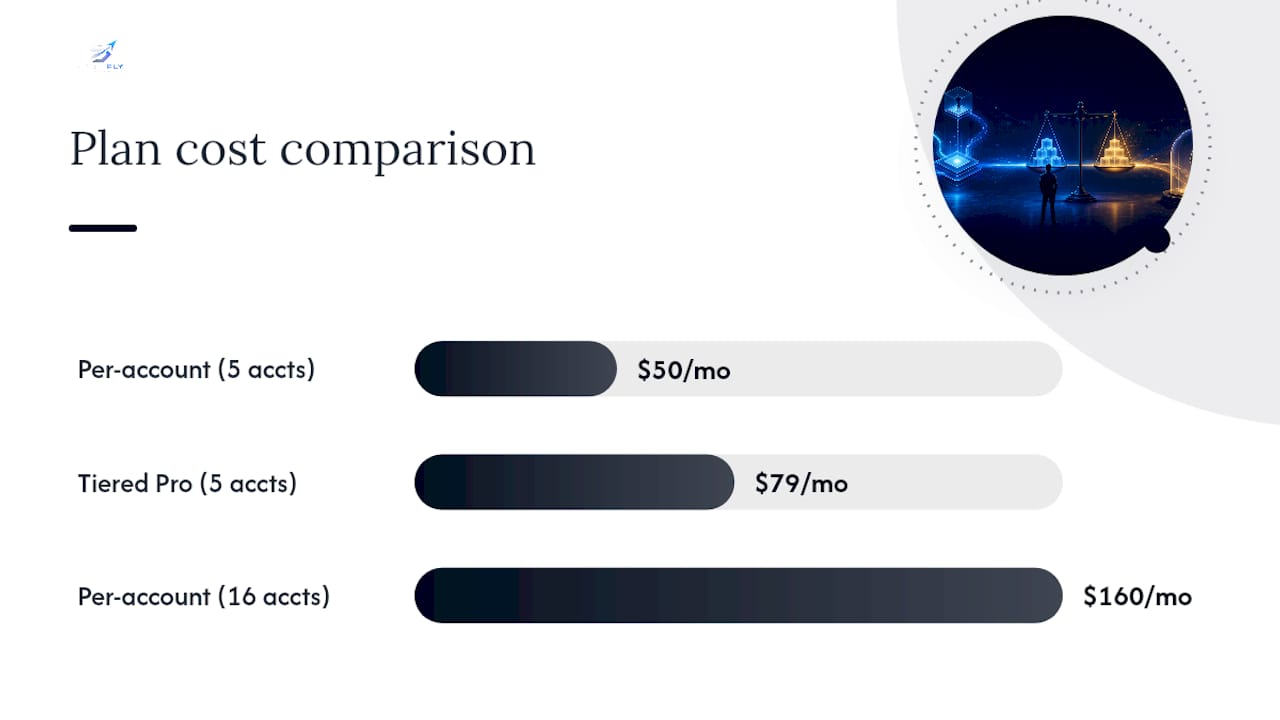
Here's a worked example. One master account mirroring trades to four followers is five accounts total. Under a per-account model at $10 per account, that's $50 per month. Under a tiered plan where five accounts fit inside a $79 Pro-level tier, the tiered option wins by a meaningful margin. Flip the ratio to one master and fifteen followers, and the same tiered plan often stays flat while the per-account model climbs past $160.
Many cloud services require a minimum of two connected accounts just to activate the account, a threshold worth checking before you assume a single-account trial reflects your eventual bill.
Why SafeFly's Design Changes the Cost Calculation
A copier's headline price only tells half the story. What it protects you from, and what it saves you from managing yourself, matters just as much for multi-account futures traders.
SafeFly runs entirely in the cloud, which removes the VPS hosting and local maintenance costs that local-license copiers often push onto the trader. Every mirrored trade carries an automatic protective stop that lives broker-side, so positions stay covered even if your connection drops, a safeguard that reduces the kind of manual-error losses that no pricing page line-item captures. Daily profit-and-loss lockouts add a second layer of risk management built for accounts running unattended for hours at a time.
Connections run through secure OAuth integration rather than stored broker passwords, which cuts both security exposure and the support overhead that comes with password-based logins on platforms like Tradovate.
SafeFly organizes its offering into three plan categories, Basic, Pro, and Ultra, each built around a different scale of multi-account operation:
- Traders running a small number of follower accounts fit the entry tier.
- Prop managers and growing multi-account setups fit the mid tier.
- High-volume operations that also want embedded market-analytics tools fit the top tier.
What Traders Consistently Underbudget
The single best move a multi-account trader can make is prioritizing risk protection over the lowest monthly fee. A $10-a-month savings means nothing next to one disconnection event that leaves a position unprotected across five accounts.
Traders routinely underbudget for data feeds, VPS hosting, and support response times, three costs that never appear on the pricing page but show up on the credit card statement anyway. Choosing a copier by headline price alone is how a "cheap" plan turns into the most expensive mistake of the quarter.
— Arturo
SafeFly Pricing and How to Get Started
SafeFly prices around the actual risk of running multiple Tradovate accounts, not just the number of trades mirrored. Instead of paying for bare-bones replication and bolting on VPS hosting and manual stop management yourself, you get broker-side protective stops and daily lockouts built into the subscription from day one.
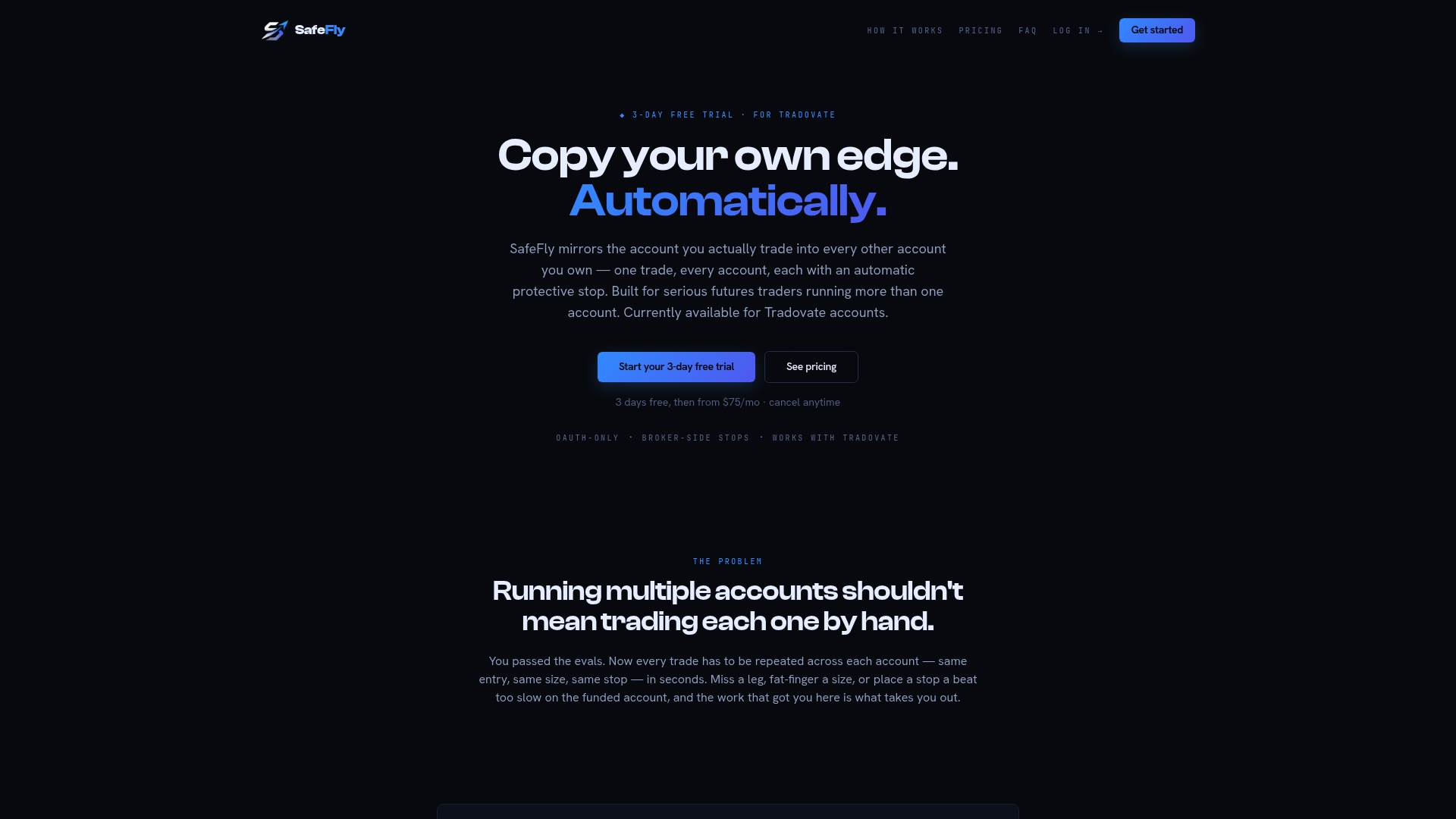
Basic starts at $49 per month, Pro runs $119 per month, and Ultra sits at $250 per month with an embedded gamma-exposure screener for traders who also watch dealer positioning. Every tier connects through secure OAuth rather than stored passwords, and the platform runs in the cloud with no local install to maintain. Before choosing a tier, check the pricing page for exactly how many accounts and connections each plan includes, then review the how-it-works page for details on migration support and the protective-stop mechanism. A 3-day trial lets you test the setup on your own accounts before the first charge.
Sources
- Pricing - Trade Copier & Trading Journal Plans
- Trade Copier Free Trial Period and Degressive Price Calculator
- Tradecopier
FAQ
How Much Do Copy Traders Charge?
Copy trading and trade copier fees typically fall between $5 and $15 per account monthly for per-account cloud plans, or $39 to $149 monthly for tiered subscriptions. SafeFly's plans run $49, $119, and $250 per month depending on tier.
Is $100 a Month Enough for Multi-Account Copying?
For a small setup, one master with two or three followers, $100 monthly usually covers a mid-range tiered plan or a per-account plan with a modest account count. It typically will not cover an institutional setup needing dedicated latency, extensive support, or a dozen-plus accounts.
Is a Trade Copier Ever Free?
A free tier can work for testing on a single account, but most serious multi-account setups outgrow it quickly.
Is Copy Trading Actually Profitable?
Copy trading itself doesn't guarantee profit; it mirrors whatever trades the master account places, so results depend entirely on that underlying strategy. Built-in risk controls like protective stops and daily P&L lockouts can limit downside from disconnections or manual errors, but they don't change the profitability of the trades being copied.