

Funded account risk automation means using software to mirror trades across multiple Tradovate accounts while enforcing broker-side protective stops and daily profit and loss lockouts at the account level. The recommended approach pairs those broker-side controls with secure OAuth authentication and real-time monitoring, since none of these elements alone protects a trader from the failures common in multi-account setups. SafeFly is one turnkey option built specifically for this workflow and is worth evaluating against a manual or self-built alternative.
TL;DR:
- Broker-side stops and daily lockouts are essential for uninterrupted risk protection during connectivity issues or system failures.
- Tradovate's API allows programmatic control over position limits, risk parameters, and order flags, which are critical to safe automation.
- Real-time WebSocket event monitoring is preferred over REST polling for immediate confirmation of stops and fills during fast market conditions.
- Automated systems must handle rejection codes gracefully, including account lockouts and position limits, to prevent missed or rejected trades.
- SafeFly automates trade mirroring with broker-side stops, P&L lockouts, and secure OAuth connections, providing a scalable risk-managed solution.
Table of Contents
- How broker-side stops and lockouts protect mirrored trades
- Tradovate risk controls and API settings that matter
- Setting up secure OAuth, real-time events, and order control
- Failure modes, slippage, and exchange protections to plan for
- Monitoring, alerts, and audit trails that confirm the system works
- A conservative starting configuration for multi-account rollouts
- The SafeFly option for multi-account Tradovate automation
- Sources
- FAQ
How broker-side stops and lockouts protect mirrored trades
A protective stop that lives only inside a local trading application disappears the moment that application disconnects. A broker-side stop, by contrast, sits on the exchange or broker's servers and remains active regardless of what happens to the client software placing it. For a trader mirroring trades across several Tradovate accounts, this distinction determines whether a losing position gets closed automatically or sits open and unmanaged during an outage.
Daily profit and loss lockouts work on a similar principle. Once a configured loss threshold is hit, the account should lock automatically and, where applicable, liquidate open positions without waiting for a human or a script to intervene. This is a post-trade risk parameter, not a courtesy feature, and it should be treated as mandatory in any multi-account configuration.
- Broker-side stops persist through disconnects, crashes, and lost internet connections.
- Daily lockouts remove the need for a trader to monitor P&L manually across several accounts at once.
- Separating execution logic (the mirroring software) from risk-control logic (the broker-side stop and lockout) means one failing does not take down the other.
CFTC research on stop orders finds that exchanges implement protection points that limit execution outside a defined price range, and that most executed stop orders are stop-limit rather than pure market stops. This reduces the chance of extreme slippage but does not eliminate risk entirely, which is why the stop's placement and type still matter.
Tradovate risk controls and API settings that matter
Tradovate's API gives traders and their software direct access to the parameters that govern how much risk an account can take on before a human even sees the position. The Tradovate API exposes position limits, product-level restrictions, and account risk status, all of which can be queried and set programmatically for each account under management.
For automation built to mirror trades across accounts, a few settings carry more weight than the rest:
- userAccountPositionLimit caps the maximum position size an account can hold, which stops a mirrored trade from scaling past what the account can safely absorb.
- userAccountRiskParameter and postTradeRisk settings define daily loss limits, trailing drawdown limits, and other thresholds checked after each fill.
- accountRiskStatus lets automation confirm, before placing the next trade, whether an account is already flagged or restricted.
Order placement itself requires attention to a specific flag. The Tradovate partner API's order-placement endpoint requires an isAutomated flag on any programmatic order, and it returns failureReason codes when an order is rejected. Automation that ignores these codes will silently fail to mirror trades rather than alerting the trader, so provisioning risk settings across multiple accounts should always include a check that each account's position limits and post-trade auto-liquidation values were actually applied, not just submitted.
Setting up secure OAuth, real-time events, and order control
Getting the integration right matters as much as choosing the right risk parameters. The following sequence reflects how Tradovate partner accounts are typically provisioned and tested before going live across multiple accounts.
- Establish an OAuth connection for each account and confirm refresh tokens renew correctly before they expire.
- Test scope restrictions directly, since an overly narrow token scope can block order placement or risk-parameter changes without an obvious error.
- Subscribe to WebSocket event channels for fills, stop confirmations, and lockout events rather than depending solely on REST polling, which introduces lag between what happened and what your software knows happened.
- Where deterministic control matters, place individual order legs rather than opaque strategy endpoints, so each leg produces its own trackable execution event.
- Run the full sequence in evaluation accounts first, then a single live account, then a small multi-account rollout, scaling only once each stage behaves as expected.
- Build in a kill-switch, a cancel-on-disconnect trigger, and a flatten-on-lock trigger so the system defaults to safety rather than to inaction.
Pro Tip: Test your kill-switch by simulating a disconnect mid-trade before you ever run the system on a funded account; if the stop does not hold without the client connected, the setup is not ready.
Failure modes, slippage, and exchange protections to plan for

Latency is the quiet cause of most stop failures. Polling instead of subscribing to real-time events, routing orders through strategy endpoints instead of individual legs, and ordinary network delay all add seconds that matter during fast moves. CFTC research on stop orders found that exchanges limit execution outside defined protection points and that most executed stops are stop-limit orders specifically to reduce slippage, but a stop-limit can still fail to fill if the market gaps past the limit price.
Automation also needs to handle rejection codes gracefully rather than assuming every order succeeds:
TradingLockedindicates the account is already in a lockout state and should stop sending further orders.InsufficientLiquidityand similar codes signal the order could not be filled at the requested terms.MaxPosLimitReachedmeans the pre-trade position limit already blocked the trade, which is the control working as intended.
The mitigations are the same ones covered above: broker-side protective stops on every trade, hard pre-trade limits, cancel-on-disconnect behavior, and stop placement that accounts for the exchange's own protection range rather than fighting it.
Monitoring, alerts, and audit trails that confirm the system works
Confidence in automated risk controls comes from verification, not assumption. A working setup tracks replication success rate across all mirrored accounts, the latency between a stop being sent and confirmed, per-account daily P&L, and every auto-liquidation event as it happens.
- Set real-time alerts for any failed mirror, any account lockout, and any unexpected auto-liquidation.
- Maintain drop-copy reconciliation and audit logs so any disputed fill or missed stop can be reviewed after the fact.
- Feed analytics back into stop placement and risk-parameter tuning rather than leaving settings static.
Real-time WebSocket events paired with drop-copy reconciliation give professional multi-account automation an audit trail where every mirrored order and stop can be confirmed independently of the trading client itself.
A conservative starting configuration for multi-account rollouts
The safest starting point enables a broker-side stop on every single copied trade, sets a moderate daily loss lockout rather than an aggressive one, and turns on cancel-on-disconnect and kill-switch behavior before any live capital moves. Validate the audit trail in evaluation accounts first, then scale account count gradually rather than all at once.
— Arturo
The SafeFly option for multi-account Tradovate automation
A specialized automation solution mirrors trades across Tradovate accounts from a single lead account, places a broker-side protective stop on every copied trade, and enforces daily P&L lockouts automatically.
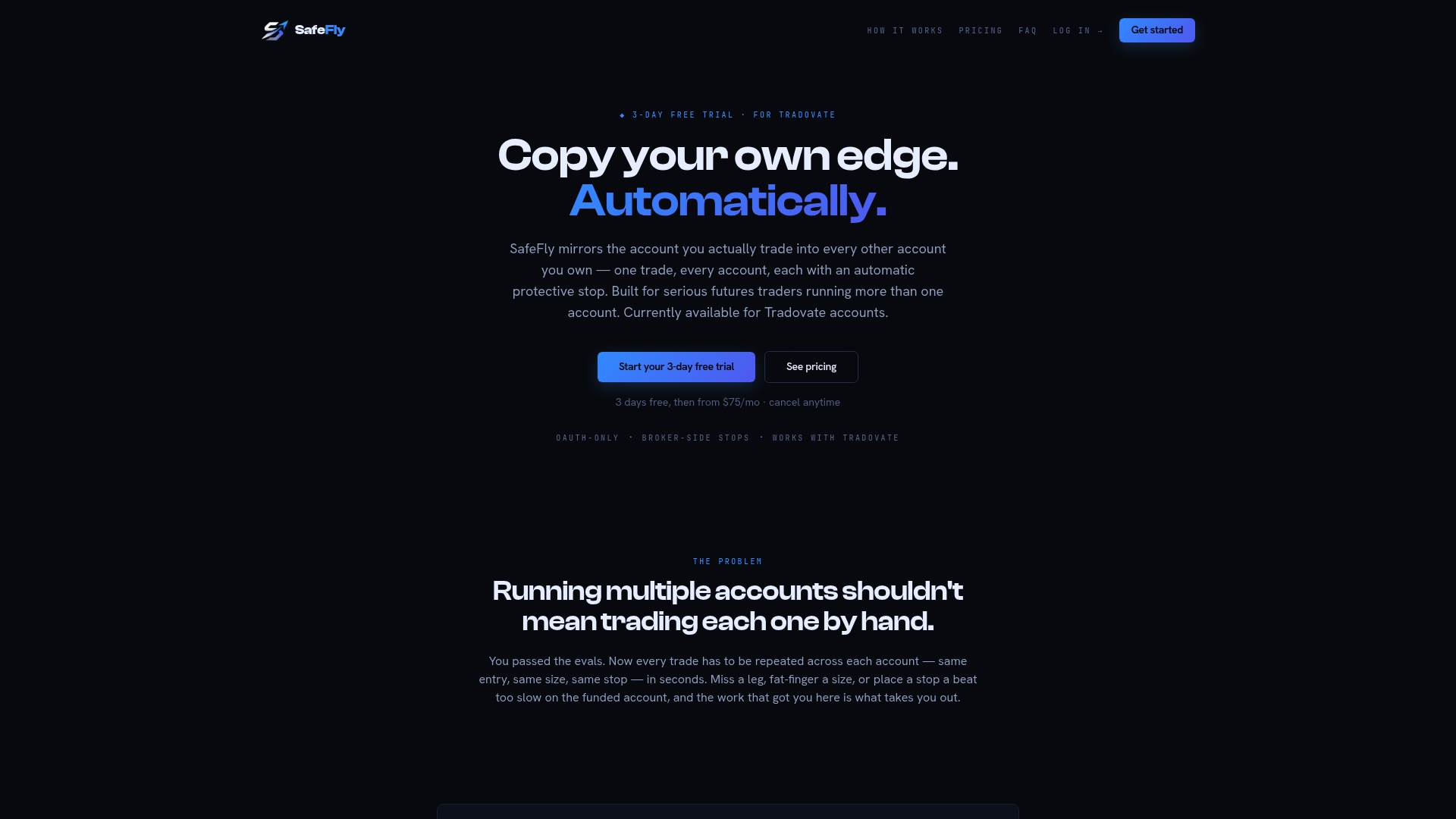
- Trade mirroring runs through secure OAuth connections, keeping credentials secure.
- Every mirrored trade carries a broker-side stop for failover protection if the connection drops.
- Analytics and performance coaching help refine stop placement and risk parameters over time.
Review how it works and compare the Basic, Pro, and Ultra plans on the pricing page to find the setup that fits your account count.
Sources
- Tradovate API
- Stoploss orders in select futures markets (CFTC research)
- Tradovate partner API introduction
FAQ
What does funded account risk automation mean for Tradovate traders?
It refers to software that automatically mirrors trades across multiple Tradovate accounts while placing broker-side protective stops and enforcing daily P&L lockouts. The goal is to keep risk controls active even if the trader's own connection or software fails.
Why do broker-side stops matter more than stops set in a trading app?
A stop set only in a local application disappears if that application loses connection, leaving the position unmanaged. A broker-side stop stays active on the exchange or broker's servers regardless of what happens to the client software.
What is the isAutomated flag in the Tradovate API?
It's a required field on programmatic order requests sent through the Tradovate partner API's order-placement endpoint, and it signals that the order originated from automation rather than manual entry. Orders missing this flag or sent with incorrect parameters return a failureReason code that automation should catch and handle.
How does SafeFly handle broker-side stops and daily lockouts?
SafeFly places a broker-side protective stop on every trade it mirrors across a trader's connected Tradovate accounts and enforces daily profit and loss lockouts automatically. Plan details and pricing are listed on the SafeFly pricing page.
Should I rely on REST polling or WebSocket events for stop confirmation?
WebSocket event subscriptions are recommended over REST polling because they deliver fills and stop confirmations in real time rather than on a delay. Polling alone can create stale risk decisions during fast market moves, which matters most during the exact moments a stop needs to fire.