

Trade allocation is the process of distributing a bunched order's shares or contracts among multiple client accounts after execution. Regulators including the NFA and CFTC accept several method families, among them pro rata and net liquidation value weighting, equal and user-specified allocation, and rotation or randomization. The compliance requirement across all of them is the same: the method must be objective, consistently applied and auditable.
TL;DR:
- Pro rata and net liquidation value weighting are best for accounts of varying sizes requiring proportional exposure.
- Equal allocation suits portfolios with uniform position sizes, while rotation and randomization combat sequencing bias during phased fills.
- Maintaining a written, detailed allocation policy and an audit trail is crucial to prevent enforcement violations from cherry-picking or discretionary adjustments.
- Average-price allocation minimizes client price discrepancies by blending fills at different prices, with residuals directed to participating accounts.
- Automated tools must reliably log allocation processes, support reconciliation, and enforce risk controls to meet regulatory standards and ensure auditability.
Table of Contents
- Core Allocation Methods and How They Work
- Regulatory Expectations and a Compliance Checklist
- Handling Split and Partial Fills Without Introducing Bias
- Building Automation and Audit Trails That Hold Up to Review
- Monitoring for Allocation Bias Over Time
- How Allocation Method Choice Affects Portfolio Outcomes
- How Firms Apply These Methods in Practice
- Technology Used to Automate Trade Allocation
- Allocation in Algorithmic and High-Frequency Environments
- Allocation Differences Across Equities, Fixed Income, and Derivatives
- Where Automation Should End and Judgment Should Begin
- Where SafeFly Fits Into an Allocation and Risk-Control Program
- FAQ
- Sources
Core Allocation Methods and How They Work
Each accepted method solves the fairness problem differently, and the right choice depends on account structure and the firm's capacity to document its process.
Pro rata allocation distributes fills in proportion to each account's net liquidation value or available equity. An adviser managing three accounts with net liquidation values of $100,000, $200,000, and $300,000 who fills 60 contracts would allocate 10, 20, and 30 contracts respectively, matching each account's 1:2:3 equity ratio. This method scales naturally as account sizes diverge, but it requires accurate, current equity data at the moment of allocation.
Equal allocation splits fills evenly regardless of account size, which works for strategies where position sizing is intentionally uniform. User-specified allocation lets the adviser set a fixed ratio or dollar target per account in advance, which is simple to administer but needs clear disclosure to clients explaining why their account receives a set share rather than a size-based one.
Rotation and randomization address a different problem: sequencing bias when fills occur in phases at different prices. A rotation cycle assigns the best price to Account 1 in the first round, then moves Account 1 to the back of the line for the next round, according to NFA interpretive guidance. Randomization uses a computer-generated sequence so no account systematically receives favorable fills over time.
- Pro rata or NLV weighting fits accounts of varying size that need proportional exposure.
- Equal allocation fits model portfolios with uniform position sizing across clients.
- Rotation or randomization fits firms filling orders in multiple phases at different prices.
Average-price allocation, covered in detail below, applies when a single bunched order fills at several prices and must be distributed as one blended cost basis.
Regulatory Expectations and a Compliance Checklist
The CFTC's amendments to Regulation 1.35 permit eligible account managers to allocate bunched orders after execution, provided the allocation is fair and equitable over time and the methodology is sufficiently objective and consistently applied. The NFA's guidance on bunched order allocation reinforces the same standard: allocation procedures must be objective, verifiable, and documented well enough that an examiner can reconstruct the reasoning years later.
Post-execution allocation, sometimes called end-of-day allocation, is permitted when the account manager cannot determine allocation at the time of order placement, but it comes with conditions. The manager must allocate before the start of the next trading day, use a predetermined objective methodology, and maintain records showing the allocation was not adjusted after the fact to favor any account.
Nearly every documented enforcement failure in this area traces back to one gap: a missing or unenforced written allocation policy. The SEC's enforcement record shows administrative orders built on exactly that gap, where advisers steered profitable trades to favored accounts because no objective methodology existed to prevent it.
A practical checklist for exam readiness:
- Maintain a written allocation policy naming the specific method or methods used.
- Record allocation instructions before or immediately after execution, never after reviewing results.
- Confirm daily that allocations match the stated methodology.
- Retain an audit trail of timestamps, account lists, and allocation rationale.
- Conduct a quarterly review comparing allocation outcomes across accounts for unexplained divergence.
Cherry-picking, the practice of assigning winning trades to proprietary or favored accounts after seeing which way the market moved, remains the enforcement risk regulators cite most often when a firm lacks these controls.
Handling Split and Partial Fills Without Introducing Bias
A single order rarely fills at one price. Average-price allocation blends every fill into one weighted price applied uniformly across all participating accounts, while price-by-price allocation assigns specific fills to specific accounts and accepts that some accounts get better prices than others on that particular order. Average pricing is generally preferred because it removes the sequencing question entirely.

Rounding creates a practical wrinkle: average prices rarely divide evenly across contract sizes, leaving a small cash residual. NFA guidance requires that residual be distributed to participating customers rather than retained by the firm, though fractions under one cent per account may be excluded from distribution.
A worked example: a bunched order for 100 contracts fills in two tranches, 60 at $5,000.00 and 40 at $5,002.50, producing a blended average price of $5,001.00. Three accounts receiving 50, 30, and 20 contracts each pay $5,001.00 per contract, with any rounding residual tracked and documented rather than absorbed silently.
- Calculate the volume-weighted average price across all fills before allocating.
- Apply the firm's predetermined ratio (pro rata, equal, or user-specified) to the total filled quantity.
- Distribute any rounding residual to accounts according to a documented rule, not discretion.
- Confirm each allocated quantity is a tradable lot size and compliant with that account's risk limits.
Building Automation and Audit Trails That Hold Up to Review
Firms choosing between pre-trade and post-trade allocation face a tradeoff. Pre-trade allocation, where account assignments are fixed before the order is sent, is simpler to audit because there is no post-execution discretion to question. Post-trade allocation offers more flexibility for bunched orders but requires stricter documentation to prove the methodology was fixed in advance and applied without adjustment.
Whichever model a firm uses, the audit trail is what an examiner actually reviews. NFA guidance on bunched orders points to daily confirmations and quarterly program-level fairness analysis as the baseline expectation, not an enhancement.
A functional audit trail includes:
- Timestamps for order placement, execution, and allocation decision.
- The full account list and each account's allocated quantity for every order.
- A written rationale tying the allocation to the firm's documented methodology.
- Retained snapshots showing the methodology existed before, not after, execution.
Automation reduces the risk of manual allocation error, but only when it is paired with safeguards: per-trade position limits, daily profit and loss lockouts that halt trading once a threshold is hit, and broker-side protective stops that remain active even if the connection between the platform and the account drops. These are the same categories of control discussed in guidance on automated risk rules for multi-account traders.
Pro Tip: When vetting an allocation tool, ask whether its audit log is immutable, meaning allocation records cannot be edited after the fact without leaving a visible trace.

Vendor selection should include a review of whether the tool logs allocation sequence independently of the trader, whether it supports daily reconciliation exports, and whether it enforces risk limits at the account level rather than only at the aggregate level.
Monitoring for Allocation Bias Over Time
A method that looks objective on paper can still produce biased outcomes if nobody checks the results. Daily reconciliation confirms allocations executed as instructed, catching data errors before they compound. Quarterly statistical review is where dispersion patterns surface, since a single day of uneven fills means little but a quarter of consistent favoritism toward one account is a red flag examiners look for directly.
- Run daily reconciliations comparing allocated quantities against the predetermined ratio.
- Track quarterly dispersion metrics such as fill-quality variance across accounts.
- Investigate the root cause of any statistically unusual divergence before the next cycle.
- Document every review and remediation step, since the absence of records is itself a finding.
When divergence appears, the fix is prospective: adjust the methodology going forward and document why, rather than retroactively reallocating trades. NFA interpretive guidance also expects FCMs and introducing brokers to monitor for unusual allocation patterns and inquire when something looks preferential, which means the obligation to watch does not rest with the adviser alone.
How Allocation Method Choice Affects Portfolio Outcomes
The allocation method a firm chooses is not a back-office detail separate from investment performance. It directly shapes each client's realized cost basis, position timing, and exposure to slippage, particularly in fast-moving futures markets where prices can shift meaningfully between the first and last fill of a bunched order.
Pro rata allocation tends to produce the most consistent risk profile across accounts because position sizes scale with capital, so a drawdown affects each account proportionally rather than unevenly. Equal allocation can distort risk when account sizes differ widely, since a fixed contract count represents a much larger percentage of a smaller account's capital. Rotation and randomization introduce short-term dispersion by design, since one account inevitably gets the better price on any given fill, but the method's fairness claim rests on that dispersion averaging out over many trades rather than on any single trade being equal.
Average-price allocation minimizes performance dispersion from execution timing alone, since every account pays the same blended price regardless of when its individual fill occurred within the bunched order. That makes it the method least likely to generate client complaints tied to price discrepancies, though it does nothing to address sizing-related risk differences between accounts.
For risk management specifically, the method interacts with position limits and lockout rules. An account nearing its daily loss limit should not receive an allocation that pushes it past that threshold, which means allocation logic and risk controls need to reference the same real-time account data rather than operating as separate systems.
How Firms Apply These Methods in Practice
A single-adviser firm managing a model portfolio across ten client accounts of similar size typically defaults to equal allocation, since the simplicity reduces both calculation errors and the administrative burden of maintaining per-account ratios. The tradeoff surfaces when a new client joins with a much larger account: equal allocation no longer reflects that client's capital base, and the firm either moves to pro rata weighting or documents a clear rationale for the exception.
A firm executing large bunched orders across accounts with significantly different net liquidation values generally adopts pro rata allocation from the outset, since proportional sizing avoids the sizing distortion equal allocation would create. The operational cost is higher: equity values must be current at the moment of allocation, which means the firm needs a reliable feed of account balances rather than a static ratio set once and left unchanged.
A firm filling orders in several phases at materially different prices, common in less liquid futures contracts, often layers rotation on top of its base method. The first phase's best price rotates to a different account than the prior order's first phase, and the firm logs the rotation sequence so an examiner can confirm no account was systematically favored across a sample of orders.
In each case, the operational pattern is the same: the method is chosen for the account structure, documented before execution, and checked afterward against the documentation. The variation between firms is in which method fits their accounts, not in whether documentation and verification apply.
Technology Used to Automate Trade Allocation
Manual allocation across more than a handful of accounts introduces the kind of error regulators flag most often: inconsistent application of an otherwise sound method. Automation addresses this by applying the same calculation to every order without the drift that comes from a person recalculating ratios by hand under time pressure.
Allocation automation generally falls into a few categories. Order management systems built for registered investment advisers often include allocation modules that apply a stored ratio automatically at the point of execution. Standalone risk and allocation middleware sits between the execution venue and the accounts, applying allocation logic and logging the result independently of either system.
For futures traders managing several Tradovate accounts specifically, the relevant question is less about whether to automate and more about whether the automation preserves a defensible record. A tool that mirrors trades across accounts but does not timestamp the allocation sequence or retain a snapshot of account lists at the moment of execution creates a gap that a manual spreadsheet, however clumsy, at least makes visible. Guidance on grouping trades versus automating them across multiple Tradovate accounts addresses this tradeoff directly.
Whatever the category, the selection criteria stay consistent: the tool must apply a documented methodology consistently, log the allocation independently of trader input, and produce records a compliance officer can export without reconstructing them manually.
Allocation in Algorithmic and High-Frequency Environments
Algorithmic and high-frequency strategies complicate allocation because the volume and speed of execution make manual review impossible and shrink the window for post-trade correction to nearly zero. An algorithm generating hundreds of fills per minute cannot wait for a human to confirm each allocation before the next order fires, which pushes the entire allocation decision into the system's pre-programmed logic.
This raises the documentation bar rather than lowering it. The methodology coded into the algorithm, whether pro rata, average-price, or rotation-based, must be specified and fixed before trading begins, since there is no practical opportunity to adjust allocation logic mid-session without creating exactly the kind of discretionary, after-the-fact decision regulators scrutinize. Firms running algorithmic strategies across multiple accounts need the allocation rule embedded in the system's code to match, word for word, the written policy on file.
Audit trail requirements also shift. With thousands of allocations per day, manual daily confirmation of every trade is impractical, so firms rely on automated reconciliation that flags exceptions rather than reviewing every line. The quarterly statistical review becomes more important in this environment, not less, because it is often the only check capable of catching a systematic coding error or logic flaw that manual review would never surface at that volume.
Latency also matters in a way it does not for manual allocation. If the allocation step introduces measurable delay between execution and the final per-account confirmation, that delay itself can create price differences between accounts that resemble bias even when the underlying method is objective. Firms running high-frequency strategies should measure that latency directly rather than assuming it away.
Allocation Differences Across Equities, Fixed Income, and Derivatives
Allocation mechanics shift meaningfully depending on the asset class, mainly because of how each market handles partial fills and lot sizes. Equity orders often fill in round lots with fine price granularity, so average-price allocation tends to work cleanly with minimal rounding residual.
Fixed income allocation faces a different problem: bonds frequently trade in minimum denominations, and a bunched order split across several accounts can leave some accounts unable to receive a tradable lot size at all. Firms allocating fixed income typically need a documented rule for which accounts get priority when the order does not divide evenly, since equal or pro rata math can produce fractional amounts no account can actually hold.
Derivatives, including the futures contracts central to many multi-account trading setups, add the complication of whole-contract allocation. A pro rata calculation that produces 10.6 contracts for one account must round to a whole number, and that rounding decision needs the same documented, non-discretionary rule applied consistently across every order, not a case-by-case judgment call. Options allocation carries an added layer because strike and expiration selection can itself become a point of discretion if not fixed in advance alongside the quantity allocation.
Across all three asset classes, the underlying regulatory standard does not change. What changes is the operational detail: lot size constraints, rounding conventions, and the specific point at which a fill becomes indivisible. A firm trading across asset classes needs allocation policies that address each one's mechanics explicitly rather than applying one generic rule and hoping the edge cases resolve themselves.
Where Automation Should End and Judgment Should Begin
Automation earns its place wherever a rule can be written down and applied the same way every time: ratio calculation, rounding, timestamping, and daily reconciliation all belong there. What automation cannot replace is the judgment behind setting the original policy and recognizing when a pattern of outcomes warrants a second look. For a small team, the highest-value first step is rarely a new platform. It is a written policy paired with a daily confirmation habit, because in most exams the deciding factor is not the sophistication of the method but whether the firm can produce the record proving it followed one.
— Arturo
Where SafeFly Fits Into an Allocation and Risk-Control Program
For futures traders running several accounts on one platform, the allocation challenge often begins as a manual replication problem. Automated tools can mirror trades from a single lead account into connected accounts, removing the manual re-entry step most prone to inconsistent application.
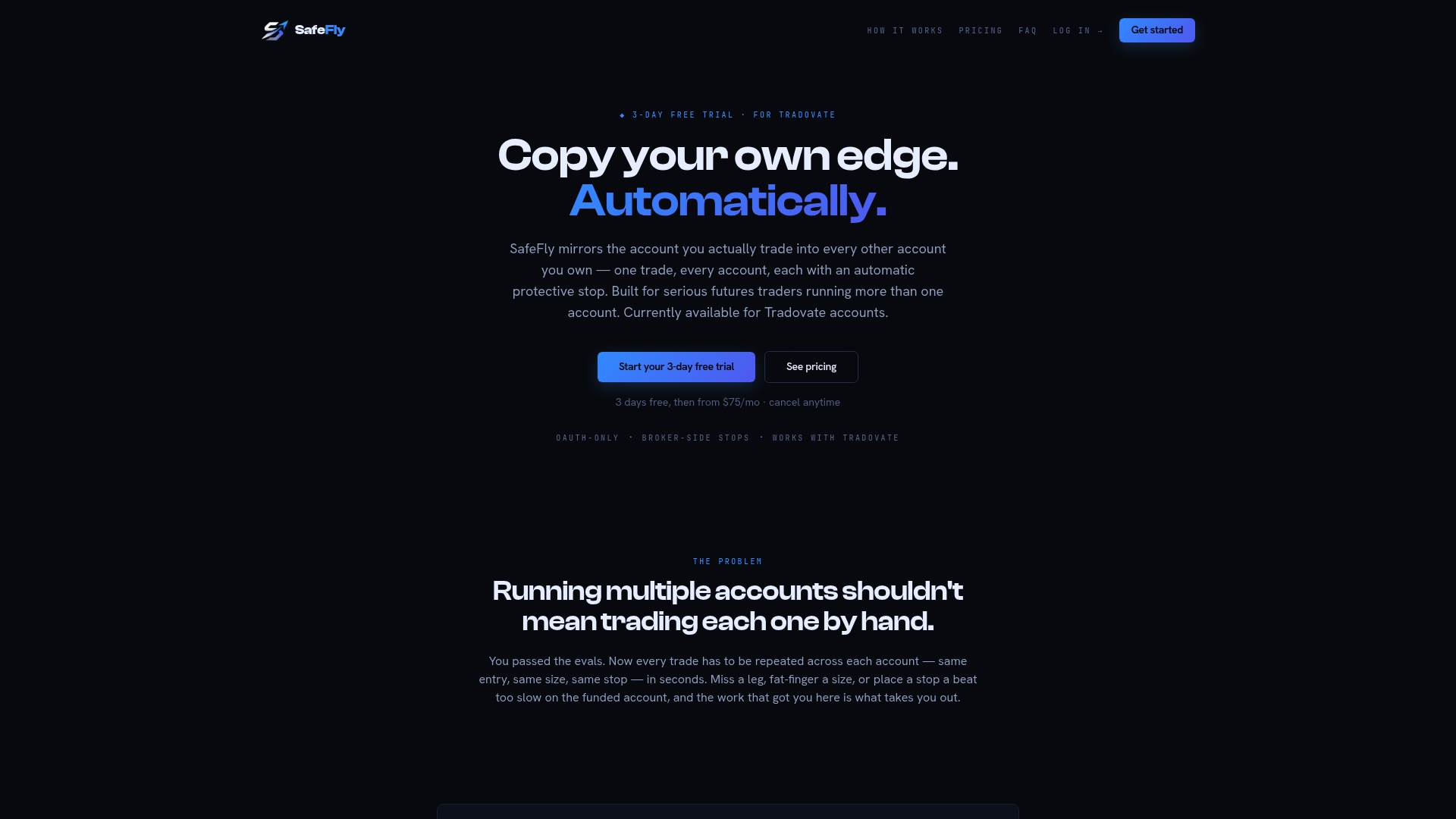
Every mirrored trade carries a protective stop that lives on the broker side, so the position stays protected even if the connection between SafeFly and the account drops. Daily profit and loss lockouts enforce a risk ceiling without requiring a trader to watch every account in real time, and OAuth connections mean no account password is ever stored on the platform.
- Automated trade replication applies the same action to every connected account without manual recalculation.
- Broker-side protective stops stay active independent of platform connectivity.
- Daily P&L lockouts cap risk per account without manual monitoring.
- Secure OAuth integration connects accounts without storing credentials.
Pricing runs from the Basic plan at $49 per month through Pro at $119 per month and Ultra at $250 per month, detailed on the SafeFly pricing page. Traders can review how the automation and protective-stop system works on the how it works page before starting a trial.
This article is general information, not a substitute for advice from a qualified financial advisor. Consult a qualified financial professional about your own circumstances before acting on anything here.
FAQ
What are the different types of allocation methods?
The main accepted families are pro rata or net liquidation value weighting, equal allocation, user-specified allocation, and rotation or randomization, according to NFA interpretive guidance. Average-price allocation is also used specifically for handling split or partial fills across multiple accounts.
What is the 3-5-7 rule in trading?
The 3-5-7 rule refers to a risk management guideline for position sizing and diversification, not a formal trade allocation method recognized by the NFA or CFTC. It falls outside the regulatory allocation framework covered in this article, so firms should not rely on it to satisfy allocation documentation requirements.
What is a trade allocation?
A trade allocation is the process of distributing a single bunched order's filled shares or contracts among multiple client accounts after execution. Regulators require the distribution method to be objective, consistently applied, and documented so it can be audited, as outlined in CFTC Regulation 1.35 guidance.
What should I put for allocation method for direct deposit?
This question refers to a different context, typically a payroll or banking form asking how to split a direct deposit between accounts, which is unrelated to trade allocation under securities and futures regulation. For that type of form, you would specify the percentage or dollar amount to route to each listed bank account rather than a trading allocation method.
Why does cherry-picking trigger enforcement action?
Cherry-picking occurs when an adviser allocates profitable trades to favored accounts after seeing how the market moved, which violates the requirement that allocation be fair and objective. SEC enforcement records show this is frequently tied to firms lacking a formal written allocation policy in the first place.
Sources
- NFA interpretive notice / allocation examples
- CFTC Rulemaking and interpretive material on Regulation 1.35
- SEC enforcement: plan of allocation and cherry-picking case examples (2024)